

Circle President and former Commodity Futures Trading Commission Chair Heath Tarbert told FOX Business on July 14 that investors who bought Circle stock near its highs should keep a long-term view, saying, "Circle is focused on long-term development, and I believe the stock price will eventually provide the answer."
That comment came with Circle shares down about 70% from their high and the company’s market value sharply reduced, according to the report. Around the same time, Mizuho Securities USA LLC cut Circle to underperform from neutral and assigned a $50 price target, which the article described as the lowest on Wall Street.
Sales kept coming after the IPO
The report says Tarbert has been one of Circle’s most active public advocates for a long-term narrative. In that framing, stablecoins are not just tools for crypto trading; they are part of the next generation of payments, settlement, and internet-based financial infrastructure, and Circle’s spending should not be judged only by short-term profit or share-price swings.
His personal trading record, as presented in the article, points in another direction. On June 4, 2025, one day before Circle finalized its IPO price and listed publicly, Tarbert adopted a Rule 10b5-1 trading plan covering the sale of up to 353,290 Circle shares over one year.
In the 13 months after the listing, he sold stock in seven of those months, disposing of more than 360,000 shares for more than $30 million in proceeds, the report says. The largest single sale came on March 2, 2026, when he sold 122,007 shares worth about $11.5 million.
The article explains that 10b5-1 plans allow executives to set future sale dates, volumes, or price conditions in advance when they are not in possession of material nonpublic information. Most of Tarbert’s sales were carried out automatically by a broker under such plans, generating about $24.4 million in profit, according to the report.
Before the first plan had fully finished, Tarbert adopted another 10b5-1 plan on March 10, 2026. That second plan would allow the sale of up to 160,000 more shares by the end of this year, including shares obtained through option exercises. The article adds that Tarbert has not bought Circle stock in the open market at any point since the company went public.
Executive stock sales are common, and diversification by senior management is routine. What drew criticism in this case, the article argues, is the contrast between large-scale selling near higher price levels and continued public calls for patience after the stock had fallen by roughly three-quarters, with no sign of open-market buying from Tarbert himself.
Circle hired a veteran of Washington and regulation
Tarbert joined Circle in July 2023 as chief legal officer and head of corporate affairs. The report says the company brought in a former regulator with experience across the U.S. Treasury, the CFTC, the White House, and Wall Street to help manage its relationship with regulators, support business growth, advance its listing plans, and help move USDC deeper into traditional finance.
Tarbert had also said he was drawn to Circle’s regulatory-first approach and wanted to help build clear and consistent rules for digital assets. In early 2025, he was promoted again, becoming Circle’s first president with responsibility for legal, compliance, risk, public policy, communications, and international expansion.
Before Circle, Tarbert had built a career at the intersection of law, policy, and finance. He held roles at the White House, the Senate Banking Committee, and the U.S. Treasury, and also led banking regulatory work at Allen & Overy. During the Trump administration, he served as assistant secretary of the Treasury for international markets, taking part in work tied to the G7, G20, the Financial Stability Board, and transatlantic regulatory coordination, and at one point also acted in the role of under secretary for international affairs.
Trump nominated Tarbert to chair the CFTC in 2019. The Senate confirmed him by a vote of 84 to 9, and his term was originally set to run until April 2024.
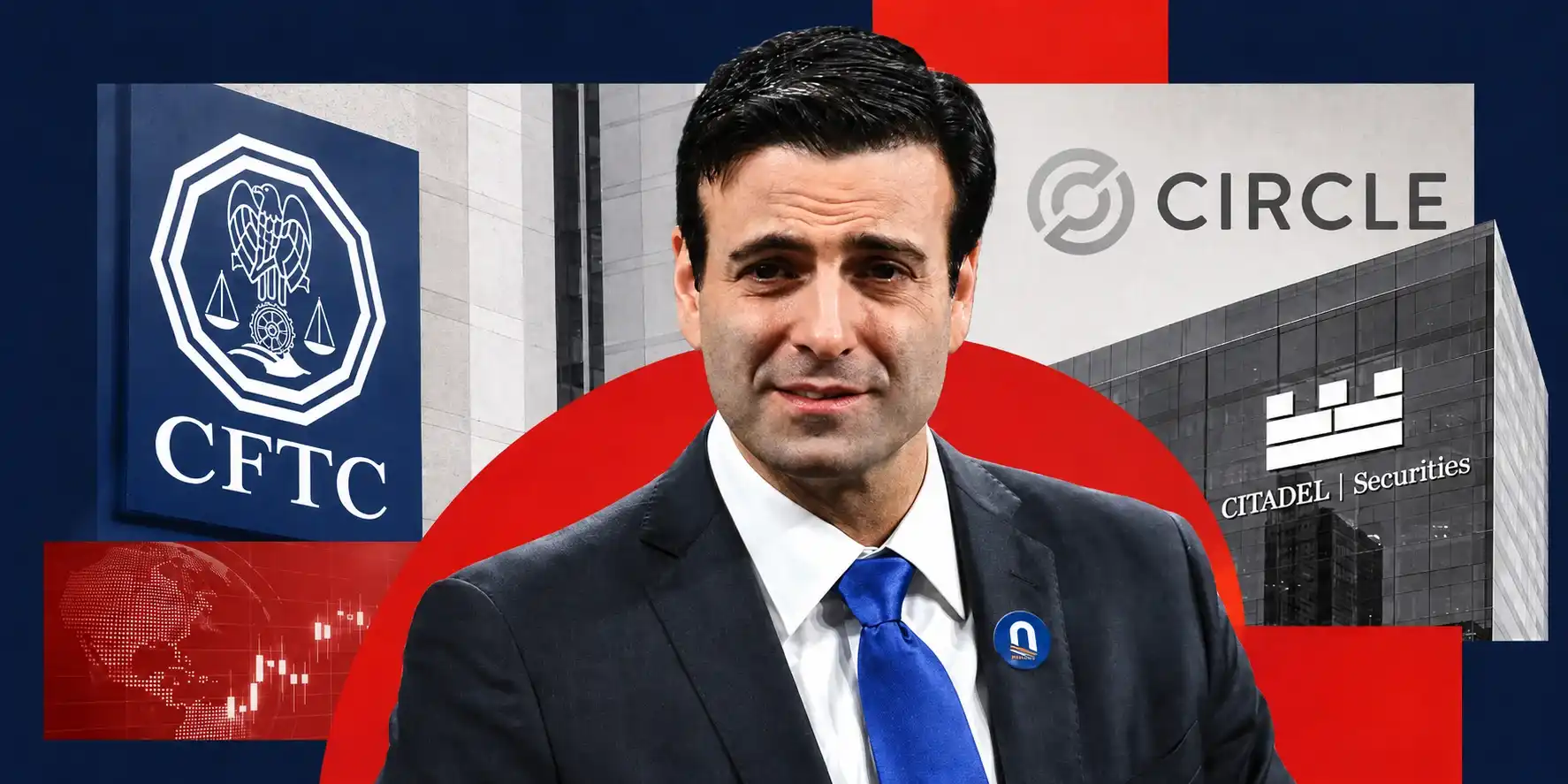
He left the CFTC and joined Citadel Securities 27 days later
After the 2020 U.S. presidential election, Democrats returned to the White House. Tarbert stepped down on the day Joe Biden took office, saying publicly that he wanted to make room for the new president to choose a permanent chair. He could have remained at the agency as a commissioner until 2024, but instead resigned from all of his posts on March 5, 2021.
Twenty-seven days later, he joined Citadel Securities as chief legal officer. The article says that move reinforced an image that had already formed around him: entering the regulatory system, building institutional knowledge and policy relationships, and then converting those assets into compliance, lobbying, and influence for major financial firms.
Why the timing at Citadel drew attention
The report also revisits the timing of Tarbert’s move to Citadel Securities. In early 2021, retail traders piled into heavily shorted names such as GameStop, sending prices sharply higher and inflicting major losses on some short-focused funds. At the peak of that episode, Robinhood restricted purchases of GameStop, AMC, and other stocks while still allowing users to sell, after which those share prices dropped sharply.
Some investors accused Robinhood and Citadel Securities of working together to push prices lower, arguing that shutting off the buy button weakened retail demand and gave Wall Street short sellers relief. Citadel became a focal point for those suspicions because it was one of Robinhood’s most important execution venues and a major source of payment for order flow. At the same time, Citadel founder Ken Griffin’s hedge fund Citadel had just injected capital into Melvin Capital, which had been hit hard by the GameStop squeeze.
Tarbert arrived as Citadel Securities’ chief legal officer during that period, taking charge of legal, compliance, and regulatory work. The article argues that his knowledge of how regulators operate, how policy gets made, and how Washington works was especially valuable at a moment when Citadel was under pressure from Congress, regulators, and the public.
Policy fights at Citadel and his role in crypto regulation debates
According to the report, Tarbert’s work at Citadel went beyond ordinary legal matters. In 2023, while he was still chief legal officer, Citadel strongly opposed a Securities and Exchange Commission proposal to introduce retail order auctions. The SEC wanted some retail orders to be exposed to open competition before execution in order to increase rivalry among market makers. Citadel responded with a lengthy comment letter saying the SEC’s economic analysis contained serious errors and describing the proposal as an untested, radical experiment that could hurt execution quality for retail investors.
The article says similar conflicts of interest appeared in crypto. In September 2022, Tarbert testified before the U.S. Senate as Citadel Securities’ chief legal officer and supported the Digital Commodities Consumer Protection Act, arguing for broader CFTC authority over crypto spot markets. At the same time, Citadel had already raised $1.15 billion from Sequoia Capital and crypto investment firm Paradigm and had publicly said it planned to expand into digital assets.
Set out in sequence, the report says, the optics were difficult to ignore: a former CFTC chair joined a market-making firm preparing to enter crypto and then publicly backed an expansion of the CFTC’s power over the same market. That left room for questions about whether he was acting as a former regulator shaping public rules or helping a future employer operate in a more favorable environment.
From Citadel to Circle
Tarbert left Citadel in 2023 and then joined Circle. The article says Circle’s earlier plan to go public through SAPC fell apart at the end of 2022 because of the regulatory environment. After that, the company needed an executive with deep political and regulatory knowledge to help clear the path for a direct IPO. Two years later, Circle completed its listing, and Tarbert again became one of the most important external-facing figures at a financial company whose business is tightly linked to regulation.
From the company’s perspective, the report says, Tarbert is a highly valuable executive. He understands how the regulatory system works and how to mobilize policy ties, relationships, and market resources when a company needs help with compliance, fundraising, or market access.
The article’s broader argument is that Tarbert’s career has been defined by his ability to read policy cycles and market windows with precision, then turn the credibility and access gained in public service into professional leverage in the private sector. The criticism follows from that same pattern: when roles shift back and forth between regulator and financial executive, and gains are realized at the right time, the long-term risk is left with the investors who took the public message at face value.