

Circle shares posted a three-day run from Aug. 19 to Aug. 21, with the sharpest gains coming in the first two sessions. The stock rose 9.56% on Aug. 19 to close at $78.59, then added 6.45% on Aug. 20 to finish at $83.66, bringing the two-day gain to about 16.7%. On Aug. 21, it climbed another 5.16% to $87.98.
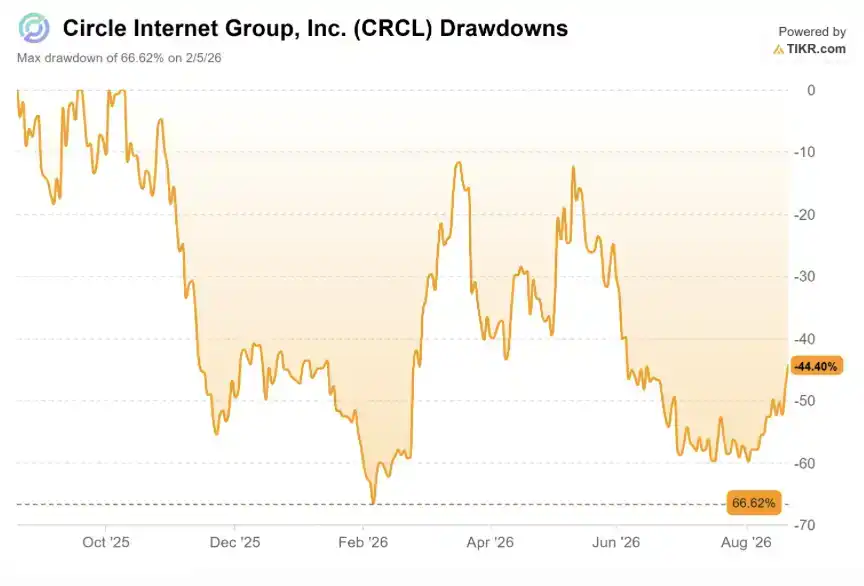
The article’s central point is that the first leg of that rebound was driven largely by sector conditions rather than a material near-term shift in Circle’s operating fundamentals. Over the same period, Bitcoin broke above $70,000, U.S. Treasury yields moved lower, and crypto-linked stocks broadly rose. Circle, which tends to trade with crypto sentiment, outperformed that move.
A near-17% jump in two days tracked the broader crypto trade
From Aug. 19 to Aug. 20, Bitcoin’s move above $70,000 and the pullback in Treasury yields helped lift the wider group of crypto-related equities. In that setting, the article says, Circle’s nearly 17% gain across two sessions is better explained by a risk-on turn in the sector than by any single company-specific development large enough to justify a rapid repricing on its own.
Other headlines added support. The White House met with crypto industry executives, USDC gained market share, and Circle hosted its quarterly earnings Q&A. Even so, the piece argues that improved appetite for the sector remained the main force behind the rally.
It also cautions against reading too much into two trading days. When Bitcoin rises and rate expectations shift toward easing, investors often assign a richer valuation to Circle. If crypto cools or Treasury yields move back up, the stock can swing hard in the other direction as well.
For a longer horizon, the article places more weight on Circle’s July 27 purchase of part of IBM’s blockchain patent assets. The deal covered more than 680 patent families and nearly 1,000 granted patents across blockchain, banking, insurance, enterprise infrastructure, and secure cloud services. Circle said the acquisition made it the largest blockchain patent holder in the United States and that the portfolio would support USDC, CPN, and Arc. Still, the piece notes that patents are unlikely to feed directly into revenue or profit in the near term.
USDC is still growing, but revenue growth has slowed
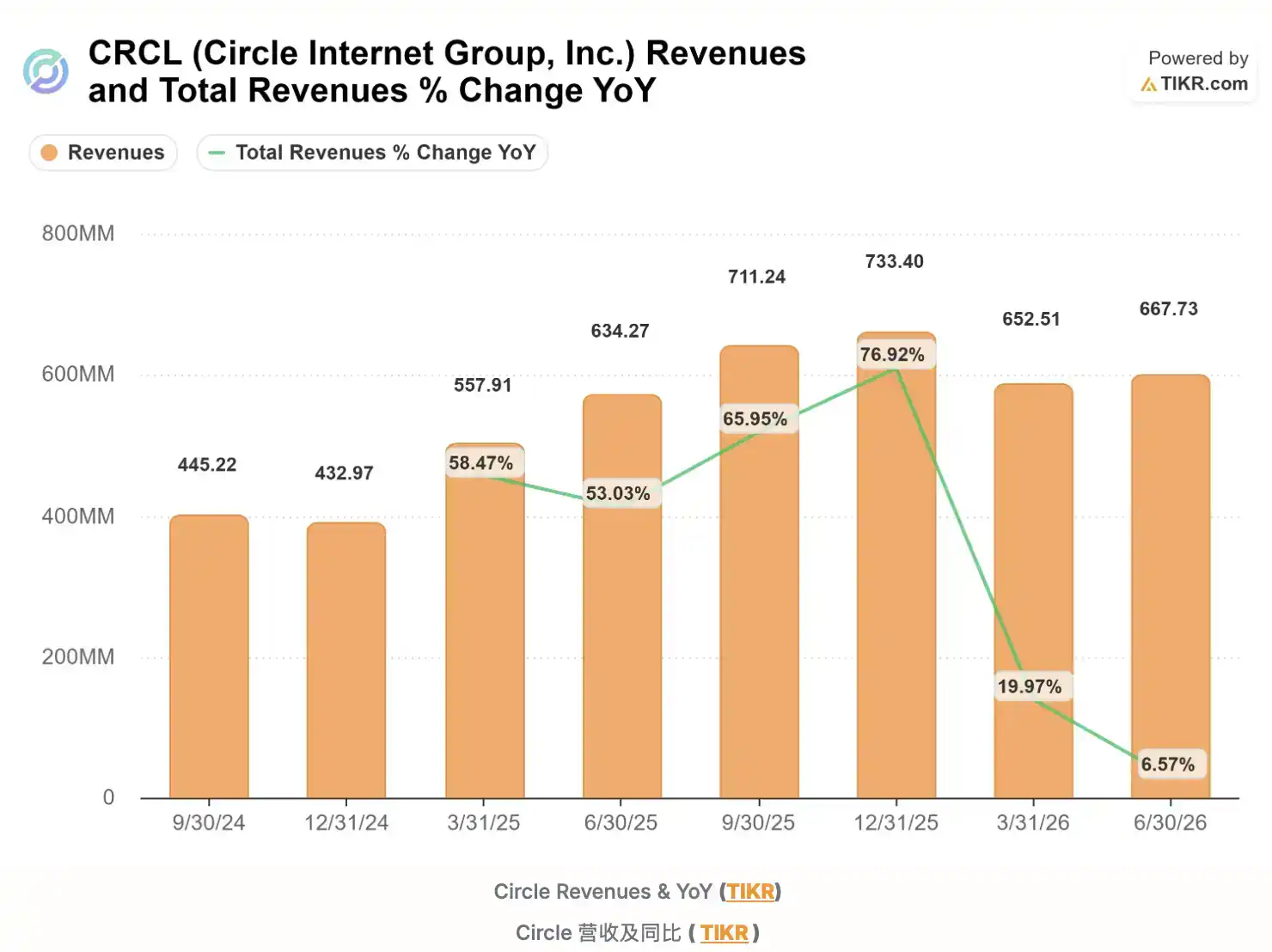
Circle reported second-quarter 2026 results on Aug. 5. Total revenue and reserve income reached $701 million, up 7% year over year. Net income from continuing operations was $48 million. Adjusted EBITDA came in at $143 million, up 8%.
USDC-related operating metrics stayed strong:
- USDC circulation at quarter end was $73.3 billion, up 19% year over year.
- Average circulation for the quarter reached $76.5 billion.
- On-chain transaction volume hit $14.8 trillion, up 151% from a year earlier.
That operating growth did not translate into the same pace of top-line expansion. Circle’s second-quarter revenue was only modestly above the $694 million reported in the first quarter, and the year-over-year growth rate slowed from earlier periods. The article’s argument is straightforward: USDC usage is scaling, but the earnings profile has not expanded at the same speed.
Rates sit at the center of that gap. Circle invests USDC reserves primarily in short-dated U.S. Treasuries and cash-like assets, and the business still relies heavily on the interest those holdings generate. In the second quarter, reserve yield fell to 3.48% from 4.14% a year earlier, offsetting part of the benefit from a larger USDC base.
That leaves Circle’s earnings tied mainly to two variables. One is USDC circulation, which determines the size of reserve assets. The other is short-term interest rates, which determine the yield on those reserves. As long as interest income remains the dominant revenue source, lower rates will keep pressing down the revenue earned per unit of USDC.
Arc and CPN carry the platform transition case
Circle is trying to reduce its reliance on reserve interest by building up software and network-service revenue through Arc and the Circle Payments Network, or CPN.
Arc is Circle’s stablecoin-native blockchain. Its public mainnet is scheduled to launch on Sept. 16. Circle said more than 100 institutions and ecosystem projects are already involved, and the initial validator set includes BlackRock, DTCC, Visa, Mastercard, ICE, Standard Chartered, and MoneyGram.
According to the article, BlackRock is expected to deploy its tokenized money market fund BUIDL on Arc, while DTCC plans to explore tokenizing its custody securities and connecting them to the chain. Those relationships add institutional credibility. They do not, by themselves, prove scaled usage or dependable revenue.
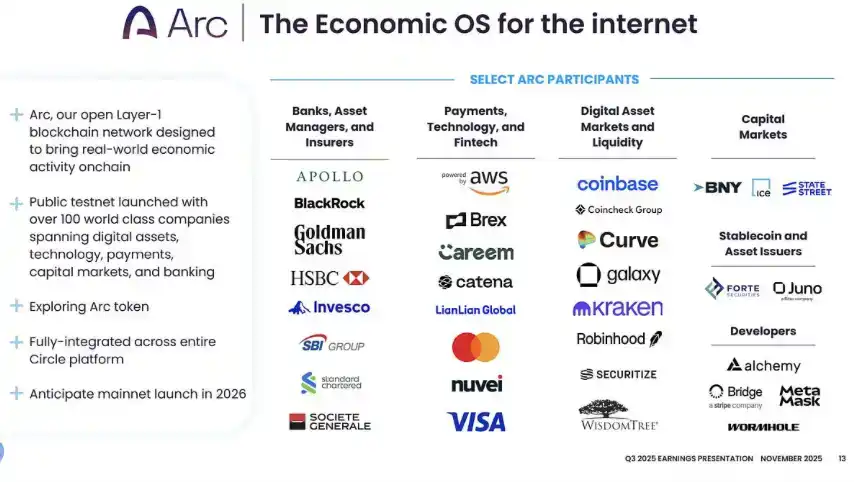
Chief Executive Officer Jeremy Allaire has framed Arc as financial infrastructure for on-chain businesses, tokenized assets, and AI agent payments. If that vision takes hold, Circle’s model would extend beyond stablecoin issuance and reserve income into transaction, settlement, software, and network-service revenue.
In the second quarter, Circle completed a $242 million Arc token presale. The related revenue will be recognized over time as product milestones are met. On the back of that, the company raised its 2026 guidance for other revenue to $310 million-$330 million from $150 million-$170 million. It also lifted guidance for RLDC margin, or revenue less distribution costs margin, to 41.7%-43.7% from 38%-40%.
The article does not treat that presale as proof of a durable business model. It says the transaction can boost non-reserve revenue in the short run, but the sustainability of that income still needs to be tested after mainnet launch, once actual assets, transactions, and developers either show up or do not.
CPN is also in the early phase of commercialization. Annualized payment volume was about $15 billion at the end of the second quarter and had risen to $23 billion by the end of July. Commercialization is expected to begin in the second half of 2026. Payment activity has grown; whether it converts into recurring revenue remains a question for future earnings reports.
A $259 valuation assumes a 2030 platform outcome
The piece cites a TIKR base-case valuation that places Circle at about $259 per share by the end of 2030. Using the $83.66 share price referenced in the article, that implies a cumulative return of about 210% and an annualized return of roughly 30% over about 4.4 years.
That figure is not company guidance, and it is not Wall Street’s consensus target for the next 12 months. The article puts the average Wall Street target at about $101, which is around 21% above $83.66. The gap between the two numbers comes from different time frames and very different operating assumptions.
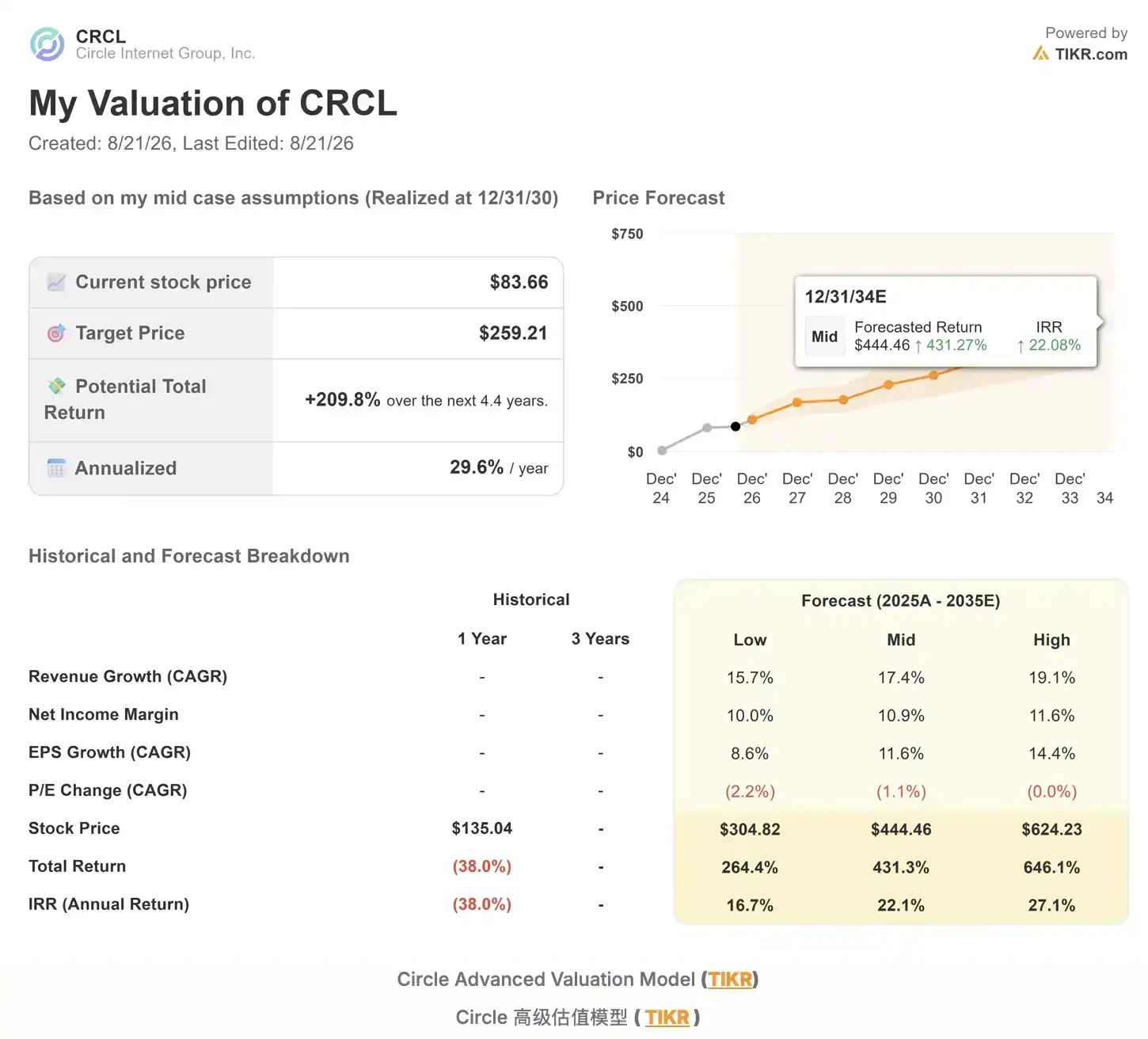
TIKR’s longer-term model assumes:
- USDC circulation compounds at roughly 40% over a full cycle.
- The global stablecoin market reaches $1 trillion to $4 trillion by 2030.
- Arc and CPN gradually generate meaningful non-reserve revenue.
- More USDC remains inside Circle’s own infrastructure, reducing distribution costs and improving margins.
By contrast, near-term analyst targets lean more heavily on reserve income, the rate backdrop, and recent financial results. The $259 scenario already prices in a successful transition from a stablecoin issuer to an on-chain financial infrastructure platform.
The article therefore treats $259 as much closer to a long-range bullish case than a near-term fair-value estimate. If Arc develops into an important settlement layer for tokenized assets and smart payments, Circle could earn the type of valuation usually given to platform businesses. If usage and commercial revenue disappoint, rates, USDC scale, and crypto sentiment are likely to remain the main drivers of the stock.
After Sept. 16, the test shifts to business data
The clearest near-term milestone is whether Arc launches on Sept. 16 as planned. But the article stresses that a mainnet launch and a roster of institutional participants only complete the first step. The real test comes later, through operating data.
The market will be watching several points: whether BlackRock, DTCC, and others actually bring real assets and transactions onto Arc; whether Arc can sustain growth in transaction volume, active addresses, and fee revenue; whether CPN can turn commercialization into steady payment and network revenue; whether non-reserve income becomes a larger share of total revenue; and whether growth in USDC and platform revenue can offset pressure on reserve income from lower rates.
If future earnings reports show durable expansion in on-chain assets, transaction activity, and commercial revenue, Circle’s platform transition would have firmer evidence behind it. If post-launch progress still centers mostly on partner lists and cooperation announcements, with limited revenue contribution, the stock is likely to remain highly sensitive to rates, USDC circulation, and crypto market sentiment. In that reading, the near-17% two-day jump reflected a renewed trade on growth expectations, while the platform thesis still awaits proof.