


Circle Chief Business Officer Kash Razzaghi has published a detailed defense of the company’s USDC economics, saying Circle keeps only a small slice of revenue after paying distribution partners and funding the infrastructure needed to run a global dollar stablecoin. In the first half of 2026, USDC processed more than $36 trillion in on-chain settlement volume, while total minting and redemption exceeded $315 billion, or about $1.7 billion a day including weekends and holidays. Over the same period, Circle spent $819 million on USDC distribution partners and transaction-related costs. As of June, USDC handled about 77% of global stablecoin transaction volume, up from 60% a year earlier.
The comments, translated and published by Odaily, address a long-running debate around Circle’s business model. For many investors in Circle, listed under CRCL, one of the main points of contention has been the amount of revenue shared with partners such as Coinbase, Hyperliquid, and Binance in order to drive USDC distribution. Critics have pointed to those payments as a drag on profitability, while supporters have argued they are necessary to preserve USDC’s reach and utility.
Circle says most of USDC’s economics are shared with partners
Razzaghi said Circle has, for years, shared most of USDC’s economic value with the partners that help expand adoption. He also said all Circle customers have always been able to redeem through standard banking channels at no cost, with settlement typically completed within up to two business days. Customers moving funds through Circle Payments Network, or CPN, and those building on Circle’s platform can now access free USDC redemption on a near-real-time, 24/7/365 basis.
He described USDC as the most practical stablecoin in the market on the metrics that matter to enterprises, and said that lead has widened as Circle has continued to invest in the underlying network for more than eight years. According to Razzaghi, Circle’s commercial team has spent years bringing USDC to leading wallets, exchanges, banks, fintech firms, large enterprises, and payment networks around the world.
How Circle allocated $1.4 billion in revenue
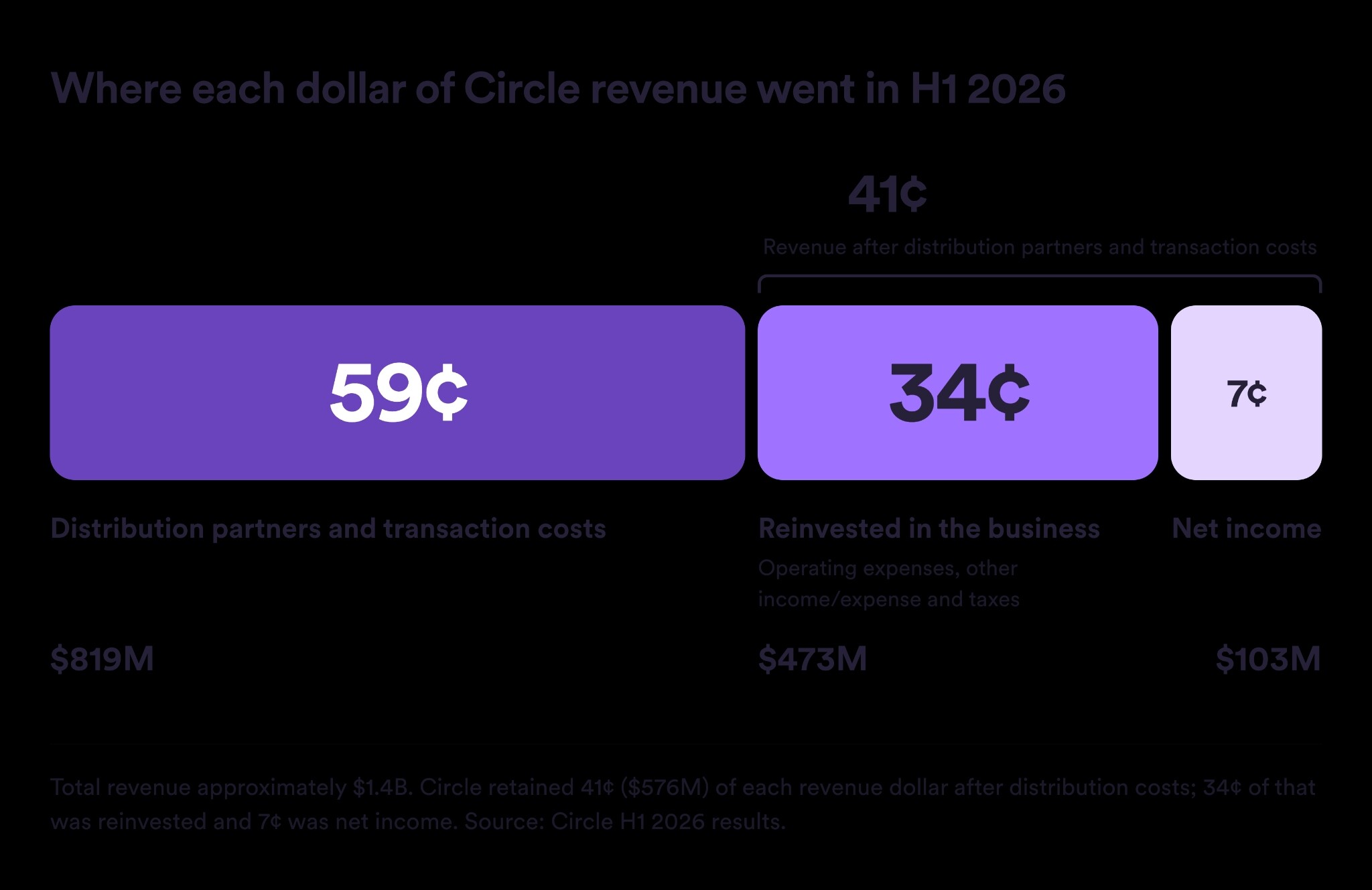
Razzaghi said Circle generated about $1.4 billion in revenue in the first half of 2026. Of that, about $819 million went to USDC distribution partners and transaction-related costs. Put another way, around 59 cents of every $1 in revenue flowed directly to global partners across wallets, exchanges, banks, fintech companies, enterprises, and payment networks.
Most of what remained was reinvested into the network. Circle spent about $473 million, or roughly 34 cents of every revenue dollar, on regulatory licenses, banking relationships, settlement liquidity, compliance systems, new product development, and blockchain integrations. After those outlays, Circle’s net profit came to just 7 cents for every $1 of revenue.
Razzaghi argued that this should not be viewed as bloated overhead. In his account, those costs are what make USDC usable at scale. A digital dollar, he wrote, has to be redeemable at any time, safely held by regulated institutions, and natively available across the public blockchains and platforms where businesses operate.
That requires Circle to hold licenses across major jurisdictions so banks in Europe, fintech firms in Latin America, and payment networks in the United States can use USDC under their local rules. It also requires native deployment across dozens of blockchains, interoperability between chains, and enough liquidity and banking depth to support billions of dollars in minting and redemption each day across major financial centers.
Without that foundation, he said, a stablecoin is not really a digital dollar and is instead just a token. He also took aim at newer issuers that claim they can hand over most of the economics while still offering a better product, saying redemption costs, compliance costs, and resilience costs do not disappear simply because an issuer chooses not to bear them.
How partners participate in USDC economics
According to Razzaghi, partner economics are tied directly to distribution performance. The more USDC a partner brings into circulation, the more it can earn. He pointed to Coinbase as the clearest example. In its second-quarter earnings report, Coinbase said the average amount of USDC held across its products reached a record $20 billion, up 44% year over year.
Coinbase is only one part of the network. Razzaghi said Binance, the world’s largest exchange, signed a five-year commercial agreement with Circle in September and invested $100 million in the company. Beyond that, more than 150 partners across the financial system and other industries share in USDC’s growth, including exchanges, wallets, digital banks, fintech platforms, payment platforms, traditional banks, and large enterprises. He linked that broad participation to USDC’s share of global stablecoin transaction volume, which reached about 77% in June, up from 60% a year earlier.
He described two main ways partners take part in USDC economics:
- They can bring in and grow balances, then receive a share of reserve income. Distribution partners that host and retain USDC pools on their own platforms can earn a portion of reserve interest based on the size of those balances.
- They can build on Circle’s platform and gain access to free near-instant redemption. Customers using CPN for payment settlement, or building with Arc, Circle Mint, and Circle Wallets, can qualify for free near-real-time redemption.
Circle’s account of how redemption works
Razzaghi said redemption is the area where confusion is greatest, so he laid out the mechanics in detail. He wrote that major payment networks including Visa and Mastercard use USDC for settlement seven days a week, including weekends and holidays when traditional banking systems are closed. Payment companies around the world rely on Circle’s infrastructure to convert USDC into dollars because the system has already been tested under continuous, large-scale operating conditions, he said.
In the first quarter of 2026 alone, Circle redeemed $71.8 billion of USDC, equal to about 90% of the circulating market capitalization at the time. In the second quarter, total minting and redemption rose to $170 billion, up 105% year over year. Razzaghi said no other stablecoin issuer matches that scale in fiat redemption processing.
He summarized Circle’s redemption terms around three principles:
- All Circle customers can redeem USDC for free. Redemptions through standard banking channels typically settle within up to two business days.
- Payment activity on Circle Payments Network now qualifies for free near-real-time settlement. Institutions using USDC as the settlement layer on CPN, including card networks, acquirers, cross-border remittance providers, large multinational companies, and fintech firms handling real volume, can redeem funds at near-real-time speed with no added cost.
- Circle platform customers can qualify for free near-real-time redemption in several ways, including by holding USDC balances on the platform and by deeply integrating products such as CPN, Arc, Circle Mint, Circle Wallets, and other eligible services.
Razzaghi also explained the cost behind that speed. To support around-the-clock, uncapped, near-instant redemption rather than forcing customers to wait days, Circle pre-positions large cash balances across its global banking network. Once a redemption request is confirmed on-chain, funds can be wired out immediately. Those balances must remain highly liquid, which means they earn less than allocations to U.S. Treasuries. They also have to stay available at all times, including when banks are closed on weekends, which requires a standing network of banking channels that can move money on demand.
Circle absorbs that carrying cost itself, he said, so customers do not have to bear the delay. In his telling, liquidity is the heaviest and most expensive component of the redemption model, but Circle does not charge extra for it as long as customers are active participants in the network.
The infrastructure Circle says sits behind USDC
Razzaghi framed stablecoins as monetary infrastructure rather than just software. When comparing different models, he said, the real questions are whether an issuer can redeem on demand at any time, remain stable under market stress, stay compliant across jurisdictions, and keep reinvesting in the ecosystem over the long term.
He also revisited USDC’s history. The stablecoin launched in 2018 under a consortium model. In 2023, Circle took full control of governance and rebuilt the operating system around one core principle: the issuer must be able to keep investing in network infrastructure. He said that decision accelerated everything that followed, and that every USDC in circulation today reflects more than eight years of long-term engineering work.
He listed the following pieces of that buildout:
- More than 55 global financial licenses and registrations, including a national trust bank charter from the U.S. Office of the Comptroller of the Currency, or OCC, and compliance under the European Union’s Markets in Crypto-Assets framework, or MiCA.
- Clearing and settlement relationships with more than 25 banks globally, including systemically important banks.
- Reserve assets placed in a government money market fund managed by BlackRock and custodied by BNY, with monthly independent attestation reports.
- An anti-money laundering and sanctions compliance framework covering 185 countries and territories.
- Native deployment support across more than 35 major public blockchains.
- Instant liquidity pools large enough to handle about $1.7 billion in two-way minting and redemption each day.
Razzaghi said this is what utility looks like at industrial scale. In his description, USDC is used by major payment companies as a settlement layer, is increasingly being held by banks as a reserve asset, and has become the default on-chain dollar for many developers. He added that in recently formed stablecoin alliances, more than 70% of participating companies had already built their businesses on USDC.
A flywheel model, in Circle’s view
Razzaghi closed by describing USDC as a self-reinforcing flywheel. Most of the economics are passed to partners that drive adoption. Customers get free redemption channels. Circle then puts the earnings it retains back into the infrastructure base that supports what he called the world’s most practical stablecoin.
In that model, partner incentives help expand USDC balances, larger scale funds more licenses, deeper liquidity, and broader blockchain integrations, and a more mature digital dollar then attracts more developers, enterprises, and end users. Razzaghi said the system has already been tested through multiple bull and bear market cycles over more than eight years, and that Circle plans to keep increasing investment in the next cycle.
He ended by saying Circle has built the broadest and deepest stablecoin ecosystem across distribution, settlement and payments, banking channels, institutional trading, and blockchain infrastructure, and that the company is ready to work with businesses deciding where to build next.