
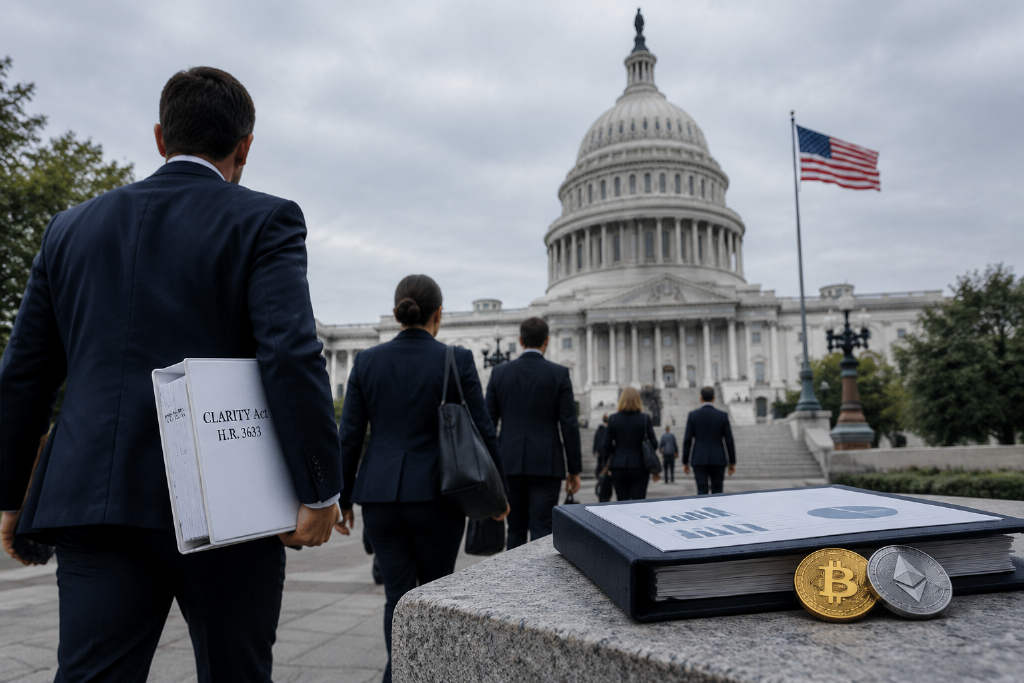
The U.S. Senate has returned to Washington from its summer recess, putting the crypto industry’s long-awaited market structure push in front of a decisive procedural vote.
At 2:15 p.m. ET on Sept. 15, senators are scheduled to vote on cloture for H.R. 3633, the Digital Asset Market Clarity Act, or the CLARITY Act. The vote is not final passage. It will decide whether the Senate is willing to begin formal debate on the bill, and it needs 60 votes to move forward.
Still, the procedural label does not capture the stakes. In practice, this vote is being treated as the real test of whether the bill can survive this Congress. If supporters cannot reach 60 votes, the measure is effectively finished before the 2026 midterm elections. In the account cited by TechFlowPost, the next realistic opening for legislation may not come until 2029.
A 630-page bill enters its final push
Late on Sept. 13 and into the early hours of Sept. 14, Senator Cynthia Lummis, chair of the Senate Banking Committee’s digital assets subcommittee, Senate Agriculture Committee Chair John Boozman, and Senate Banking Committee Chair Tim Scott jointly released what was presented as the latest version of the CLARITY Act, document number EHF26724.
Lummis described the text as Democrats’ “last, best and final offer.”
The revised draft rewrites several of the bill’s most disputed parts. The changes focus on ethics requirements, the legal treatment of non-custodial software developers, Treasury intervention powers in stablecoin markets, and the line between genuinely decentralized infrastructure and protocols that only claim to be decentralized.
Ethics rules were tightened
The new version would require federal officials and their spouses to divest “substantial” crypto interests or place them into qualified blind trusts. State attorneys general would also gain authority to enforce the ethics provisions, a concession the White House had previously resisted, according to the report.
Lummis said the new language covers roughly 80% of the ethics counterproposal put forward in late July by Senators Thom Tillis and Ruben Gallego. TechFlowPost also said President Donald Trump convened an advisory team on Sept. 12 for closed-door discussions focused on the wording of the ethics section.
BRCA protections were narrowed to civil matters
The Blockchain Regulatory Certainty Act provisions were also narrowed. Language shielding non-custodial software developers from being treated as money transmitters would now apply only to civil enforcement under the Bank Secrecy Act and to a civil safe harbor.
Earlier wording that could have extended into criminal cases was removed. The report said this change responded to longstanding concerns raised by prosecutors’ associations.
Treasury got a stablecoin “circuit breaker”
The draft would also give the Treasury secretary authority to intervene if there is evidence that community bank deposits are moving into stablecoins at scale.
According to the report, that design was first proposed by Senator Tillis in July as a way to calm regional banking groups worried about deposit disintermediation tied to stablecoins.
DeFi language drew a sharper line
The revised DeFi section would require protocols that present themselves as decentralized, but are in fact controlled by identifiable individuals or groups, to register with the Commodity Futures Trading Commission, or CFTC, and comply with the Bank Secrecy Act.
At the same time, infrastructure considered genuinely decentralized would remain exempt, including activities tied to providing interfaces, administering governance systems, and participating in consensus validation. The report added that the DeFi provisions were narrowed to spot and cash transactions in digital commodities.
The stablecoin rewards fight is still unresolved
The new text does not settle the fight over stablecoin yield. The bill would ban passive stablecoin returns that function like bank deposit interest, while preserving rewards linked to platform activity.
That language matters for Coinbase. TechFlowPost said about $1.35 billion in annual USDC rewards revenue hangs on the wording. On Sept. 10, 77 state banking associations sent a joint letter to Senate leadership calling for revisions to close what they described as a loophole for stablecoin rewards based on balances or holding duration, with Coinbase at the center of the dispute.
The vote math remains difficult
Republicans control 53 Senate seats. If the conference were unified, supporters would need seven Democratic senators to reach the 60-vote threshold.
But full Republican unity does not appear guaranteed.
TechFlowPost said Senator Rand Paul of Kentucky opposes the bill from a libertarian position, arguing that any federal regulatory framework intrudes on technological freedom. Senator Josh Hawley of Missouri opposes it on the grounds that it favors large fintech companies. If three Republicans vote no, the bill would need 10 Democrats. If four Republicans break away, that number rises to 11.
On the Democratic side, the hurdle looks higher. On July 22, seven Democratic senators involved in negotiations issued a joint statement saying the text at that time “falls short,” specifically citing ethics, consumer protection, anti-money-laundering safeguards, and conflicts of interest. Through the entire August recess, no Democratic senator publicly said they had changed position.
As of Sept. 14, Politico reported that the latest version of the bill still had no public support from any Democratic senator.
Prediction markets and research desks have cut expectations
Pricing in prediction markets has turned much colder.
Polymarket cut the implied probability of CLARITY Act passage by 2026 from 82% in February to 16% in early September. Galaxy Research estimated the odds at 10%. Kalshi was somewhat higher at about 22%.
One of the few publicly optimistic voices has been Coinbase Chief Executive Officer Brian Armstrong. Speaking to CNBC in late August, he said Senate Majority Leader Thune would not schedule a vote without confidence that it could succeed, and he said he believed the bill could eventually clear 60 votes.
Trump’s crypto interests remain at the center of the dispute
TechFlowPost framed one issue as the biggest obstacle hanging over the legislation since the start of the year: how to handle the sitting president’s crypto conflicts of interest.
The report said Trump’s crypto income rose 250% during his term to roughly $2.2 billion, mainly from World Liberty Financial and affiliated meme coin projects.
Senator Elizabeth Warren put the criticism plainly: “If a so-called ethics provision does not stop the president from profiting from cryptocurrency, and does not stop him from using cryptocurrency to openly accept bribes, then it is nothing at all.”
The July 22 draft included an ethics section drafted by Lummis, Senator Bernie Moreno, and the White House. It barred federal officials from issuing or sponsoring new digital assets, but exempted existing holdings. According to the report, that exemption happened to cover all of the Trump family’s existing crypto assets. Democrats argued at the time that the language did not even cover Trump’s sons, leaving the family’s broader crypto business largely untouched.
The Sept. 14 version toughened the ethics section by requiring divestment of substantial crypto holdings or use of blind trusts, and by adding enforcement authority for state attorneys general. Lummis said Trump had “voluntarily accepted the most comprehensive ethics restrictions in American history.”
Even so, by publication time, no Democratic senator had publicly responded in support of the revised ethics language.
Even a successful cloture vote would not end the fight
If the Sept. 15 cloture vote succeeds, the bill would still face amendments, line-by-line votes, and final passage in the Senate. The Senate version also differs substantially from the House version, meaning lawmakers would still need bicameral coordination.
Time is the other constraint.
TechFlowPost said the office of House Majority Whip Tom Emmer had notified Republican lawmakers that all voting days in the weeks of Sept. 21 and Sept. 28 were canceled. House members returned to Washington on Sept. 14, would stay only four days, and then leave until after the midterm elections.
That means even if the Senate somehow completed its process in the next two weeks, the House would have little or no time to take up a Senate-amended version.
Galaxy Research’s Alex Thorn wrote on X: “The House has one week left in September. The odds of CLARITY passing before the midterms are extremely low.”
If Congress stalls, the industry may fall back on agency rulemaking
Coinbase Chief Financial Officer Alesia Haas outlined that fallback route on Sept. 11 at Goldman Sachs’ Communacopia technology conference.
She said there are three paths to regulatory clarity: congressional legislation, rulemaking by regulators, and court decisions. If the CLARITY Act fails in the Senate, Coinbase believes new products and services could still move forward through rulemaking by the Securities and Exchange Commission, or SEC, and the CFTC. The report said SEC Chair Atkins and CFTC Chair Selig have both shown a willingness to pursue change through administrative action.
TechFlowPost also noted that the GENIUS Act, passed in July 2025, had already created a reserve, disclosure, and licensing framework for stablecoins. The SEC has already adjusted its regulatory posture toward crypto assets at the administrative level, and the CFTC is actively expanding its reach over spot markets in digital commodities.
If passed, the CLARITY Act would answer the classification question at the center of U.S. crypto regulation: what counts as a security and what counts as a commodity. The report said that would give major tokens including BTC, ETH, SOL, and XRP a clearer legal identity. If it fails, the industry would not stop operating, but it would remain in a more fragmented environment shaped more heavily by administrative discretion.
UNI, COIN, and CRV were named as near-term watchpoints
TechFlowPost said the vote’s short-term market relevance is especially direct for UNI, COIN, and CRV.
- UNI: Uniswap is pushing hard into stablecoin infrastructure, and the bill’s stablecoin language is closely tied to that strategy.
- COIN: Coinbase shares are highly sensitive to regulatory developments, and the stablecoin rewards provision bears directly on its annual revenue mix.
- CRV: Regulatory clarity around stablecoins would shape the long-term growth room for on-chain stablecoin liquidity.
At a broader level, the bill is also being treated as a test of a larger policy question: should crypto be governed mainly by statutes passed by Congress, or by rules written through administrative agencies.
The Senate vote is about to offer the next answer.