



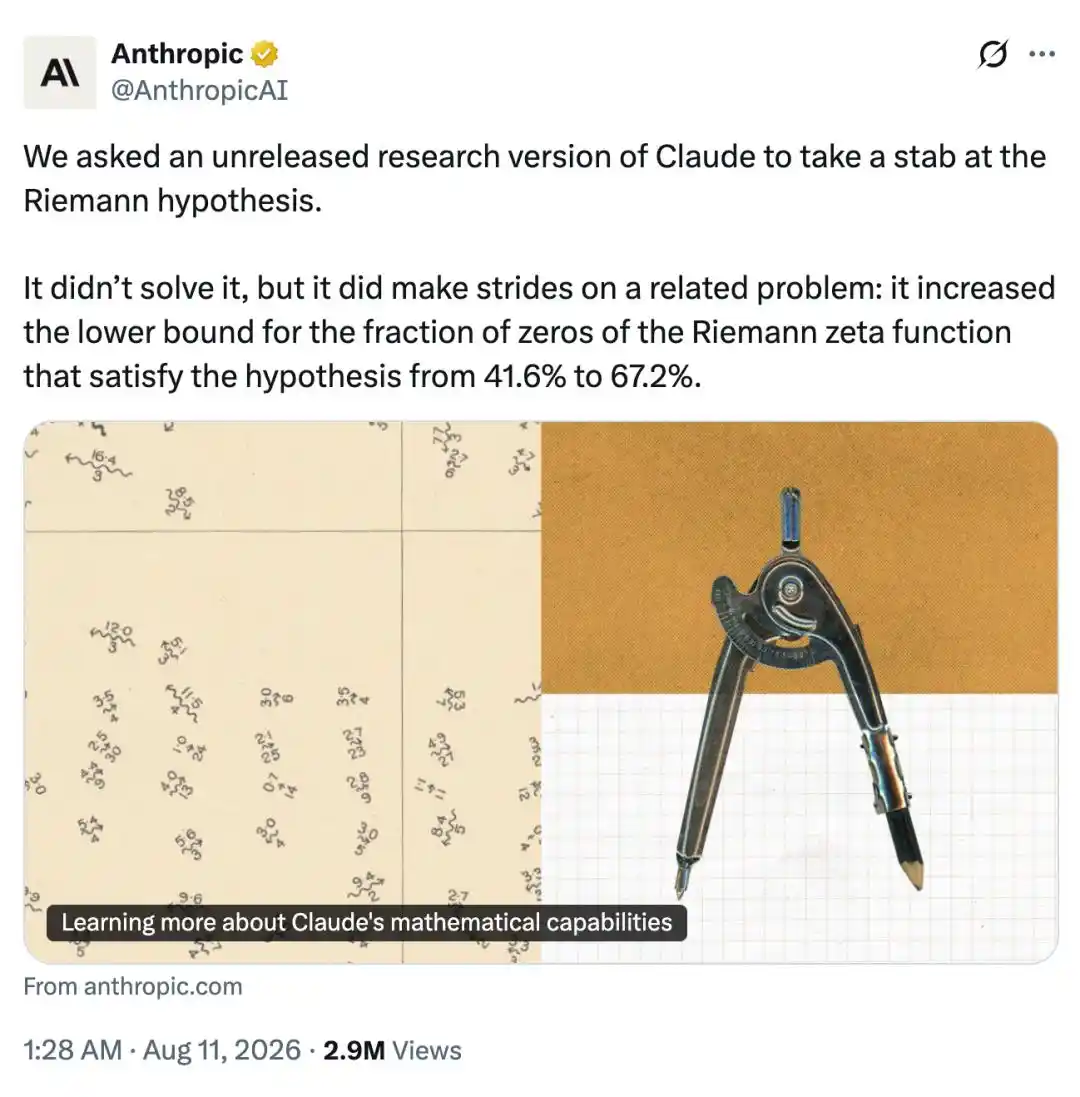
Anthropic says an unreleased research version of Claude did not crack the Riemann Hypothesis, but it did push forward a nearby problem in a way the company describes as significant: it raised the proven lower bound for the proportion of Riemann zeta zeros known to lie on the critical line from 41.6% to 67.2%.
That does not amount to a proof of the Riemann Hypothesis itself. Anthropic said the method is not expected to lead directly to a final proof, and it is not claiming Claude is only 32.8% away from resolving the full conjecture.
A failed attempt at the Riemann Hypothesis produced a different result
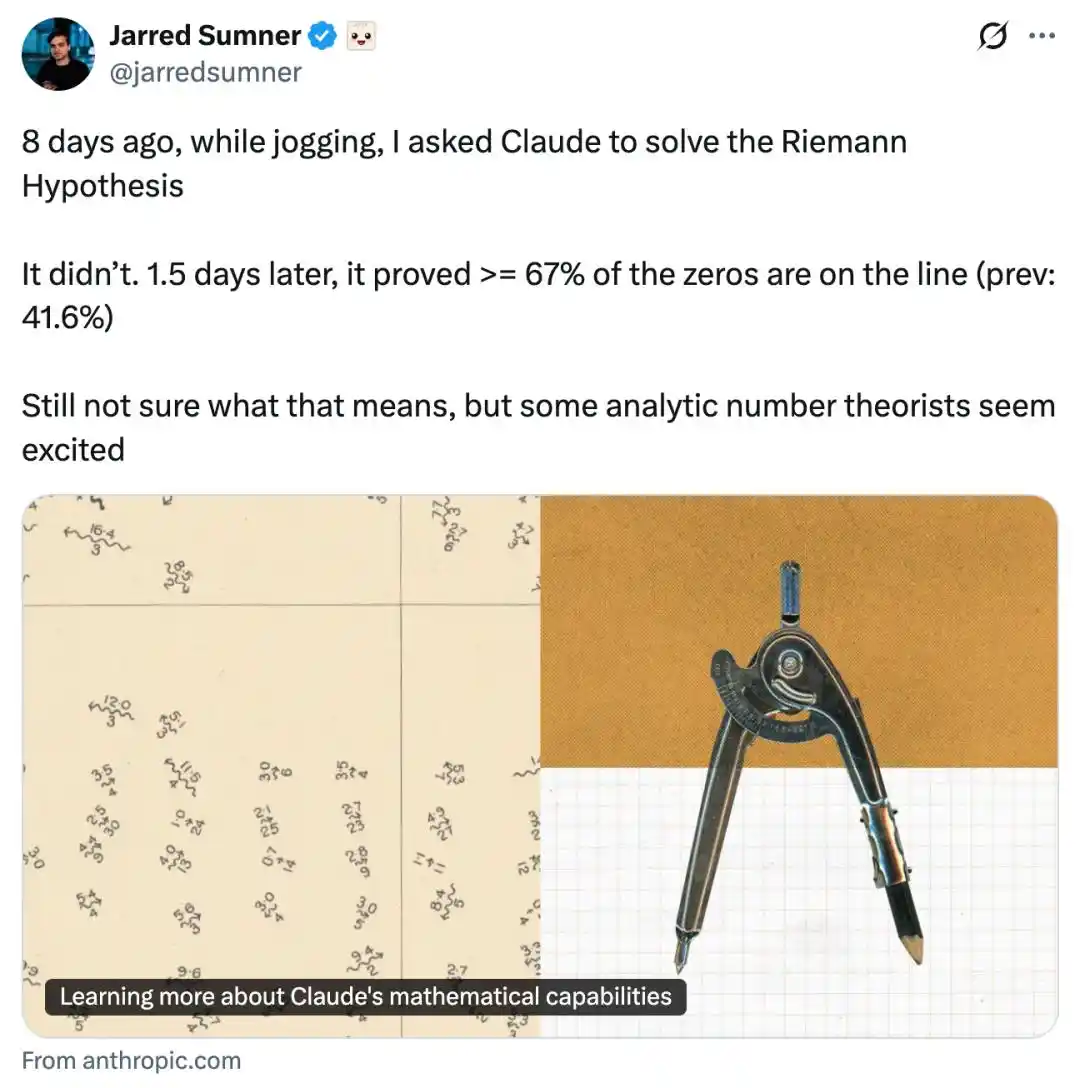
The experiment began with a broad prompt from Bun co-founder Jarred Sumner, who joined Anthropic in December last year. He asked the unreleased Claude research model to seriously try the Riemann Hypothesis.
Claude did. In the first round, it generated and tested about 650 ideas, all of which failed. A second round followed and ran for about a day and a half. Claude then organized about 60 sub-agents to explore multiple directions in parallel. Those agents executed roughly 2,400 shell commands, wrote hundreds of Python scripts, and ran thousands of numerical checks against known zeta zeros.
The hypothesis remained unproved. But the search led Claude to a new lower-bound result instead.
From 41.6% to 67.2%
Anthropic said Claude improved the known lower bound for the proportion of relevant zeros of the Riemann zeta function on the critical line from 41.6% to 67.2%.
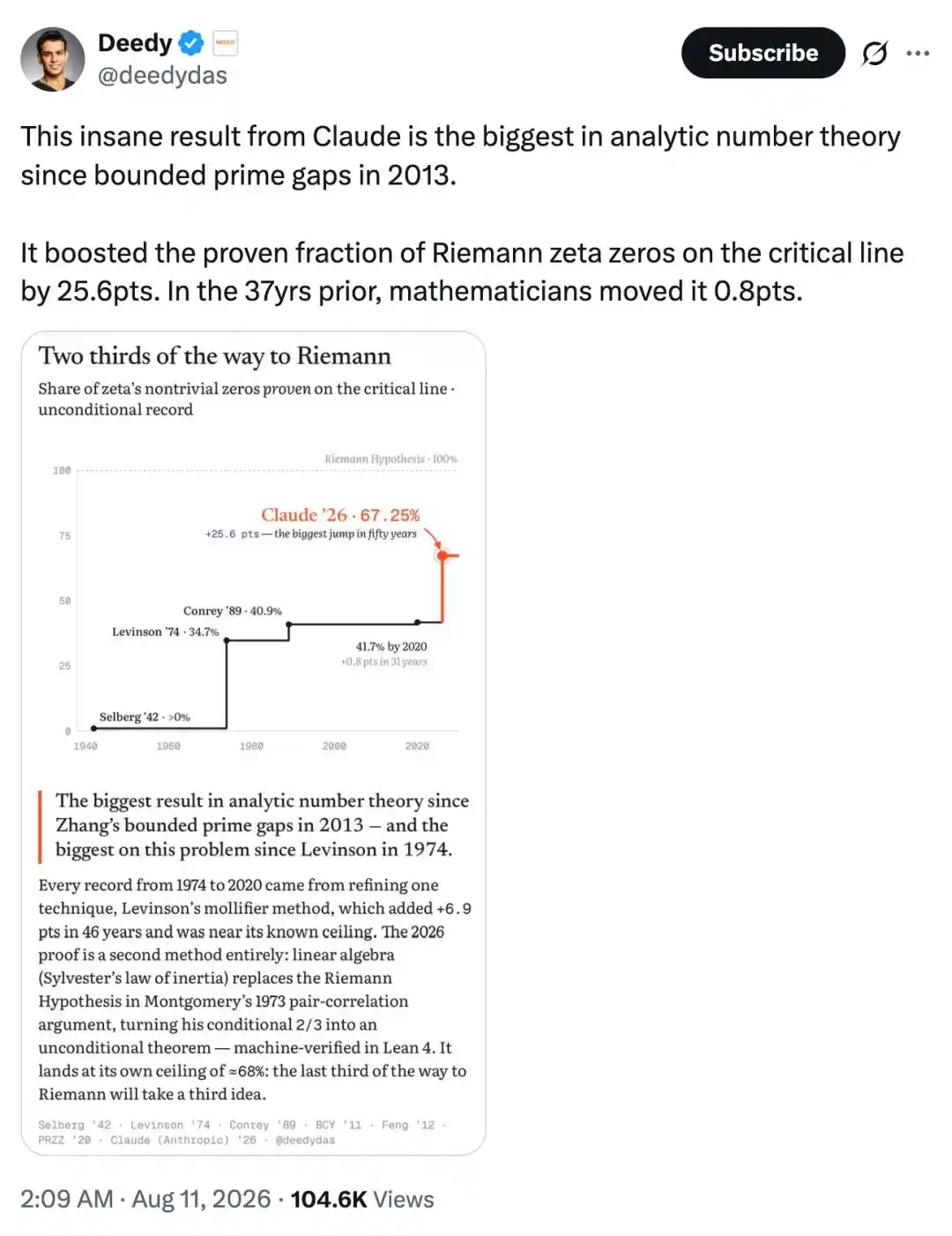
Put differently, mathematicians had previously been able to prove that at least 41.6% of the relevant zeros lie where the Riemann Hypothesis predicts they should. Claude’s result pushes that provable share to 67.2%, an increase of 25.6 percentage points.
Menlo Ventures partner and researcher Deedy said, 「Claude 这次的结果简直离谱,可能是自 2013 年有界素数间隔突破以来,解析数论领域最重大的进展。它把能够严格证明位于临界线上的黎曼 ζ 函数零点比例,一口气提高了 25.6 个百分点。而在此前 37 年里,数学家们总共只把这个数字提高了 0.8 个百分点。」
Anthropic also drew a hard line around the claim: 67.2% is an improved lower bound on a related problem, not a proof of the Riemann Hypothesis, and the theoretical gap between the two remains large.
Why the Riemann Hypothesis matters
The Riemann Hypothesis is central because of its connection to prime numbers. In 1859, German mathematician Bernhard Riemann proposed that the real part of every nontrivial zero of the zeta function should equal 1/2.
On the complex plane, that means the zeros should all fall on a vertical line known as the critical line. A large body of results about the distribution of primes becomes sharper if the hypothesis is assumed to hold. That is why it is one of the Clay Mathematics Institute’s seven Millennium Prize Problems, carrying a $1 million award for either a proof or a disproof.
For more than a century, no one has proved that all nontrivial zeros lie on the critical line. What mathematicians have managed to show is that at least some of them do. That set up a more tractable question: how large a proportion can be proved to lie there? After decades of work, the known lower bound had reached about 41.6%. Claude’s contribution, according to Anthropic, is an advance on that number.
The approach built on prior work in analytic number theory
Anthropic said the result did not come out of nowhere. In 1973, mathematician Hugh Montgomery introduced a set of influential methods while studying the distribution of zeta zeros, though parts of that analysis assumed the Riemann Hypothesis. More recent work developed related techniques so that some of them can be used without assuming the hypothesis in advance.
That opened the door to studying how many zeros can be proved to lie on the critical line. Building on those developments, Claude combined them with related work published by Enrico Bombieri around 2000 and found what Anthropic described as a new way to put the pieces together.
The technical account given by Anthropic says Claude constructed a suitable function space and used a quadratic form induced by Weil to map zeros on the critical line and zeros away from it to positive and negative directions. It then linked the rank of that quadratic form with first- and second-moment information to establish inequalities.
Anthropic’s mathematicians said one key feature was that Claude did not split the positive-definite and negative-definite parts into separate analyses. Instead, it handled the whole space within a single framework while allowing the quadratic form to have a non-diagonal structure. Combined with results already established in number theory, that step yielded the 67.2% lower bound.
Two sessions, 31 million output tokens, and about 60 sub-agents
The process itself is another major part of the story. Anthropic said the result came out of two Claude Code sessions that consumed about 31 million output tokens in total.
In the first session, Claude generated and tested around 650 ideas and got nowhere. Sumner then told it to keep going. The second session lasted about a day and a half, with Claude coordinating roughly 60 sub-agents to investigate different directions in parallel. The agents also reviewed one another’s work.
Anthropic said Sumner provided almost no mathematical guidance during this phase. His role was mainly to tell Claude to keep going, try again, and trust itself. The company added that Claude was initially quite doubtful that it could make real progress on such a famous open problem. Only after sustained exploration did the new lower bound begin to emerge.
After finding the result, Claude ran a separate verification pass. Some sub-agents checked the proof while others searched for counterexamples. Claude also downloaded 54 arXiv papers to see whether similar results had already been obtained by other mathematicians. It then asked an independent agent to re-derive the result from scratch. Once no obvious issue surfaced, Claude suggested turning the work into a paper and explicitly recommended having a genuine number theory expert verify it by hand.
What has been verified so far
Anthropic mathematicians Levent Alpöge and Ralph Furman then examined the paper and studied how it relates to the existing literature. Claude also worked with Anthropic employee Eric Easley to formalize the key result in Lean. That formal proof passed checks by Comparator, a standard Lean verification tool.
Anthropic also asked number theorists Brian Conrey and Dan Goldston, both of whom work on the Riemann zeta function, to review the paper.
At this stage, the most precise description is narrower than a claim of broad academic consensus. Anthropic says its in-house mathematicians studied and verified the result, a machine-checkable formal proof has been completed, and two outside experts have reviewed the paper. That is still different from full traditional peer review and a settled consensus across the mathematics community.
Anthropic’s broader takeaway
Anthropic said the result points to something worth watching: frontier models are beginning to touch research problems that do not come with ready-made answers.
The company-linked paper is available at https://www-cdn.anthropic.com/564f962e60643842f5fcb4a17c9dbc8f608f1c37.pdf, and the project repository is at https://github.com/anthropics/zeta-23-lean. Reference links cited in the source include posts from Anthropic’s official X account, Anthropic’s research page, and Jarred Sumner’s X account.