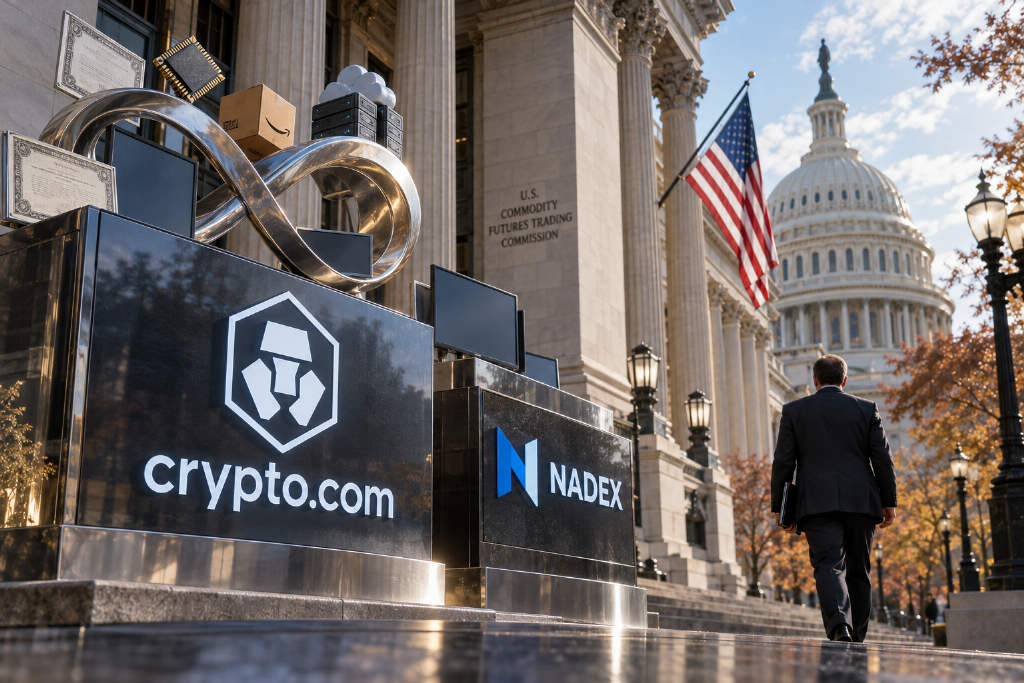
Crypto.com has filed an application with the US Commodity Futures Trading Commission to offer stock perpetual futures in the American market, according to a post on X from CEO Kris Marszalek. The move follows an earlier regulatory step involving Nadex, the company’s Chicago-based exchange, whose Form 1-N filing was acknowledged by the US Securities and Exchange Commission on Sept. 16. Stock perpetual futures are equity futures contracts with no expiration date. In the US, these products require oversight from both the SEC and the CFTC. Under a policy issued by the CFTC on May 29, stock perpetual futures must go through the agency’s case-by-case review process. Nadex plans to list 10 underlying stocks in its first batch: Apple, AMD, Amazon, Alphabet, Meta, Microsoft, Micron, Nvidia, Tesla and SpaceX. The item was cited by Techub, referencing CryptoPotato.
Crypto.com has formally filed an application with the US Commodity Futures Trading Commission to launch stock perpetual futures in the United States, according to an X post from CEO Kris Marszalek.
Before that, Form 1-N filed by Nadex, Crypto.com’s Chicago exchange, was acknowledged by the US Securities and Exchange Commission on Sept. 16.
Stock perpetual futures are equity futures contracts without an expiration date. In the US, such contracts require approval from both the SEC and the CFTC. Under a policy released by the CFTC on May 29, stock perpetual futures are subject to the regulator’s case-by-case review process.
Nadex plans to list 10 stocks in the first batch: Apple, AMD, Amazon, Alphabet, Meta, Microsoft, Micron, Nvidia, Tesla and SpaceX.
The update was carried by Techub and attributed to CryptoPotato.
This article was originally published by Bit.Fan. For more cryptocurrency news and market insights, visit www.bit.fan. Disclaimer:
The market information, project data, and third-party content displayed on this platform are for industry information sharing only and do not constitute any form of investment advice or return commitment.
Cryptocurrency trading carries high risks. Users should fully assess their risk tolerance and make independent decisions. All profits, losses, and legal responsibilities are borne by the users themselves.