
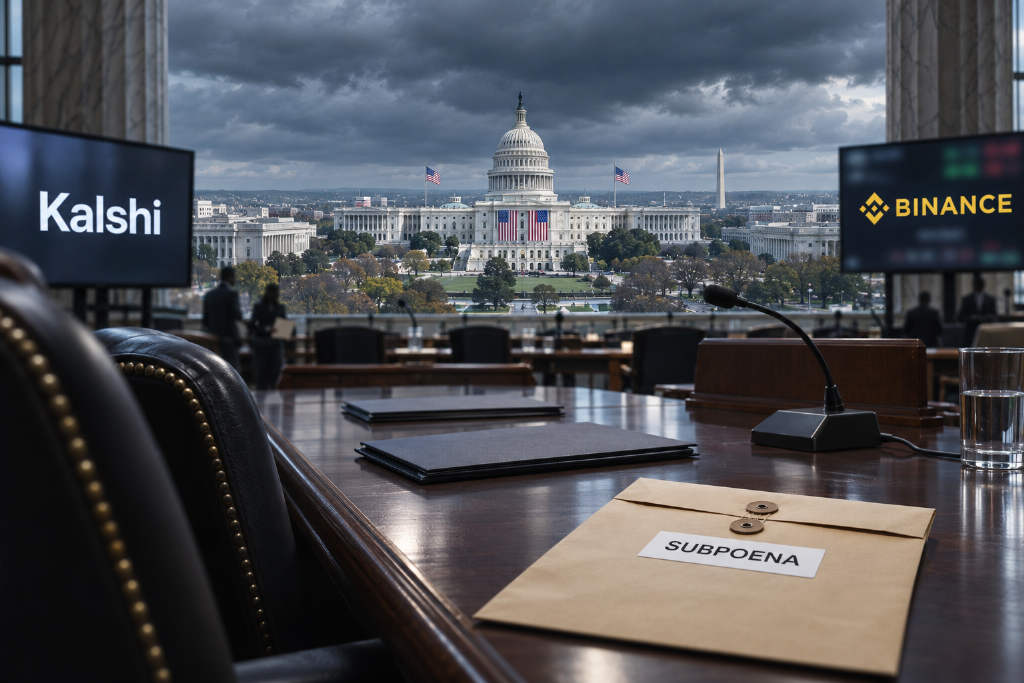
Less than a week after hackers stole about $6.3 billion from Binance, the crypto industry may be heading into another shock: a Democratic sweep in the U.S. midterms that would put some of the sector’s most entrenched critics in charge of congressional oversight.
Unlike the hack, this risk has been building in plain sight. As of Tuesday Eastern Time, Kalshi pricing put Democrats at roughly 94% to control the House and about 75% to control the Senate. That does not mean the outcome has been fully priced into crypto assets, but a shift in congressional control no longer looks surprising.
The more important question is how Democrats would use that power, and whether developments around Iran could overwhelm the political narrative altogether.
From letters to subpoenas
If Democrats win the House, they would gain control of committee investigations, including the power to hold hearings and compel documents or testimony. The direction of travel is already visible.
Sen. Elizabeth Warren and Rep. Maxine Waters, two of the best-known crypto critics in Washington, began laying the groundwork in April 2025 by asking the U.S. Securities and Exchange Commission to preserve records tied to Trump’s World Liberty Financial and possible conflicts of interest. Other lawmakers have sought scrutiny of the $TRUMP memecoin, while Rep. Robert Garcia, the top Democrat on the House Oversight Committee, has made Trump family crypto ventures and overseas business dealings an investigative priority.
The Binance hack has given them another opening.
In an Oct. 30 statement, Waters linked the breach to Trump’s pardon of Binance founder Changpeng Zhao, or CZ, and to ties between Binance and World Liberty Financial. The article notes that no established connection has been shown between those relationships and the hack itself. Even so, the incident gives Democrats another chance to push for tighter cybersecurity standards, stronger financial crime safeguards, and more exchange accountability.
The author says that may not be entirely negative. After large losses from recent hacks, more oversight of exchange security could help. The concern is how far that scrutiny might spread. In the author’s view, investigations should stay focused on specific transactions rather than pulling unrelated businesses into the fight.
Prediction markets could also face pressure
Prediction markets may be drawn into the same spotlight because of their own links to the Trump family.
Donald Trump Jr. serves as an adviser to Kalshi and joined Polymarket’s advisory board after 1789 Capital invested in the company last year. After The New York Times reported that Trump Jr. urged Republican attorneys general not to pursue prediction markets, Warren called on those attorneys general to release a transcript. On Monday, four Democratic senators sent a letter to X asking whether Polymarket ads had received preferential treatment.
Democrats have also introduced the STOP Corrupt Bets Act, which would ban contract trading on elections, sports, government actions, and war. That would strike at the center of Kalshi’s business. The article says sports and parlay trading account for 84% of Kalshi’s volume this year, while elections make up just 0.5%. All of this is unfolding as the fight between state and federal authorities over who gets to regulate these platforms grows more intense.
Dustin Gouker of The Event Horizon said that compared with what could happen if Democrats take Congress, hearings so far may 「look like an ice cream social」.
Kalshi appears to be preparing for that possibility. It recently hired a lobbying firm tied to Hakeem Jeffries, who could become House speaker. And as the Commodity Futures Trading Commission defends prediction markets against interference from state regulators, congressional scrutiny of those platforms could spill over to the agency itself.
Regulatory work is still moving
Heavier congressional scrutiny does not automatically mean the regulatory process stops.
Although the CLARITY Act failed to advance in September, the SEC and CFTC have kept using their existing authority to move policy forward. Two days after CLARITY stalled, the SEC granted temporary relief allowing eligible venues to trade tokenized U.S. stocks onchain.
In October, the CFTC sought comment on rules for leveraged crypto trading and federally registered crypto markets. Then came a more concrete sign of progress: CFTC Chair Michael Selig said stock perpetual futures could begin trading on qualified U.S. regulated exchanges.
Platforms still need to complete SEC and CFTC registrations, product filings, and clearing arrangements, but the pathway is now open. Payward has filed to offer these perpetuals through Bitnomial, while Lighter and ICE-backed Trade[XYZ] are also advancing their own regulatory routes.
That progress is not insulated from politics. Warren has already questioned the CFTC’s enforcement record and staff reductions. If Democrats control Congress, the agency’s decisions could face tougher review. Still, a change in congressional control would not erase powers regulators already have. Investigations could speed up even as approvals continue.
The larger unknown may be Iran
For traders focused on positioning, the less predictable force may be Iran rather than Congress.
An Axios report last week suggested Trump was considering a return to large-scale strikes after the midterms. That raised the prospect of higher oil prices, sticky inflation, and another pullback in risk assets.
There was a brief sense of relief on Monday. Trump said he was not in a hurry to resume major action, and diplomacy held out hope for a sharp drop in oil prices. Later on Monday, however, the Associated Press reported that U.S. forces had carried out limited strikes on Iranian targets near the Strait of Hormuz. A U.S. official said the strikes were defensive in nature and that negotiations remained active.
The question now is whether those strikes stop there or expand into a broader conflict.
The article closes by arguing that investors have already had weeks to prepare for Democratic control of Congress. Iran remains much harder to model, and its effect on markets could prove larger than domestic U.S. politics. The author says he hopes the situation cools quickly, not only for the market, but for the coins investors are holding.



