
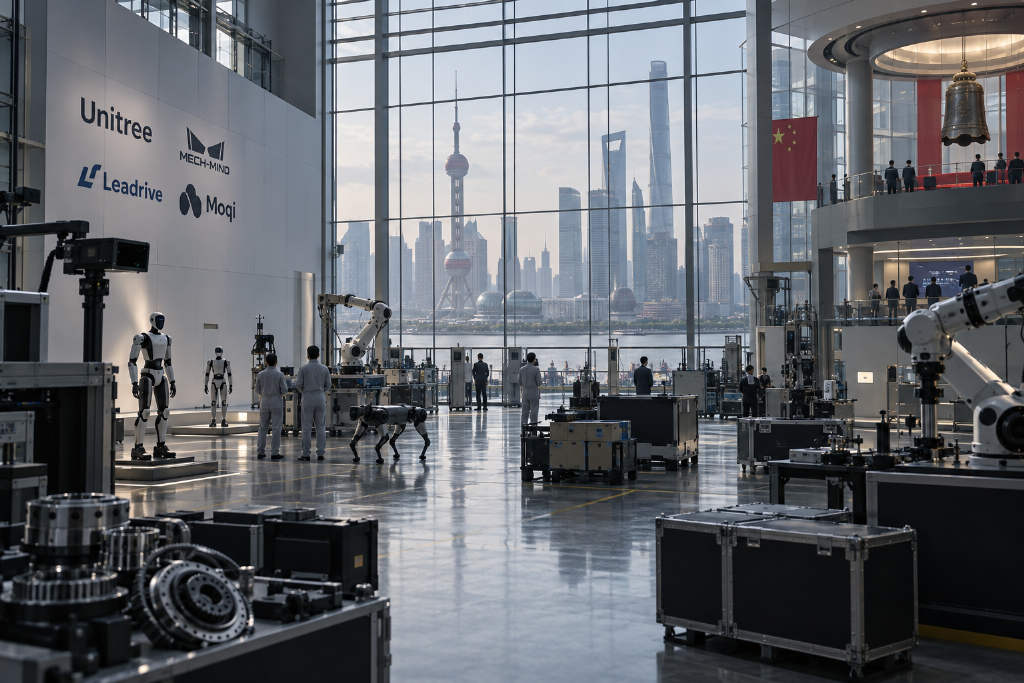
Embodied AI companies are getting watched from all sides. Robots keep grabbing headlines at sports events. Some old names in the field have also headed for the public market. But the talk has snapped back to something much less exciting: where the money actually comes from, whether it lasts, and how much is left once growth has been paid for.
On Sept. 10, a screenshot of a Moments post by Mech-Mind founder Shao Tianlan spread fast across the industry. In that post, he asked whether some companies were relying on data collection centers, leasing companies, and related-party transactions to manufacture revenue that cannot last, then leaning on that revenue to get listed. The article says those claims alone are not proof of financial wrongdoing. Still, they pushed one old question right back to the front: how good is the revenue, and how durable is it?
One day before that argument broke out, The Information reported something the article treats as even bigger. People familiar with the matter said the China Securities Regulatory Commission had recently given informal "window guidance" to some investment banks and institutions, lifting the IPO approval threshold for humanoid robotics startups. The report said regulators would focus on three things: whether a company can generate recurring revenue, whether its losses are actually narrowing, and whether its technological innovation is real and substantial.
So embodied AI companies are staring at a pretty direct checklist, both before and after listing: will customers keep paying, how close is the business to profit, and what has all that R&D really produced?
The PANews article says it is only half right to say these companies need a clear business model and revenue stream. A lot of them already have revenue. Unitree even has profit. The harder issue is why those businesses still could not hold up the rich prices the market gave them at first after listing. At the very least, the secondary market has not accepted those early valuations on faith.
Unitree: profit is not the same as a defensible price
Unitree is the first example the article takes up.
The company listed on Aug. 19 with an offer price of 150.80 yuan. On its first trading day, it opened at 1,100 yuan, implying a market value of roughly 444.9 billion yuan. By Sept. 10, the stock closed at 498.55 yuan, about 55% below that opening price, even though it was still more than three times the offer price.
The article says this drop should not be read in the lazy way, as if it simply proves a hardware company is "not worth much." CCB International and Nomura had earlier put Unitree’s valuation in the hundreds of billions of yuan, still well below its first-day opening market value. So the real gap is not about whether the company has value at all. It is about how much investors are willing to pay in advance for growth that has not arrived yet.
It also says the small free float on day one probably made the stock swing harder. Prices can jump or fall sharply day to day even when the business underneath has barely changed.
The operating numbers say more. In the first half of this year, Unitree’s revenue rose 48.54% year over year, while net profit excluding non-recurring items fell 19.34%. The company said the main reason was higher period expenses, including R&D and sales costs.
Why keep pouring money into R&D? During an online IPO roadshow on Aug. 7, founder Wang Xingxing talked about the problem of moving robots out of performances and research settings and into large-scale household use. He said, "The biggest technical challenge is still that embodied large models around the world remain in an early stage of development and lack sufficient generalization ability."
That is the economic core of it. Selling a robot does not mean the machine is already ready for every demand a customer will throw at it. Models still need training. Manufacturing costs money. Delivery costs money. Maintenance too. Higher sales volume can spread some of that load, sure. But if prices drop too fast and costs do not improve just as fast, profit may not rise with revenue.
For emphasis, the article quotes Warren Buffett’s 2000 shareholder letter: "Growth can also hurt value." The point is blunt. If the cash burned to chase growth is greater than the present value of the net cash the business will one day generate, then growth itself works against shareholders.
That is why the article says Unitree’s next stage should not be judged by sales volume alone, but by the cost tied to that growth. Once shipments rise, can the expense assigned to each machine fall? That answer may tell investors more about future profit than the top-line sales number by itself.
Mech-Mind: customers are buying again, but profit still has not arrived
Mech-Mind shows a different side of the story.
For years, the company has sold robot perception, planning, and operation products. In its own words, these are the robot’s "eyes, brain, and hands." If parts are dumped randomly in a bin, the system must help a robotic arm identify the target, decide where to grab it, and avoid nearby obstacles during pickup. Its 3D cameras and algorithm software are built to solve exactly that. Customers pay because the products help robots complete that industrial step reliably.
Looking at the reported numbers, it is hard to wave Mech-Mind away as a company living only on repetitive engineering projects. From 2023 to 2025, revenue climbed from about 181 million yuan to 389 million yuan, while gross margin rose from 39.1% to 64.6%. In 2025, existing customers contributed 78% of revenue. Repeat purchases at that level are real operating evidence.
But expenses change the picture. Reports citing the prospectus say Mech-Mind produced about 251 million yuan in gross profit in 2025. Its selling expense ratio was about 43%, and R&D expense was about 113 million yuan. Using revenue as a rough base, selling and R&D expenses together reached about 280 million yuan, already higher than gross profit, and that is before administrative and other costs. The company’s adjusted net loss for the year was about 109 million yuan.
That arithmetic suggests the product matters, but the company still has ground to cover before full profitability. The article says the better question is not whether Mech-Mind counts as a "brain company." It is how big revenue has to get before it can carry the current expense base.
On Sept. 1, Mech-Mind opened flat at HK$101.70 and later traded below its issue price during the session. The market’s message was simple enough: real business does not exempt a company from price discipline.
In an interview with Tencent Technology about how capital markets judge robotics companies, Shao Tianlan said, "In the same market, something built in 10 years and something built in 100 years definitely do not carry the same value." The article says that same line can be turned back on Mech-Mind itself.
One bright spot it points to is the company’s lower selling expense ratio, which fell from 103% in 2023 to 43% in 2025. Revenue growth is starting to dilute selling costs. The next test is obvious: can that keep going long enough to push the company into profit?
What kind of spending deserves a higher valuation?
After Unitree and Mech-Mind, the article shifts to a broader valuation question across embodied AI. Pretty basic, really. After a company spends the money it raised, what extra revenue can it generate, or what cost can it avoid?
Xingdong Jiyuan said in April that it had raised more than $200 million, with SF Group leading the round. At the time, the company said it had already partnered with SF and China Post and had deployed in more than 10 logistics centers.
The article says SF Group’s lead investment is one reason this company deserves attention. A logistics operator with years of frontline experience knows which process most needs automation and what a robot actually has to do to be useful. Given the disclosed cooperation in logistics centers, that funding gives the company a shot at matching R&D more closely to real operating demand.
This is the model the article likes best: industrial investors put up the capital, and real-world use cases tell the team what to fix or improve next. As robots start creating value in more parts of the workflow, customers have stronger reasons to keep buying, and revenue growth sits on firmer footing.
The same logic reaches upstream to component suppliers. Their valuations also hinge on how much real order flow robot makers can create. The article presents LeaderDrive as a company worth tracking.
LeaderDrive already has industrial business and profit. The article says one appealing trait of this kind of component business is that it may be able to supply several OEM customers at once, instead of forcing investors to guess early which robot manufacturer will win in the end.
But execution risk is still there. Future humanoid robot output still has to turn into real orders. Once new equipment is installed, will production lines stay occupied? Will pricing pressure cut into profit per unit? Those are the questions that decide whether capacity expansion adds earnings or just leaves idle assets behind.
The article also points to Moqi Intelligence. Its long-term goal is the home, but it is entering first through hotels and other quasi-home settings. Its wheeled dual-arm robot, KINO, is built for longer-horizon tasks such as delivery, grasping, and organizing. According to the article, the company completed more than 1 billion yuan in angel-series financing within six months of its founding.
For hints about how household robots may one day make money, the article looks abroad. When 1X introduced NEO in 2025, it disclosed a planned subscription model priced at $499 per month, to launch later, along with expert help for unfamiliar tasks. The pricing idea is straightforward: users pay every month for help with chores.
The article says that on social media platforms like Xiaohongshu, people often talk about robots helping with housework. Follow that demand far enough and household robots start to resemble a new kind of appliance, one that can clear tables, organize clothes, and take on more repetitive work at home. The author’s view is that the direction looks promising because it aims at problems people face every day.
But this kind of product takes time. Only if the product becomes more useful and the number of paying users gradually rises will the revenue picture for household robots come into focus, giving market expectations something firmer to stand on.
After the listing, valuation still comes back to the ledger
The article ends with a plain point. Last week’s fight around embodied AI companies was, underneath all the noise, a fight about economics. Whether a company is already public or still getting ready to list, it has to answer the same basic questions: who will keep paying, what is driving revenue growth, and how much money is left after buying that growth.
If those accounts cannot be explained, valuation loses its business foundation. If they can, capital markets have a firmer basis for pricing the company.