
Vitalik Buterin’s comments on the progress of EIP-8141, or Frame Transactions, quickly sparked a blunt market take: if people can use Ethereum without holding ETH for gas, what value does ETH still have? The article’s answer is more restrained. The asset a user sees when paying a fee and the asset the Ethereum protocol uses to settle network fees are not the same thing.

The discussion starts with a familiar problem for on-chain users. A new wallet receives stablecoins, but the holder cannot move them because there is no ETH to cover gas. A swap on a decentralized exchange stalls for the same reason. Someone withdraws USDC from a trading platform and only then realizes the wallet has no ETH for the next step. In practice, that often means finding a fiat on-ramp or asking someone else to send a small amount of ETH first.
What it means to pay gas without holding ETH
The article explains the issue through a simple Ethereum transfer. Frank has 1,000 USDC in his wallet and wants to send 100 USDC to a friend. If he does not hold ETH, the transaction cannot be sent under the current account model.
That is because Ethereum’s standard account flow tightly links three actions together: Frank signs the transaction, Frank submits it, and Frank’s ETH balance pays the gas. EIP-8141 is meant to separate those responsibilities.
Under the design described in the proposal, a Frame Transaction can be split into multiple frames. Different frames can handle transaction validation, determine who pays the gas, and carry out the user’s intended action.
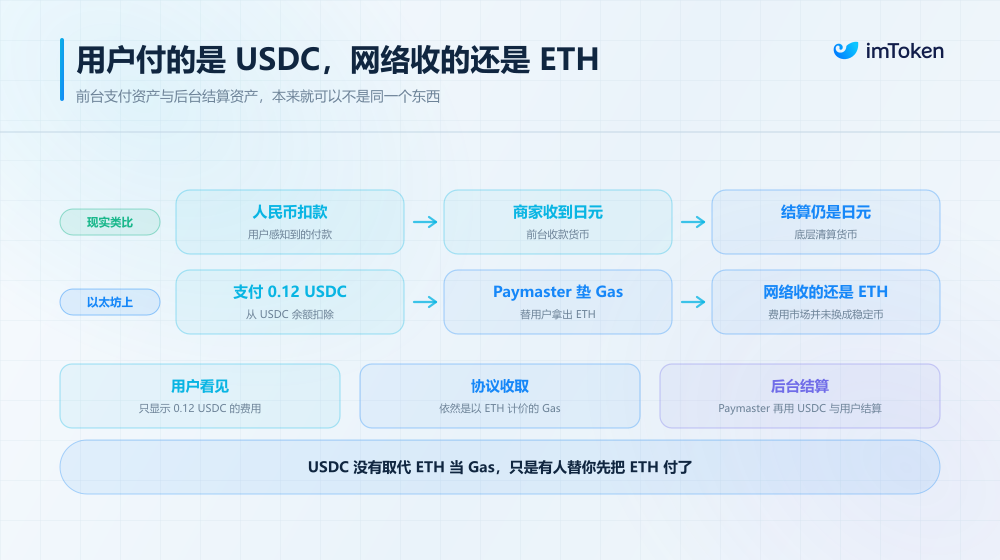
In that setup, Frank still signs to prove that the transfer of 100 USDC is what he wants to do. But another account, such as a Paymaster, can provide the ETH needed to pay Ethereum network gas. Frank can then reimburse that Paymaster with a small amount of USDC.
From Frank’s point of view, the wallet interface may show only two numbers: transfer 100 USDC, network fee 0.1 USDC. He does not need to know the ETH gas price and does not need to prepare ETH in advance.
From Ethereum’s point of view, though, nothing has changed at the base layer. The network is not suddenly accepting USDC as gas. Someone else is paying gas in ETH in the background and settling with the user afterward in USDC.
The article notes that EIP-8141’s official ERC-20 payment example follows the same structure. A sponsor approves and covers the gas, while the user transfers ERC-20 tokens to that sponsor as compensation.
It compares the setup to using a renminbi-denominated credit card in Japan. The user experiences a charge in renminbi and the merchant may receive yen, but that does not make renminbi the settlement currency of Japan’s payment rails. Front-end payment and back-end settlement can differ. The article argues that EIP-8141 applies the same kind of abstraction to Ethereum.
Why Ethereum wants to hide gas from users
The piece stresses that the idea itself is not entirely new. ERC-4337 introduced account abstraction and Paymaster-based gas sponsorship for smart accounts, allowing applications to pay fees on behalf of users or let them settle fees with stablecoins.
The difference is where the capability sits. ERC-4337 adds an external stack built around UserOperation, Bundler, EntryPoint, and Paymaster infrastructure. EIP-8141, by contrast, aims to move similar functionality closer to Ethereum’s native transaction structure.
The underlying question is simple: why should ordinary users have to understand gas mechanics in order to use a product?
The article draws a consumer analogy. When someone sends 200 yuan to a friend on WeChat, the app does not interrupt the process and ask the user to buy 2 yuan worth of a separate settlement token somewhere else first. Yet that sort of friction has long been normal in crypto.
On Ethereum, users need ETH. On Solana, they need SOL. On BNB Chain, they need BNB. Even on a new Layer 2, many users first check whether the wallet has enough startup funds to begin. An experienced user may bridge assets in two minutes and move on. A newcomer may simply close the page.
The article also says Frame Transactions could clean up other weak points in today’s flow. On a DEX, buying a newly listed token often requires one approval transaction and then a separate swap transaction, which means two wallet confirmations.
If the swap fails, the approval can remain on-chain. That leaves a standing permission behind and can increase theft risk. With frames, those steps could be packed into a single atomic batch. If the swap fails, the prior approval would roll back with it.
That opens a broader design space. Authorization, execution, fee payment, and validation methods can all be separated and recombined in different ways.
Is the change bullish or bearish for ETH?
This is where the market discussion tends to split into extremes. One side says ETH loses value if users no longer need it directly for gas. The other says a lower onboarding barrier should drive much more transaction activity and therefore becomes strongly positive for ETH.
The article does not commit to either conclusion. It says large protocol-level changes to usability are hard to price in ahead of time. What can be said with confidence is narrower: EIP-8141 does not remove ETH from its role as Ethereum’s base gas and fee settlement asset.
Even if users no longer see ETH in the payment flow, Paymasters, applications, or other accounts covering fees on their behalf still need the ability to pay network costs denominated in ETH. The EIP-1559 fee market is not being replaced by stablecoins because of Frames.
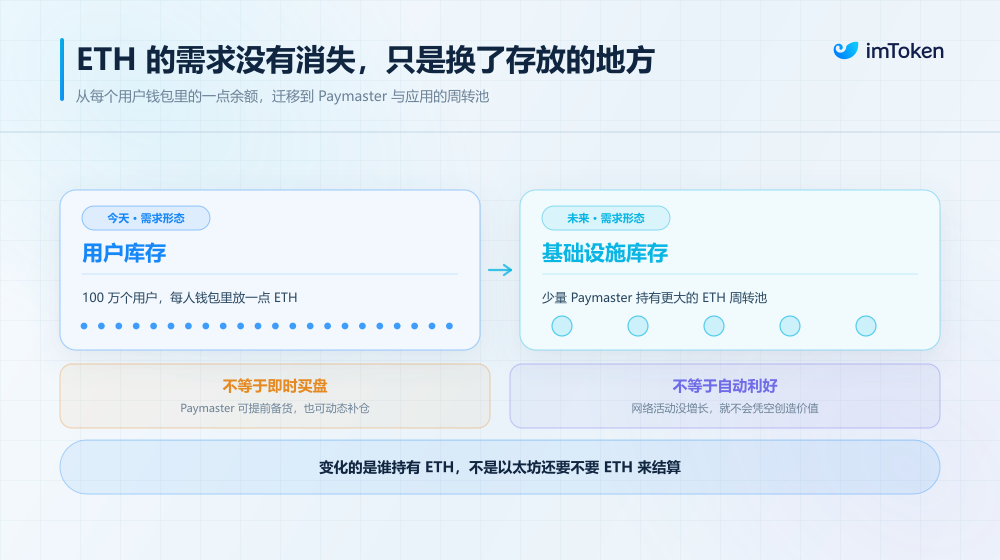
What changes is where ETH demand sits. Today, that demand may be spread across 1 million users, each keeping a small amount of ETH in a wallet to pay gas. In the future, the article suggests, a smaller number of Paymasters, wallet providers, and applications could hold larger working balances of ETH and process gas centrally for a much larger user base.
The author also cautions against a simplistic trading interpretation. It is unrealistic to assume that every stablecoin fee paid by a user would trigger an equal market buy of ETH in the secondary market. Fee sponsors can manage inventory, hedge exposure, pre-fund balances, or replenish dynamically.
For that reason, the mere fact that users may settle gas in stablecoins does not by itself reveal how much new spot demand ETH would gain.

The real question, the article says, is whether the better user experience leads to more genuine Ethereum usage. That is the variable that matters.
It offers a simple illustration. If 100 people intended to enter the ecosystem before, but 70 gave up after struggling with buying gas, checking gwei, and bridging across chains, only 30 completed a transaction. If wallets absorb all that complexity in the background and 80 people complete their transactions smoothly in the future, then the network could consume and burn more ETH overall, even if those users never personally hold any ETH.
The reverse is also true. If the ecosystem does not generate incremental activity and only changes who fronts the fee payment, then no new value is created just by shifting the payment flow.
What this points to for wallets
The article closes by saying EIP-8141 weakens one old assumption: that every user must stockpile a little ETH before being able to use Ethereum at all. What it is really betting on is that removing that hurdle brings more people into actual usage.
For ordinary users, there is no immediate need to change behavior because of this proposal. For wallet design, however, the direction is becoming clearer. A well-built wallet may no longer need to ask users to understand gas first.
Users decide where assets should go and what operation they want to execute. The wallet’s job is to explain the risk and the final cost. Which account actually pays, whether ETH or a stablecoin is shown to the user, and whether a gas sponsor is available are protocol details that can be pushed into the background.
The article’s closing line is brief: mature infrastructure usually works that way.