
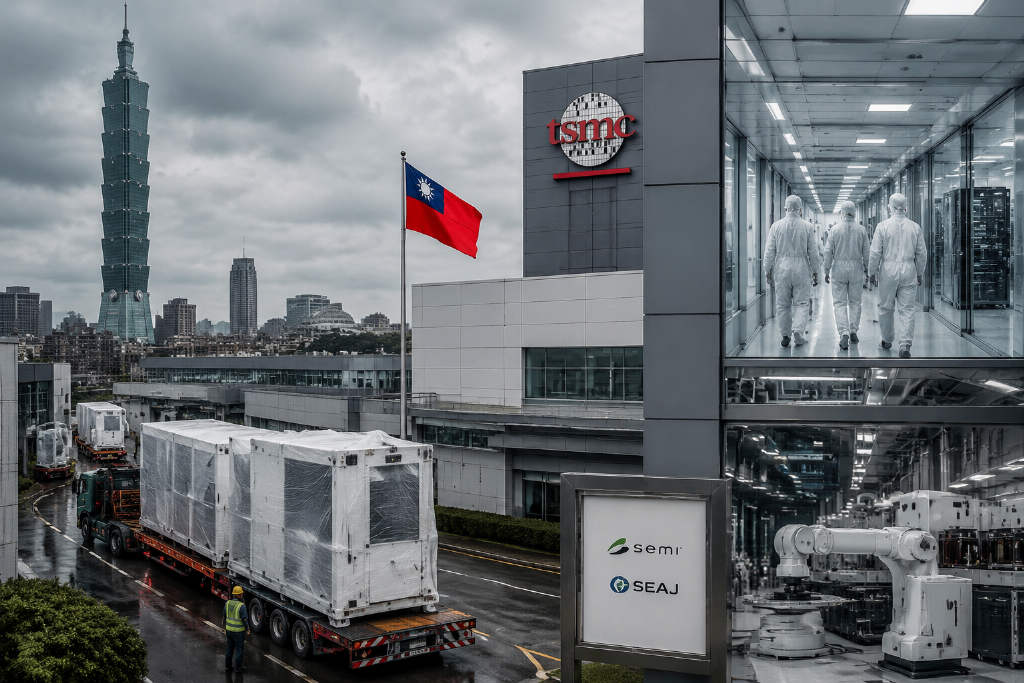
Global semiconductor manufacturing equipment sales reached $40.53 billion in the second quarter of 2026, up 23% from a year earlier, according to the latest figures released by SEMI, the industry association, and the Semiconductor Equipment Association of Japan (SEAJ).
The total set a new record. It also marked the ninth consecutive quarter of growth and the second straight quarter at an all-time high, pointing to continued investment by chipmakers in equipment purchases and capacity expansion.
AI infrastructure demand continues to drive spending
The report said the increase in semiconductor equipment sales was mainly supported by fast-growing demand tied to artificial intelligence infrastructure. AI applications are driving volume production needs for advanced logic chips as well as key memory components including high-bandwidth memory, or HBM, and DRAM.
With supply for advanced process capacity still tight, semiconductor manufacturers have kept capital spending at a high level and are using advanced equipment purchases to expand chipmaking output. That broader investment has also supported growth across the hardware supply chain.
China stayed No. 1, Taiwan moved ahead of South Korea
By region, China recorded $11.91 billion in semiconductor equipment sales in the second quarter, up 5% year over year and 8% from the previous quarter. It remained the world’s largest chip equipment market for a 13th consecutive quarter.
Taiwan posted $10.89 billion in second-quarter sales, rising 24% from a year earlier and 24% from the prior quarter. That moved Taiwan into second place globally, ahead of South Korea.
South Korea reported $9.08 billion in second-quarter sales. The market was up 54% from a year earlier and 2% quarter over quarter, but still slipped to third place.
North America, Europe and Japan also showed activity
Markets outside Asia also posted broad gains. North America reached $3.5 billion in second-quarter equipment sales, up 27% year over year and 7% from the prior quarter. Europe recorded $1.23 billion, up 70% from a year earlier and 30% sequentially, the strongest annual growth rate among the regions listed.
Japan posted $2.44 billion in second-quarter sales, down 9% from a year earlier but up 13% quarter over quarter. The figures indicate that, beyond Asia’s main manufacturing hubs, investment in semiconductor capacity is also continuing across the Americas and Europe, adding to a more geographically broad growth pattern in the equipment market.
Ajit Manocha says advanced capacity buildout is continuing
SEMI President and CEO Ajit Manocha said the back-to-back record quarters in equipment sales showed that chipmakers were actively expanding advanced manufacturing capacity to meet chip demand tied to AI infrastructure.
He added that simultaneous growth across the Americas, Europe and Asia showed procurement demand across the global semiconductor supply chain was still strengthening. Continued investment in semiconductor manufacturing, he said, will serve as infrastructure for next-generation AI development and applications.
ABMedia said the latest round of equipment purchases and capacity expansion continues to shape production trends across the global technology sector.