
Goldman Sachs said in a report released on Aug. 24 that China’s semiconductor integrated circuit self-sufficiency rate by unit volume had reached 70% as of June 2026, up from 38% in January 2010. The bank said the gap in value self-sufficiency remains wide, with the lack of lithography equipment still the core bottleneck.
In the fourth annual report of its “Chip Act” series, Goldman raised its forecast for China’s semiconductor capital expenditure in 2030 to $82 billion, up 79% from its previous estimate. The bank said the revision reflects stronger demand from higher self-sufficiency, generative AI and customer localization strategies. The report also initiated coverage on Chinese DRAM company CXMT with a Buy rating and a target price of 129 yuan.
Capex forecast revised sharply higher
Goldman expects China’s semiconductor capital expenditure to grow at an annual rate of 10% to 15% from 2026 to 2030, reaching $82 billion by the end of the period.
It said front-end wafer fab equipment spending is projected to rise 13%, 20% and 15% in 2026, 2027 and 2028, driven mainly by investment in memory and advanced process nodes.
Supply gap in sub-7nm wafers seen narrowing faster
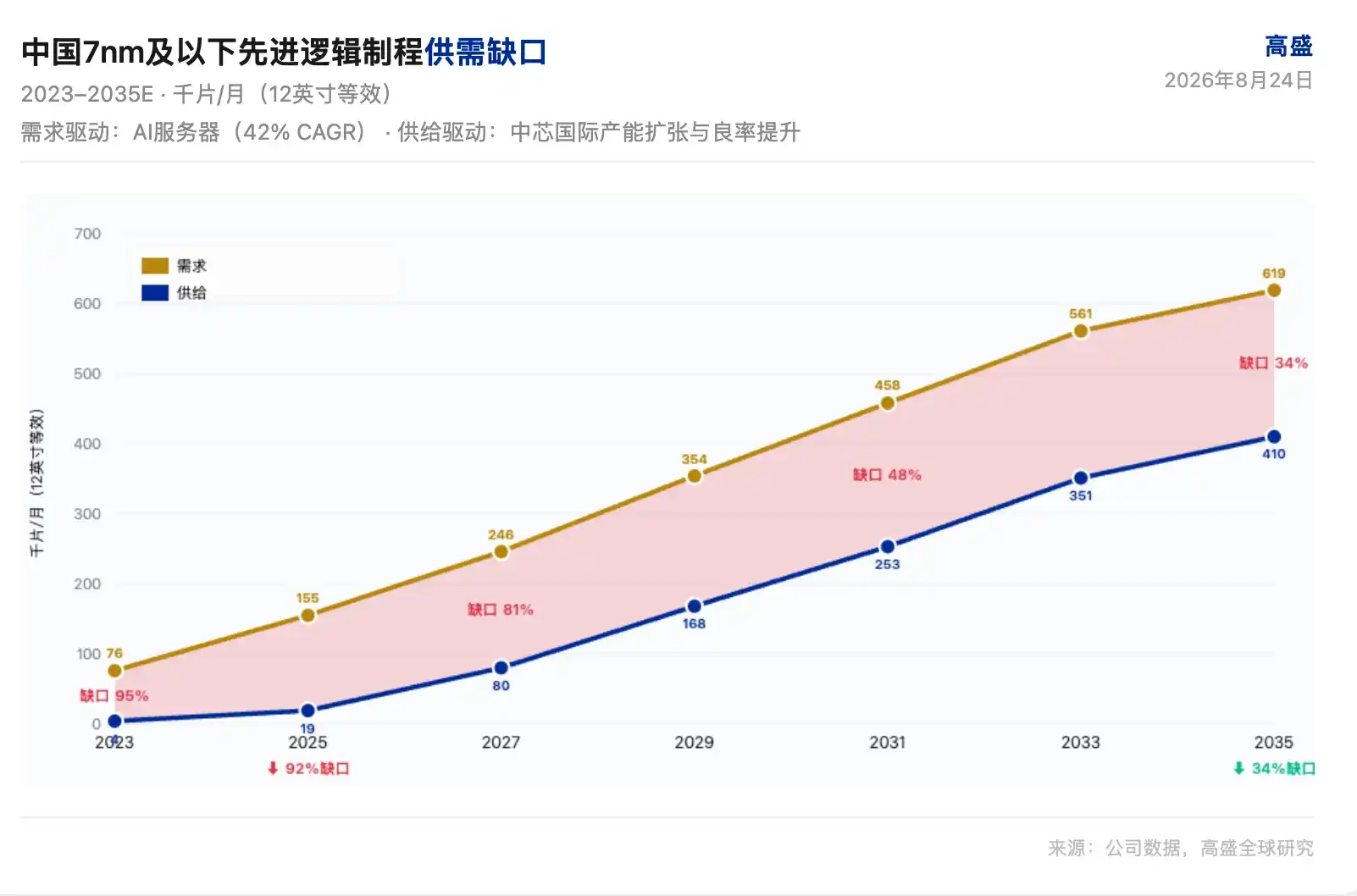
According to Goldman’s model, demand for 7nm and below wafers in China is expected to grow at a 17% compound annual rate from 2025 to 2035, reaching 619,000 wafers per month by 2035. The bank said AI servers are the main driver, with AI server wafer demand posting a 42% compound annual growth rate over the same period.
Supply is projected to grow faster. Goldman estimates that supply of 7nm and below wafers will expand at a 46% compound annual rate from 2025 to 2035, reaching 410,000 wafers per month in 2035. The bank attributed that to SMIC adding 30,000 to 50,000 wafers per month of capacity each year and yields improving from 23% in 2026 to 75% in 2035. On that basis, the supply-demand gap would narrow from 92% in 2025 to 34% in 2035.
Goldman sizes China AI chip market at $678 billion in base case
The report also offered Goldman’s first total addressable market estimates for China’s AI chip and DRAM markets.
Under its base-case scenario, Goldman sees China’s AI chip market reaching $678 billion by 2030, implying a 69% compound annual growth rate from 2025 to 2030. That scenario corresponds to shipments of 27 million H800-equivalent AI chips and 32GW of IT power demand.
In a more optimistic scenario, Goldman said the AI chip market could reach $4.1 trillion, equivalent to 238 million chips and 196GW of power demand.
For DRAM, Goldman expects China’s market to grow at a 50% compound annual rate from 2026 to 2028 and reach $257 billion in 2028. Within that, HBM is projected to grow at a 188% compound annual rate and hit $32 billion by 2028, which the bank linked to demand from AI inference and training workloads.
CXMT coverage starts with Buy rating
Goldman said CXMT is becoming a central supplier in China’s DRAM market. It expects the company’s capacity to rise from 270,000 wafers per month in 2026 to 447,000 wafers per month in 2028, then to 665,000 wafers per month by 2030, more than double the 2026 level.
The bank expects CXMT’s average annual capital expenditure in 2026-2030 to increase to 84 billion yuan from 60 billion yuan in 2024-2025, equivalent to about $12 billion.
For conventional DRAM supply, Goldman estimates that CXMT will reach 41% and 50% of Samsung and SK hynix, respectively, by 2028, versus 28% and 35% in 2025. In HBM, Goldman expects CXMT’s HBM revenue to grow at a 166% compound annual rate from 2026 to 2030.
Goldman described CXMT as China’s only DRAM IDM with large-scale mass production, covering both design and manufacturing, and serving major domestic cloud service providers and consumer electronics brands. The bank forecasts a 47% compound annual growth rate in net profit from 2026 to 2030, with conventional DRAM growing at a 34% compound annual rate over the same period.
Domestic tool makers gain share, but global suppliers remain critical
Goldman expects Chinese equipment vendors to raise their revenue share in the domestic WFE market from 31% to 38% between 2026 and 2028. Deposition, etch and lithography are the three largest WFE categories, and the bank estimates China’s WFE market will reach $53 billion in 2027.
Japanese equipment suppliers are still expected to benefit from the expansion of the China market. Goldman said four Japanese front-end equipment makers — Tokyo Electron, SCREEN, Kokusai Electric and Ebara — generated a combined 1.21 trillion yen in China revenue in fiscal 2025, accounting for 35% of their semiconductor equipment revenue. That share was down from 41% in fiscal 2024, but all four companies expect their China revenue to keep rising in absolute terms.
The report said Chinese fabs remain more dependent on non-Chinese equipment suppliers as they move to more advanced nodes and seek to secure yields.
For U.S. equipment suppliers, Goldman said export controls remain a constraint and expects China shipments to stay at about 25% of revenue. The bank kept a bullish view on global equipment stocks and said WFE would grow 36% in 2026 and 45% in 2027. It expects etch and deposition equipment to benefit from the expansion of gate-all-around transistors, 3D NAND and advanced packaging. In its U.S. coverage, Goldman listed Applied Materials, Lam Research and Onto Innovation as preferred names.
129 yuan target based on discounted 2030 P/E
Goldman said its 129 yuan target price for CXMT is based on a discounted 2030 price-to-earnings method, using a target multiple of 16.6x and discounting it back to 2027.
That valuation implies a 24x 2027 P/E, alongside average earnings per share growth of 77% across 2027 and 2028 and a PEG of 0.31x. Goldman compared that with Cambrian, Silergy and Advanced Micro-Fabrication Equipment, which were listed at 1.12x, 1.46x and 2.21x, respectively, on the same metric.
Goldman said CXMT’s scarcity value, product mix upgrade and AI demand make the valuation attractive. It also listed downside risks including stronger market competition, weaker-than-expected end demand and geopolitical uncertainty.
Article cites third-party broker research
The original article said it was a整理 and interpretation by Chaoxiang Research of a Goldman Sachs research report dated Aug. 24, 2026, combined with public market information. Ratings, target prices, earnings forecasts and related judgments cited in the article are the views of Goldman analysts and represent only the stance of their institution, not that of Chaoxiang Research, and do not constitute investment advice.
The article also said market decisions should be made independently and that the content should not be used as a basis for buying or selling any securities.