
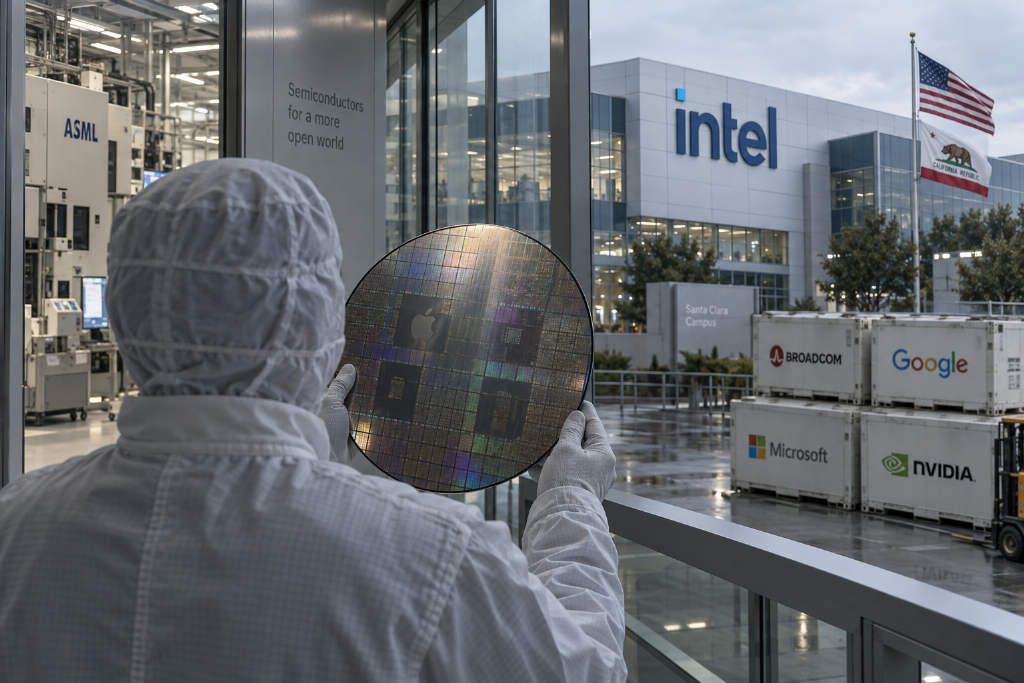
Intel’s foundry business has reportedly secured a string of high-profile customer programs, with its 14A process emerging as the main attraction, according to a Wccftech report that cited KeyBanc analysts following an Asia supply-chain survey. The note said Intel may already have work tied to Broadcom, Google, Microsoft and Nvidia, while Apple could use Intel 14A to produce multiple generations of M-series and A-series chips. KeyBanc estimated that Apple alone could bring Intel $15 billion to $20 billion in revenue.
KeyBanc points to Broadcom, Google, Microsoft and Nvidia programs
According to Wccftech, KeyBanc analysts said after recent visits across the Asian supply chain that Intel has obtained foundry contracts for Broadcom (AVGO) networking switch chips and Google server processors. The firm also said Intel is expected to manufacture server processors for Microsoft (MSFT) and gaming graphics chip products for Nvidia (NVDA).
As for Anthropic, Amazon (AMZN), and the Terafab fab project linked to SpaceX and Tesla (TSLA), the report said those groups are still evaluating two Intel process technologies. KeyBanc said most customers may prefer 14A. None of those potential collaborations has been publicly confirmed by the companies.
Apple order estimated at 600,000 wafers and up to $20 billion
KeyBanc also said Intel has reached a multigenerational, cross-family foundry agreement with Apple (AAPL). The scope would cover M-series chips used in Macs and A-series chips used in iPhones, and would rely on Intel’s 14A process rather than the previously rumored 18A-P.
The firm estimated Apple’s volume on 14A at about 600,000 wafers, implying a revenue opportunity of roughly $15 billion to $20 billion.
Another closely watched potential customer is Anthropic. KeyBanc estimated that Anthropic’s custom ASIC order volume could range from 5 million to 10 million chips. Including advanced packaging, that could translate into a revenue opportunity of as much as $40 billion to $80 billion.
What Intel 14A includes
The report described Intel 14A as a 1.4-nanometer-class process built around two main technology features.
- PowerDirect backside power delivery, which moves power lines to the back of the wafer so the front side can be used for signal routing, lowering resistance and increasing transistor density.
- RibbonFET 2 transistors, Intel’s second-generation gate-all-around, or GAA, architecture. The design is intended to deliver tighter current control as transistors keep shrinking, while increasing drive current and reducing leakage.
Advanced packaging opportunity extends to Google, Qualcomm, Amazon and Microsoft
Beyond wafer foundry work, KeyBanc estimated that Intel’s EMIB-T could package Google’s next-generation TPU chips at a scale of about 5 million to 6 million units, representing a revenue opportunity of about $12 billion to $15 billion. Packaging around 1 million Qualcomm (QCOM) AI300 chips could add another $2 billion to $3 billion. A separate version, EMIB-M, could win orders for Amazon Trainium 3 and Microsoft Cobalt 400.
KeyBanc said substrate suppliers for EMIB-T include Japan’s Ibiden and Shinko Electric, Taiwan’s Unimicron (3037), and Austria’s AT&S. Average substrate yields currently stand at about 50% to 60% for Ibiden, while Unimicron is at just 20% to 30%, which may cap Google TPU shipments at roughly 5 million to 6 million units.
According to Chain News, Intel EMIB-T could support more than 2 million substrate units by 2028 to meet MediaTek’s (2454) demand. MediaTek is seen as the main design partner for Google’s next-generation TPU chips.
Customer commitments remain unconfirmed
The report said favorable headlines around Intel Foundry have continued to surface. Wccftech had previously reported that Nvidia may adopt Intel’s Foveros 3D packaging technology in 2028. Foveros uses copper-to-copper hybrid bonding to stack chips vertically on a base die, offering high interconnect density and low signal latency.
Still, the order discussions and revenue estimates cited above are based on analyst projections drawn from supply-chain checks. Intel and the related customers have not publicly confirmed them.