
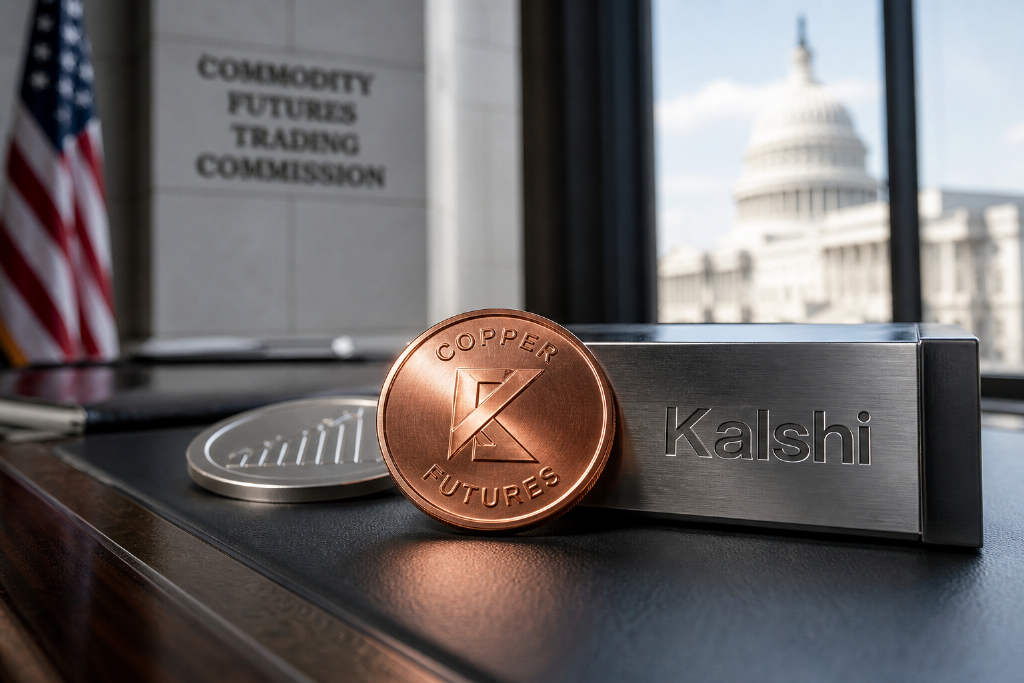
Kalshi asked the U.S. Commodity Futures Trading Commission on Aug. 18 to approve perpetual futures tied to a U.S. large-cap stock index and to copper, marking its first attempt to bring the crypto-native contract structure into equities. The filing came about a month after Kalshi asked the agency to approve a perpetual future on gold.
Perpetual futures do not expire. Instead of rolling a position into a new contract every quarter, traders can hold the contract indefinitely and make periodic funding payments designed to pull the contract price back toward the market it tracks. That structure traded on offshore crypto venues for years before U.S. regulators cleared it in May.
What Kalshi proposed to list
The equity-linked product, called US500, would track the MerQube US Large Cap Index, a float-adjusted index made up of 500 U.S.-listed, U.S.-domiciled large-cap companies.
Kalshi’s filing for US500 sets out the following terms:
- A multiplier of $1 for each index point
- A minimum tick of 0.05 index points
- Cash settlement with no delivery
- A position accountability level of $25 million in mark-to-market value
- A funding transfer at 4 p.m. ET on each index business day
The metals contract, COPPERPERP, would cover 1,000 pounds of copper and use Pyth Network’s XCU/USD feed for pricing.
For COPPERPERP, Kalshi proposed:
- A minimum tick of $0.0005 per pound
- A tick value of 50 cents per contract
- A spot-month position limit of 25,000 contracts
- The same federal limit applied to COMEX copper futures
- A daily funding transfer at 10 a.m. ET
Both contracts would clear through Kalshi Klear, the exchange’s in-house clearinghouse. They would trade continuously from 6 p.m. ET Sunday to 5 p.m. ET Friday. Kalshi said it plans to list each contract shortly after receiving CFTC approval.
Perpetual futures still face a legal challenge in the U.S.
The new filings arrived while the first U.S. approvals for perpetual contracts are still being challenged in court. The CFTC approved perpetual products at Kalshi and Coinbase in May. In June, CME Group sued the agency, arguing that contracts with funding payments and no fixed delivery date are swaps, not futures, because they transfer price risk without a set delivery schedule.
Kalshi has continued developing the format anyway. John Wang, Kalshi’s head of crypto, has described perpetuals as “the purest trading instrument available.”
The copper filing leans on the CFTC’s May decision. It cites the approval of a bitcoin perpetual future and the Commission’s policy statement on perpetual contracts as precedent.