
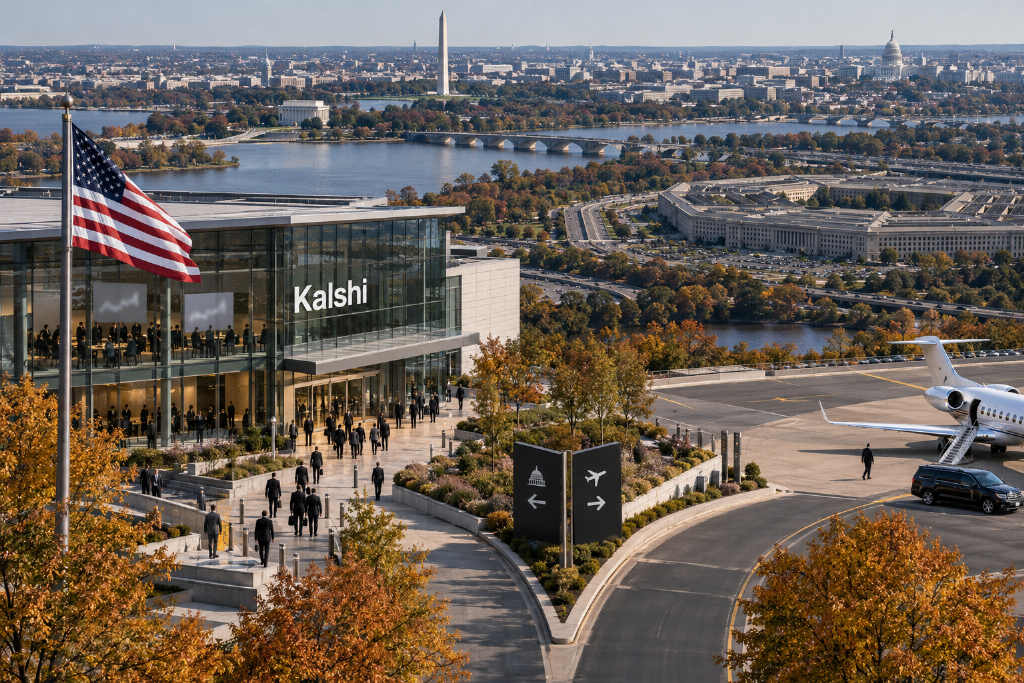
Kalshi CEO Tarek Mansour said Wednesday that the legal battle over prediction markets will determine more than who regulates the industry. He said it will decide whether the business can operate in the United States at all.
Speaking at DC Fintech Week in Arlington, Virginia, Mansour said, 「It s not a choice of state versus federal market. It s a choice of whether prediction markets exist in the U.S. or whether they go offshore.」
CFTC moves set the backdrop
Mansour’s remarks came five days after two actions by the Commodity Futures Trading Commission.
On Oct. 9, the agency proposed a rule that would expressly define event contracts tied to sports, politics, culture, and weather as swaps. It also issued an interim final rule that keeps sportsbook wagers and casino games outside that definition.
CFTC Chairman Michael S. Selig said at the time that such contracts are commodity derivatives that fall squarely within the agency’s authority under the Commodity Exchange Act and are subject to the CFTC’s exclusive jurisdiction.
Courts have split on the issue
Federal appeals courts have not reached a single view. One major ruling favored Kalshi, while two rulings favored the states.
New Jersey has petitioned the Supreme Court, and the NFL filed a brief backing the state.
Mansour said at the event that Kalshi feels 「pretty good about where we stand overall.」 He also pushed back on the idea that sports contracts do not involve real financial stakes.
「The notion that sports does not have economic consequence is ludicrous,」 he said.
Trading transparency and enforcement
Mansour also said the visibility of trading on prediction markets is both a blessing and a curse, but argued that it makes misconduct easier to detect.
「You re committing crime in broad daylight, and that makes it so much easier to kind of police that sort of activity,」 he said.
He pointed to former Rep. George Santos, saying Santos chose to insider trade on Kalshi and that the platform received 100 whistleblower complaints within minutes.
「You know, we caught it,」 Mansour said.
The Santos case
In the CFTC’s own case against Santos, the agency treated the matter as manipulation.
In a July 31 order, the CFTC found that he traded a State of the Union attendance contract, an outcome he controlled, while making misleading statements about whether he would attend.
He agreed to disgorge $17,569.98, pay a $17,500 civil penalty, and accept a three-year trading ban.
The teleprompter case
In a separate insider-trading case, the CFTC settled with Gabriel Perez, a former White House teleprompter operator, and thanked KalshiEX for its assistance.
Perez traded presidential mention contracts using speech text he saw before delivery.
He agreed to pay more than $172,000 in disgorgement and penalties and accepted a three-year ban.
Volume claims on bitcoin and ether contracts
As scrutiny has increased, both Kalshi and Polymarket have rolled out insider-trading controls.
Mansour also rejected claims posted on X that Kalshi’s bitcoin and ether perpetual-futures volume was inflated. He said the recurring trade sizes reflected fixed-size orders from market makers.
Public comments on both CFTC rules are due within 30 days of their publication in the Federal Register.