


Sanan Optoelectronics said on the night of Oct. 23 that it had been notified by family members of its ultimate controller, Lin Xiucheng, that prosecutors had approved his arrest on suspicion of occupational embezzlement and misappropriation of funds. Sanan shares closed that day at RMB 10.10, leaving the company with a market capitalization of about RMB 50.4 billion.
The announcement brought Lin back into public view. Sanan once traded at more than RMB 200 billion in market value and was widely seen as a next-generation semiconductor leader. Lin, the company’s founder, was at one point ranked as Fujian’s richest man.
From scrap steel to LED chips
Lin’s business career began in Anxi, Fujian, where he made his first money in the 1980s by buying scrap steel offcuts from mills and reselling them to factories. That trade earned him the nickname “scrap king.”
In 1992, he partnered with Sanming Iron and Steel to set up Sanan Ironworks, moving from trading into manufacturing. By 2002, Sanan Group had total assets of RMB 2.6 billion and about 6,000 employees, ranking 14th among Fujian’s top 100 enterprise groups.
The turning point came at the Shenzhen Hi-Tech Fair in 1999, where Lin first encountered LED technology. At the time, core LED chip technology was largely controlled by companies in the U.S. and Japan, and China relied heavily on imports. Lin decided to build a domestic LED chip business. Media accounts cited in the source say he traveled to the U.S. to inspect technology, hired key talent with high pay, bought production equipment and worked with EMCORE to build an R&D and industrialization center.
Sanan Electronics was established in Xiamen in November 2000. The business lost about RMB 600 million in its first three years, almost wiping out profits from the steel segment, but Lin kept investing. In 2002, Sanan developed its first epitaxial wafer. In 2003, it achieved mass production of full-color ultra-high-brightness LED chips, breaking China’s long dependence on imported LED chips.
At the same time, Sanan also moved into space-grade solar cells. More than two decades later, its gallium arsenide multi-junction solar cells have been used in commercial satellites.
Lin also stepped briefly into traditional consumer industries. He acquired a 54% stake in Anxi Tea Factory, described in the source as the country’s largest oolong tea producer, with about 70% of its premium Fengshan Tieguanyin exported overseas. Three years later, he exited the investment.
A backdoor listing and a rapid rise
In October 2007, Lin launched a larger capital operation through *ST Tianyi, a suspended listed company in Hubei whose major shareholder’s stake was being auctioned by court order. The company had previously been tied to the once-famous detergent brand “Vital 28.” Sanan Group paid RMB 16.781 million for a 45.43% stake. Including bankruptcy restructuring assets and debt assumption, the total outlay was about RMB 149 million, giving Sanan a listed shell.
In July 2008, Sanan completed the injection of LED assets from Sanan Electronics, renamed *ST Tianyi as Sanan Optoelectronics and resumed trading in Shanghai. Over the following years, the Lin family’s paper wealth increased by more than tenfold.
In November 2012, Sanan Optoelectronics said it would invest RMB 505 million in Taiwan LED chipmaker Epistar, taking about 19.9% and becoming its largest shareholder. The source describes it as the first time a mainland LED company had taken a stake in a Taiwan peer.
Speaking in Taipei, Lin said the way to raise industrial standing was first to expand economies of scale and second to improve employee pay and benefits. He said the money “must be used in Taiwan” so employees could feel happy and the company could stay competitive.
By 2017, Sanan’s MOCVD equipment base had grown from just over 10 units in 2012 to about 360 units, with a global market share of about 12%, while the company was still targeting 30%. International manufacturers including Samsung and Philips outsourced chip production to Sanan instead of expanding their own capacity. The scale-up helped push down chip prices, speed up LED adoption in lighting and displays, and turn China from an LED chip importer into the world’s largest production base.
Sanan also opened the door to domestic equipment suppliers. In 2017, it had installed Advanced Micro-Fabrication Equipment Inc. China’s Prismo A7 MOCVD tools. Then-general manager Lin Kechuang said publicly that AMEC could meet Sanan’s advanced technology requirements. As China’s largest LED chipmaker, Sanan’s adoption gave domestic MOCVD equipment a validation and volume window in a market long dominated by international players.
Local capital, subsidies and pledged shares
The formula behind Sanan’s expansion was straightforward: local governments provided land, subsidies and industrial funds, while Sanan brought projects, capacity and jobs.
Under that model, Sanan built bases in Wuhu, Quanzhou, Changsha, Ezhou and Chongqing. The Quanzhou Sanan project was planned with total investment of RMB 33.3 billion including public supporting facilities. The Hubei Mini/Micro LED project had a budget of RMB 12 billion. The Hunan silicon carbide base carried total planned investment of RMB 16 billion. In Chongqing, the silicon carbide joint venture was planned at about $3.2 billion, while Sanan separately committed about RMB 7 billion to build a supporting substrate plant.
According to incomplete media tallies cited in the source, Sanan Optoelectronics has received more than RMB 11.3 billion in government subsidies since its backdoor listing. Time Finance, also cited in the source, said state-backed capital from Hubei, Changsha and Chongqing had put more than RMB 20 billion into the broader Sanan system over the past several years.
At the same time, Lin repeatedly pledged listed-company shares to raise cash for expansion.
The source also cited public court documents in the bribery case of former Xiamen executive vice mayor Zheng Yunfeng. Those documents showed Zheng accepted money and property from Lin between 2003 and 2010 and provided assistance on matters including tax rebates and headquarters land use.
The cycle turned, and pressure spread from operations to financing
In recent years, the LED industry has swung into oversupply and intense price competition, eroding Sanan’s core business. Silicon carbide, another major bet, ran into a global capacity buildout and price war just as production lines were still ramping and depreciation costs were rising. Government subsidies also began to taper off, cutting annual support by several hundred million yuan.
That pressure showed up in the numbers. In 2025, Sanan Optoelectronics posted revenue of RMB 17.949 billion, up 11.45% year on year, but attributable net profit was a loss of RMB 353 million. It was the company’s first annual loss since the 2008 backdoor listing.
When news broke in March that Lin had been placed under lien, Sanan shares fell by the daily limit and lost 24% over five trading days. The more serious chain reaction hit the controlling shareholder level, where creditors activated risk controls, early-maturity clauses on loans were triggered and recovery actions followed.
As of Oct. 14, all 1.312 billion Sanan shares held by Sanan Electronics and Sanan Group had been judicially frozen, accounting for 26.30% of total share capital. Including waiting-list freezes, the total number of shares subject to waiting-list freezes reached 8.213 billion, equal to 625.89% of their holdings.
In June, a natural-person creditor named Lin Suzhen applied to the Xiamen Intermediate People’s Court for bankruptcy reorganization of Sanan Electronics and Sanan Group, then withdrew the application on Sept. 2. A new application was filed on Oct. 15 by Hubei Changjiang Anxin Industrial Investment Fund and Hunan Lugu Development Group.
That left a striking reversal: local industrial capital that once backed Sanan’s expansion in Hubei and Changsha is now lined up as creditor capital. Expansion financed through pledged shares is now feeding back into the question of control.
The “firewall” between founder and listed company is being tested
In July 2017, Lin stepped down as chairman of Sanan Optoelectronics and handed the role to his eldest son, Lin Zhiqiang. The company then set up what the source describes as a firewall: the founder exited all positions at the listed company, the second generation took over the board and professional managers handled day-to-day operations.
Legally, that separation exists. Lin does not hold a position at the listed company, and the announcement on the suspected crimes did not disclose which entity was involved. The source says outsiders cannot and should not directly equate the case with problems at the listed company itself.
In practice, though, Lin never fully left the Sanan system. He remained chairman and general manager of Sanan Group. The source says that when Chongqing officials met STMicroelectronics President and CEO in February 2025, “Sanan Group chairman Lin Xiucheng and his delegation” were present.
The listed company’s leadership also remains closely tied to the family. Chairman Lin Zhiqiang is Lin’s eldest son. Director and deputy general manager Lin Zhidong is his second son. Vice chairman and general manager Lin Kechuang is his son-in-law.
An internal Sanan source quoted in the article described Lin Zhiqiang as low-key like his father, casual in dress and diet, quiet in speech and rarely interacting with employees outside work.
On the ownership side, Lin still holds 59.68% of Sanan Group, and together with Lin Zhiqiang controls about 71.83%. Sanan Group in turn controls Sanan Electronics. Management was handed to the son, but control remained with the father.
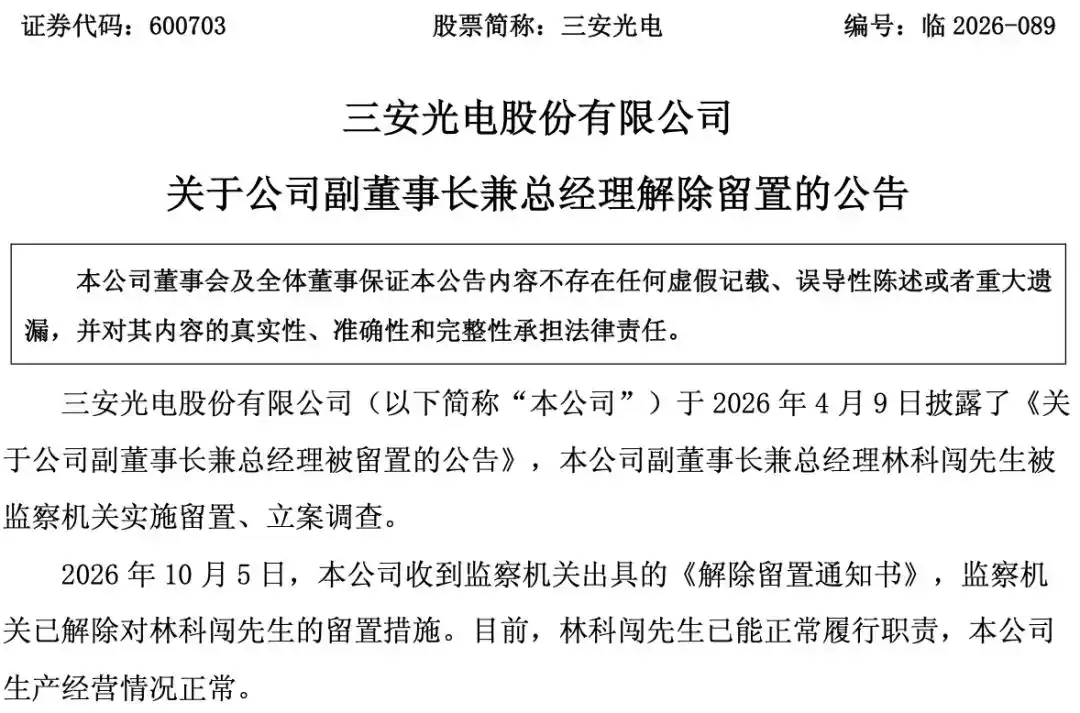
The firewall was hit once already this year. On March 30, Lin Kechuang said at a press conference that the ultimate controller’s lien was a personal matter unrelated to the company, and announced a share purchase plan together with Lin Zhiqiang. Just one week later, on April 7, Lin Kechuang himself was placed under lien and investigated by the Yuzhong District Supervisory Commission in Chongqing. The lien was lifted on Oct. 5 and he resumed duties. His share purchase commitment was completed instead by Lin Zhiqiang, who bought a cumulative 3.57 million shares for about RMB 49.86 million.
The company kept operating and delivering to customers during the six months when the general manager was absent. From an operating standpoint, the firewall withstood the first round of shock. The financial strain, however, remained visible.
First-half results, optical chips and heavy-capex pressure
In the first half of 2026, Sanan Optoelectronics reported revenue of RMB 6.468 billion, down 28.04% year on year. The company said the main reason was that revenue from precious-metal scrap recycling was no longer recognized; excluding that factor, revenue rose 8.97%.
Attributable net loss for the period was RMB 98 million, while net loss after non-recurring items was RMB 504 million. Inventory impairment alone reached RMB 329 million.
By segment, LED epitaxial chips generated RMB 3.103 billion in revenue, up 11.81%, suggesting the legacy business had stabilized through price increases and a move upmarket. Integrated circuit revenue was RMB 1.268 billion, down 15.40%, with filters and silicon carbide still the biggest drag on profit.
A newer bright spot came from AI-related optical chips. Sanan said its optical chips have established cooperation with four of the world’s top 10 optical module makers. Its 400G and 800G optical chips are shipping in volume, 1.6T products have been sent for sample verification, and the company plans to expand monthly capacity from 2,750 wafers to 4,500 wafers. The Chongqing silicon carbide joint venture announced in March that it had entered mass production.
Heavy-asset expansion is still weighing on the group. The Hunan Sanan silicon carbide project had a budget of RMB 16 billion, but cumulative investment had already reached RMB 21.163 billion by the end of June, more than 30% above budget. The Hubei Mini/Micro display project has been delayed by two years. The Chongqing substrate project had a budget of RMB 7 billion, but only RMB 1.159 billion had been invested so far.
Three questions now hang over Sanan
After Lin’s formal arrest, Sanan Optoelectronics faces at least three immediate questions.
- First, what happens to the frozen 26.30% stake. If a court accepts the reorganization case, new investors could enter at the controlling-shareholder level, and control of the listed company could change hands. Who comes in, at what price and with what resources will shape the next phase of the platform.
- Second, how the controlling shareholder’s debt will be resolved. Media estimates cited in the source put publicly disclosed rigid debt across Sanan Electronics and Sanan Group at roughly RMB 12 billion to RMB 15 billion. Until that is clarified, the listed company’s financing capacity, bank credit lines and funding arrangements for major projects may continue to trade with an “associated risk” discount.
- Third, whether the second generation can prove governance is truly independent. Legal separation is not the same as credit separation. Suppliers, customers, banks and local governments will look not only at formal corporate titles, but also at whether the company can still win orders, secure funding and deliver products without the founder’s relationship network.
The source’s conclusion is blunt: the real test is not how many times the company says the matter is “unrelated to the company,” but whether Sanan can keep earning money on its own without Lin Xiucheng at the center.
Lin was willing to make large bets in an unfamiliar industry and, in the source’s telling, was adept at using local resources and capital leverage to keep increasing the size of those bets. That approach helped turn Sanan into an important platform in China’s compound semiconductor industry and helped shift China from an LED chip importer to the world’s largest production base.
It also built a balance sheet loaded with risk. The same leverage that accelerated expansion is now pressing on ownership, debt and the founder’s own future.