
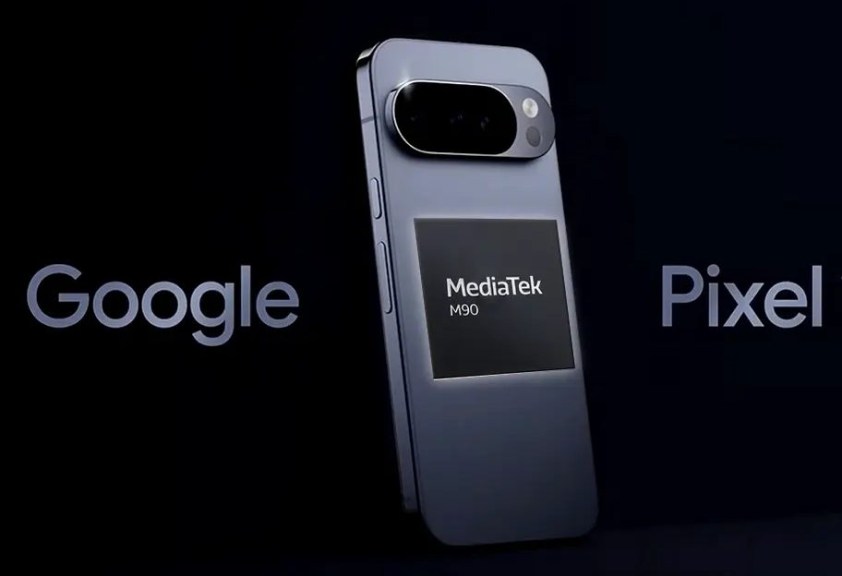
MediaTek has reportedly entered Google’s supply chain for the Pixel 11, a smartphone series expected in 2026, and will supply 5G modem chips for all four models, according to Digitimes, citing sources. The move would make Pixel 11 the first Google Pixel lineup to part ways with Samsung on modem chips.
Pixel’s modem strategy is said to be changing with Pixel 11
Since Google introduced its in-house Tensor mobile SoC, every generation of Pixel flagship phones has used Samsung Electronics’ Exynos modem chips. Even Tensor G5, launched in 2025 and manufactured by Taiwan Semiconductor Manufacturing Co. (TSMC), was still paired with a Samsung modem solution, the report said.
That would make Pixel 11 the first Google smartphone to fully move away from Samsung at the modem layer, ending a long-standing arrangement in that part of the hardware stack.
MediaTek reportedly beat both Samsung and Qualcomm
The report said MediaTek came out ahead of Samsung and Qualcomm in Google’s technical review for the modem slot. Its strengths were described as a well-balanced mix of signal stability, cost control, and power efficiency. Outside of millimeter wave, or mmWave, specifications, MediaTek was also said to have capabilities that can compete with Qualcomm.
The order itself stands out because it covers all four Pixel 11 models. The report contrasted that with past situations in which MediaTek would more often land only a specific sub-model or an entry-level version, rather than an entire flagship family. In that reading, Google’s decision amounts to a broader endorsement of MediaTek’s 5G modem technology.
The timing matters for MediaTek’s handset business
Digitimes placed the Pixel 11 win against a tougher backdrop for MediaTek’s smartphone chip segment. Higher DRAM prices and rising component costs have pushed Chinese smartphone brands, excluding Huawei, to lower shipment targets for the year. As a major chip supplier, MediaTek has been directly affected. The report said its annual smartphone chip shipment forecast has already been revised down twice this year, while supply-chain orders for the third and fourth quarters have continued to weaken.
Against that backdrop, MediaTek has been working to upgrade its customer mix. The report said the company entered the Apple Watch supply chain for the first time in 2025, marking its first modem foothold with a top U.S. brand. The Pixel 11 design win was described as another sign that MediaTek’s 5G modem business can move beyond its own SoC platform and compete as a standalone component in the flagship smartphone segment.
In the report’s framing, that creates a second overseas growth line separate from AI ASIC.
TSMC capacity remains a constraint
The report also said tight capacity for TSMC’s advanced process technologies is affecting both of MediaTek’s expansion tracks: AI ASIC volume growth and modem sales to external customers. Tensor G5 has already shifted to TSMC manufacturing, and the 5G modem that MediaTek is expected to supply for Pixel 11 also depends on TSMC capacity.
With major customers such as Nvidia continuing to account for more than half of CoWoS advanced packaging capacity, the report said one key variable for the second half will be whether MediaTek can secure enough wafer allocation for both ASIC and modem products at the same time.
Attention turns to Apple and other device categories
After Google, the next question is how far MediaTek can expand into Apple’s product lineup. The report noted that Apple is currently developing its own wireless transmission chips, a factor that could limit MediaTek’s room to grow there.
Industry views cited in the report said winning a place in any iPhone model would count as a major breakthrough, while entry into iPad would also be seen as positive progress. Over a longer horizon, IC design industry peers said MediaTek’s 5G modem may also have room to extend into automotive applications, PCs, and AI glasses.