
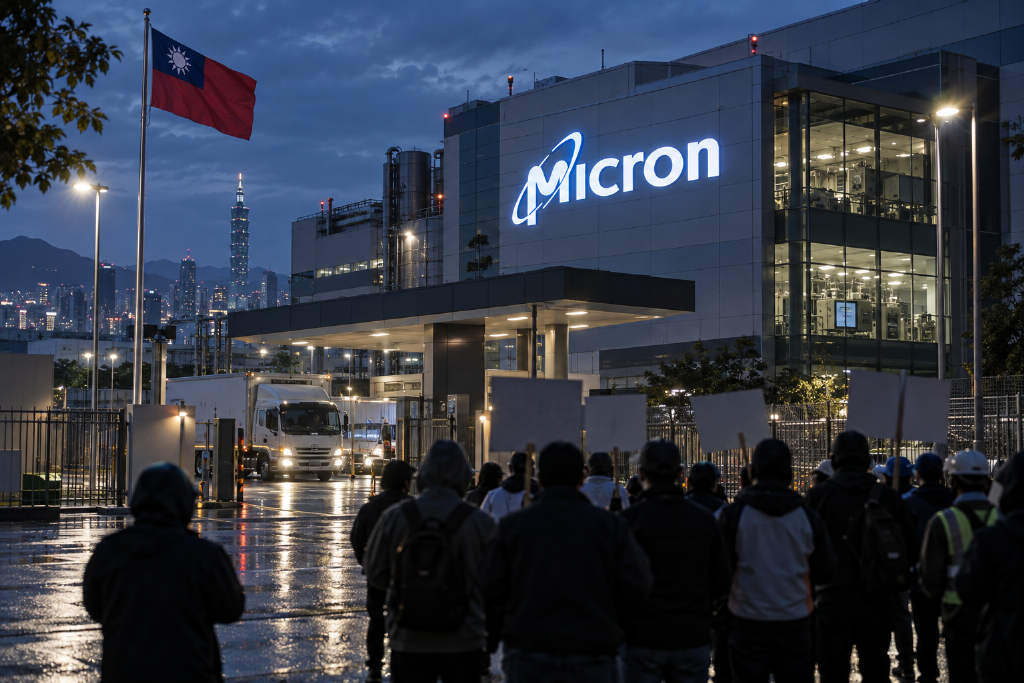
Micron’s wafer fab union branch in Taoyuan, Taiwan, has formally obtained the right to strike after a vote announced on Oct. 7. According to a CNA report cited in the source article, 2,258 members were eligible to vote and 2,012 cast ballots, putting turnout at 89.1%. The count showed 1,994 votes in favor, 14 against, and 4 invalid ballots. Approval reached 99% of votes cast.
A report by Commonwealth Magazine in late September said the strike vote marked a first for Taiwan’s semiconductor industry.
Union seeks 15% operating profit-sharing plan
The union’s central demand is a system that would allocate 15% of operating profit as profit sharing, replacing the current one-time bonus decided by the company. The union said such a structure would make employee compensation more transparent, tie pay to company profitability, and bring Micron in line with peers including Samsung and SK Hynix.
It also said the demand is based on industry standards and does not mean the company should keep paying when it is operating at a loss.
Micron had already responded to the compensation dispute. According to an Economic Daily News report on Sept. 1, the company said it would issue what it called the highest performance bonus in its history, with details expected in October, and would keep talking with employees through existing channels.
The union said that if Micron’s board meeting on Oct. 8 and Oct. 9 does not produce a concrete result, it will notify employees of follow-up action by text message. It also encouraged employees to take leave on Oct. 19 and go to Ketagalan Boulevard to voice their demands.
Labor ministry urges a workable proposal
Taiwan’s Ministry of Labor said it respects the voting result and sees it as reflecting employees’ expectations for a reasonable profit-sharing system. The ministry called on the company to carefully consider employee views and put forward a concrete and workable proposal for talks with the union.
The ministry also said a strike is the last resort for workers seeking to protect their rights. It added that it will coordinate with the Taoyuan City Government and the Central Taiwan Science Park Bureau to help move both sides toward further negotiations.
Micron said it respects employees’ legal rights and due process, and that it takes employee concerns seriously. The company said it will continue to communicate with employees and unions in good faith. It added that it will proceed under existing dialogue and mediation procedures, continue mediation with the Taichung union, and keep communicating with the Taoyuan union in search of a constructive solution acceptable to all sides.
DRAM production could be affected if process monitoring is disrupted
Micron’s Taoyuan plant mainly produces DRAM. TrendForce analyst Wang Yu-chi said that if a strike takes place and affects engineers’ equipment maintenance and process monitoring, production yield and stability could decline and output could be affected. If the strike lasts longer, the supply-side impact could widen. She added that the actual effect would still depend on the scale of the strike, its duration, and the company’s response.
Memory module makers Apacer and Transcend said their share of DRAM procurement from Micron is not high and that current supply remains normal.
The labor dispute comes at a time when memory supply is tight. Micron had previously said that its 2027 HBM supply was almost entirely sold out, a point that Chain News had also reported earlier. The union’s next move now depends on whether Micron’s board presents a concrete proposal this week.