


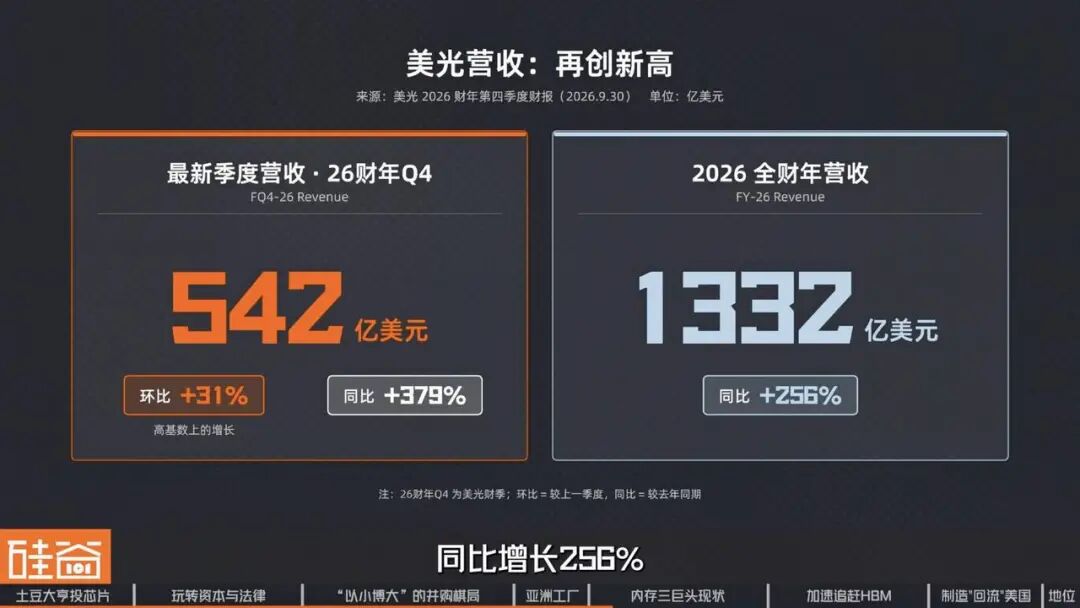
On Sept. 30, Micron Technology reported another record quarter. In fiscal 2026 fourth quarter, the company posted $54.23 billion in revenue and an operating margin of 80.7%, setting new highs for both revenue and net profit as AI demand drove one of the most profitable periods in the company’s history.
Those numbers tell only the latest chapter. Over nearly five decades, Micron survived repeated memory downturns that pushed many former industry leaders out of the market. What emerged was a company with an unusual operating model: it relied on U.S. capital markets and legal tools while steadily moving most of its manufacturing base into Asia. Now the U.S. government is offering billions of dollars in support in an effort to pull advanced memory production back home.
The company’s starting point was far from Silicon Valley. Micron began in Boise, Idaho, in the basement of a dental office. Its path into memory manufacturing was helped by J.R. Simplot, the businessman whose company became McDonald’s largest supplier of frozen French fries.
From Mostek alumni to a basement startup
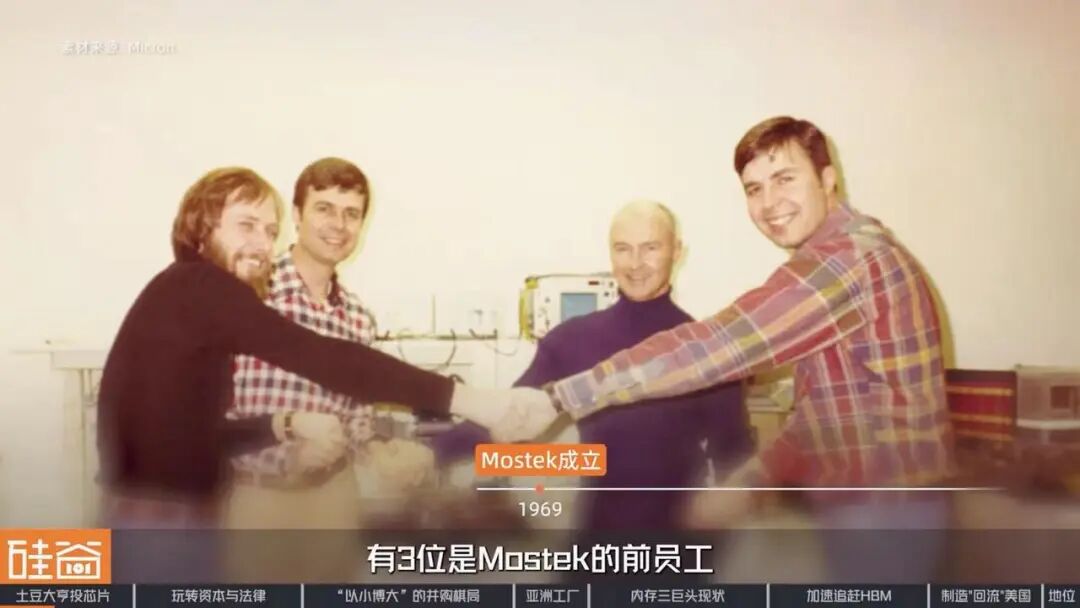
Micron did not appear out of nowhere. Its roots trace back to Mostek, a company founded in 1969 by people from Texas Instruments. In the era of 4K and 16K DRAM, Mostek held a significant share of the market and was an important early player in memory. Three of Micron’s four founders had worked there.
Micron was founded in 1978 in the basement of a dentist’s office in Boise. At the time, it had no manufacturing business. Its entire operation consisted of semiconductor design consulting for Mostek.
Unlike the venture-backed path associated with later Silicon Valley startups, Micron initially raised money from local business figures in Idaho. The article compares that approach to early Starbucks: a handful of successful local investors decided to back a small team they liked.
That model broke down quickly. In 1979, after Mostek was acquired by United Technologies, Micron lost its contract and with it its only source of revenue.
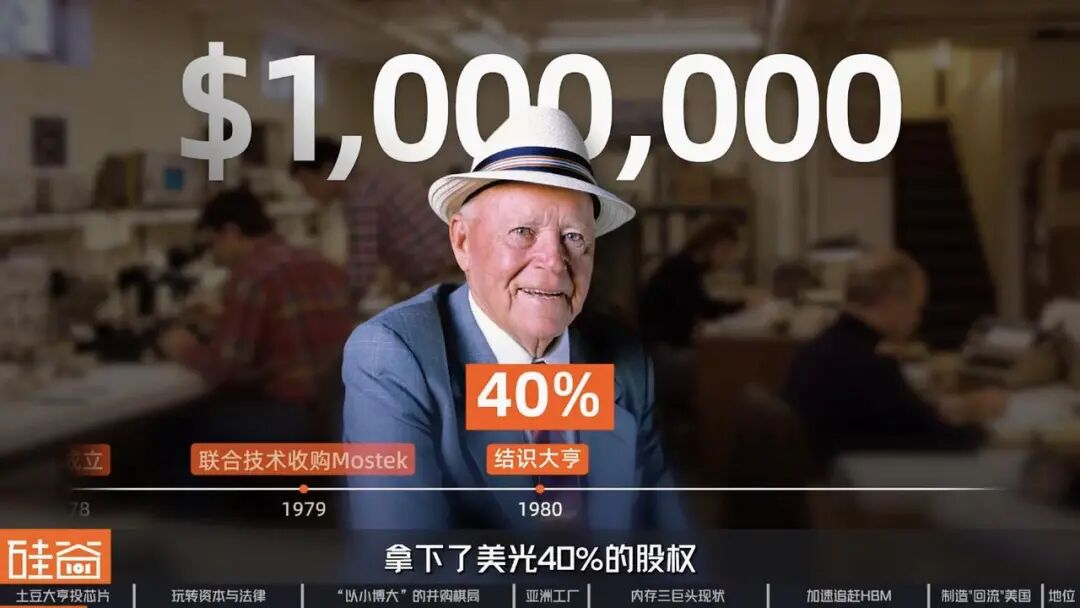
With its sole customer gone, Micron decided to make chips itself. Building a fab required more money, and through local contacts the founders met J.R. Simplot. In 1980, after visiting Micron’s basement office, Simplot invested $1 million for a 40% stake in the company.
Simplot was already in his 70s and had built a fortune in potatoes. His company was McDonald’s largest supplier of frozen fries. The article says the $1 million was nowhere near enough to build a fab, but it gave Micron something just as important: credibility. With Simplot’s backing, Micron secured bank loans and raised more money from other Idaho businesspeople.
At the time, a DRAM fab could cost more than $100 million. Micron cut costs aggressively. It adapted a supermarket building plan for its factory, expanded what had been meat refrigeration space into a clean room, and bought large amounts of second-hand equipment discarded by other manufacturers. The result was a 50,000-square-foot wafer fab completed in 1981 for about $7 million.
That same year, Micron began producing 64K DRAM and became a real semiconductor manufacturer rather than a design shop. The timing mattered. IBM PC entered the market in 1981, and the rise of personal computers quickly lifted demand for DRAM. Micron broke in with a smaller, more advanced 64K DRAM design and relatively low manufacturing costs.
Just three years later, on June 1, 1984, Micron went public on Nasdaq. Adjusted for stock splits, its opening price on the first trading day was about $1.35.
Why Micron survived when other U.S. memory players left
In the early years, memory was largely an American business. Intel’s first mass-produced product was a memory chip, and companies including IBM, Texas Instruments, AMD, Motorola, and National Semiconductor all had memory operations.
That changed in the 1980s, when competition in memory shifted into a different model. The article argues that state support became a decisive force. Some countries backed selected companies with policy support across R&D, funding, and talent, allowing them to keep spending through downturns even when profits disappeared. The goal was not short-term returns. It was survival at the expense of rivals.
Japanese companies used that model to displace U.S. firms, and South Korean companies later used a similar playbook against Japan. In the end, nearly every U.S. semiconductor company exited memory. Micron was the one that remained.

Yang Yige, head of the technology group at Sunshine Insurance Asset Management’s securities research department, said memory resembles foundry manufacturing in one crucial way: it is highly capital intensive. Companies need large-scale capacity and heavy capital spending to keep fabs running. In downcycles, current profits often cannot cover depreciation on those assets, and many companies fail at that stage. She added that the most important technical barriers remain concentrated in the U.S. and Europe, while some upstream materials and components are concentrated in Japan, and Taiwan and South Korea benefited from lower manufacturing costs and early government support.
The article’s answer is that Micron developed what it calls a dual character, combining American and East Asian strengths.
Micron’s American side: capital markets and legal leverage
Micron’s first advantage came from being an American company. The article says that identity gave it access to deep capital markets and flexible financial tools, which it used to expand cheaply during industry downturns.
An early example came in 1998, when Micron bought Texas Instruments’ memory business. On paper, it looked like a deal worth more than $800 million. In practice, Micron paid no cash. It used more than $800 million in newly issued stock and $950 million in corporate bonds.
The structure went even further. Texas Instruments did not just accept a non-cash deal. It also provided $750 million in financing to help convert the acquired fabs to Micron’s process technology. In a cyclical low for memory, TI wanted out of a deeply unprofitable business. Micron acquired the entire operation without spending cash and also secured broad patent cross-licensing.
The company’s American side also showed up in law. Beginning in the 1980s, Micron repeatedly turned U.S. trade and legal systems into competitive tools.
In 1985, when Japanese manufacturers were overwhelming U.S. DRAM producers, Micron filed an anti-dumping complaint with the U.S. government. That helped trigger an investigation into Japanese DRAM and contributed to the 1986 U.S.-Japan Semiconductor Trade Agreement.
In the 1990s, as South Korean producers rose, Micron pushed for anti-dumping action again. In 2002, after its attempt to acquire Hynix failed, Micron also pushed for an investigation into Korean DRAM subsidies, which eventually led to high countervailing duties on Hynix.
The article describes Micron’s most famous legal move as the DRAM price-fixing case. In 2002, when the U.S. Department of Justice investigated multiple DRAM makers for colluding on prices, Micron was the first company involved to report the conduct and seek leniency. It provided key evidence on how the cartel operated and continued to cooperate with investigators. Samsung, Hynix, Infineon, and Elpida were later hit with major fines, while Micron avoided criminal prosecution and paid no fine.
Still, access to capital markets and legal systems was not unique to Micron. The article says the difference was strategic focus. Other U.S. companies had more profitable core businesses to fall back on. Yang said IBM, Texas Instruments, and Intel all had other businesses they could prioritize. TI could focus on analog chips, Intel on CPUs, and IBM on computer manufacturing. When the industry consolidated, they sold or shut memory operations.
Micron had no such option. It was focused on memory from the start. The worse the cycle became, the fewer alternatives it had, and the more it had to survive. Crises that pushed larger U.S. rivals out became opportunities for Micron to expand.
Micron’s East Asian side: Inotera, Elpida, and Rexchip
From 2008 onward, Micron completed a series of deals that helped shape today’s three-player memory market. During that period, while keeping its U.S. corporate identity, it became increasingly East Asian in manufacturing.
One key transaction involved Qimonda and Inotera. Qimonda had been spun out of Germany’s Infineon as a dedicated memory company. After the 2008 financial crisis, collapsing memory prices left it under severe cash pressure. Inotera, a DRAM manufacturer formed by Taiwan’s Nanya Technology and Infineon, had also become tied to Qimonda after the spinout. In 2008, Qimonda held about 35% of Inotera.
Micron agreed to buy that entire stake for about $400 million in cash. But the financing was structured in a way that sharply reduced Micron’s own outlay. Inotera itself lent Micron $85 million, and Nanya Plastics, the parent of Nanya Technology, lent Micron another $200 million. Micron’s own cash contribution was only about $113 million.
For that amount, Micron obtained roughly 35% of Inotera, about 50% of its capacity allocation, and the right to transfer Micron process technology into the fabs.
In August 2009, Inotera issued about $310 million in stock to fund the conversion of its fabs to Micron’s process. By then the share price had recovered, allowing Micron to record tens of millions of dollars in accounting gains.
Micron completed the takeover in December 2015, buying the remaining Inotera shares for about $4.1 billion. Of that amount, about $2.5 billion came from local bank loans secured by Inotera’s fab buildings, land, and some equipment. About $1 billion came from newly issued Micron stock sold to Nanya Technology. By the article’s calculation, Micron used only $600 million of its own cash to acquire the rest. After the deal, Inotera was renamed Micron Technology Taiwan, or MTTW.
The next major deal came in 2012, when Elpida Memory, described in the article as Japan’s national memory champion, filed for bankruptcy protection in what became the largest manufacturing bankruptcy in Japanese history. Micron moved in again, agreeing to acquire 100% of Elpida for 200 billion yen, or about $2.5 billion at the exchange rate at the time.
Micron did not pay that amount upfront. At signing, it put down only 60 billion yen in cash, about $750 million. The remaining 140 billion yen, roughly $1.75 billion, was scheduled to be paid over six years after closing: 20 billion yen per year from 2014 through 2017, then 30 billion yen per year in 2018 and 2019.
The payment structure was even more favorable than it first appeared. After becoming a wholly owned Micron subsidiary, Elpida continued producing DRAM. Micron paid Elpida wafer manufacturing fees, R&D service fees, and management service fees in U.S. dollars, and Elpida used the cash flow from continued operations to pay creditors in yen.
Exchange rates also worked in Micron’s favor. The deal was reached in July 2012, but closing did not occur until August 2013. During that period, the yen weakened from about 80 to the dollar to about 98 to the dollar. As a result, the 60 billion yen cash payment fell in dollar terms from about $750 million to about $615 million by closing. The yen weakened further during the six years of installment payments, reducing Micron’s effective dollar cost well below the nominal $2.5 billion.
The Elpida deal also gave Micron control of Rexchip in Taiwan. At the time of bankruptcy, Elpida held about 65% of Rexchip, a DRAM manufacturing joint venture with Powerchip Technology and a major production base for Elpida.
After acquiring Elpida, Micron inherited that 65% stake and separately agreed with Powerchip and related parties to buy another 24% of Rexchip for about NT$10 billion, or roughly $334 million. The article notes that this was one of the rare cases where Micron paid cash directly. When the transaction closed in 2013, Micron held about 89% of Rexchip. In 2014, it bought another 9.9% from Kingston for about $146 million, lifting its stake to more than 99%. Rexchip later became Micron Memory Taiwan, or MMT.
Yang said Elpida was under heavy debt pressure at the time of bankruptcy and had long struggled with low yields and slow capacity ramp. For the Japanese government and creditor banks, only a large buyer could keep operations running and absorb most employees and liabilities. For Micron, the acquisition brought technology, capacity, and staff. She described it as buying a call option on a future oligopoly at a very low point in the cycle.
The article argues that the Elpida and Rexchip acquisitions were the most important in Micron’s history and the foundation of its current scale. By taking over Elpida’s Hiroshima DRAM fab, Akita packaging and testing plant, and Rexchip’s Taichung DRAM fab, Micron moved from fourth place globally to second, behind only Samsung.
Strategically, the deal also filled a product gap. Micron had been stronger in PC and server DRAM, while Elpida had strengths in mobile, tablet, and low-power DRAM. That helped Micron build out its mobile lineup and later become a DRAM supplier to Apple.
The article adds that Micron did not win every battle. It came close to acquiring Hynix, but its terms were so demanding that Hynix’s board unanimously rejected the deal even though creditor banks had agreed. Hynix survived another decade, was eventually acquired by SK Group, and later became one of the biggest winners of the AI era through its HBM bet.
A company American in politics, East Asian in operations
After those acquisitions, the article says it no longer makes sense to view Micron simply as a U.S. company. In wafer manufacturing, it can almost be seen as an East Asian company.
At present, Micron has only one factory in the U.S., in Manassas, Virginia, and that site accounts for about 2% of global memory supply. Most of the rest of its capacity is in Asia. The core manufacturing and support base for advanced DRAM and HBM is concentrated in Taoyuan, Taichung, Tongluo in Miaoli, and Tainan.
Taoyuan is one of Micron’s earliest DRAM bases, centered on Fab 11. A new Fab 11E will introduce EUV and is planned to begin production in 2028.
Taichung is the largest site. It handles advanced DRAM wafer manufacturing and is also a major HBM packaging and testing hub. The area already has two advanced packaging plants, with the second entering service in October 2026.
Tongluo in Miaoli is the newest DRAM expansion base. In 2026, Micron bought Powerchip’s P5 fab for $1.8 billion and is building a second wafer fab there.
Tainan serves as a wafer testing base. It was converted from an old AUO facility and supports DRAM expansion in Taoyuan and Taichung. The first batch of equipment moved in during September 2026.
In Japan, Hiroshima Fab 15 is the core site for advanced DRAM wafer manufacturing. That fab came from Micron’s 2013 Elpida acquisition and is being upgraded to support future DRAM nodes and AI memory production.
Singapore is Micron’s most important NAND manufacturing base, accounting for about 98% of its NAND output. As AI demand lifts memory consumption, Micron is expanding there on two fronts: a new NAND wafer fab costing about $24 billion began construction in early 2026 and is planned to start production in the second half of 2028, while a roughly $7 billion HBM advanced packaging plant is also under construction and is expected to contribute HBM capacity from 2027.
Yang summarized Micron as “an American company politically and an East Asian company operationally.” She said no manufacturer has much of an advantage building fabs in the U.S. She pointed to TSMC’s U.S. expansion, saying gross margin could be diluted by 2 to 3 percentage points and that ramping production and managing labor conditions in the U.S. are difficult. In her view, the same applies to Micron, except that Micron also carries strategic political value as an American company.
That helps explain how Micron, despite the well-known problems of U.S. manufacturing, managed to stay competitive in a sector that depends heavily on efficiency and engineering talent. Most of its production was not in the U.S. to begin with.
Current position: smallest of the three, but recently the fastest-growing
By scale, the global memory industry now has three true giants: Samsung, SK hynix, and Micron. By revenue and capacity, Micron is the smallest of the three.
Using financial data for the second quarter of 2026, SK hynix generated about $55 billion in revenue, Micron about $41.46 billion, and Samsung’s semiconductor division about $87.7 billion.
The capacity gap is wider. SemiAnalysis estimates that by the end of 2026, Samsung’s DRAM monthly capacity will be about 720,000 wafers, SK hynix about 595,000, and Micron about 385,000. In HBM, the gap is even more visible. By the end of 2025, SK hynix and Samsung were each at roughly 160,000 to 170,000 wafers per month, while Micron was at about 60,000, around one-third of the other two.
Yet over the past several quarters, Micron has been the fastest grower and the strongest profit generator among the three. Its latest quarterly report showed revenue of $54.2 billion, up another 31% on top of a high base. Full-year fiscal 2026 revenue reached $133.2 billion, up 256% year over year. Operating margin rose from about 25% at the start of 2025 to above 80%, and in the second quarter of 2026 it moved ahead of SK hynix to rank first among the three.
The article ties that performance to business mix. Samsung has a more complicated structure, including foundry and chip design businesses with lower margins. Micron and SK hynix are more comparable. Both are built mainly around DRAM and NAND, with DRAM accounting for close to 80% and NAND around 20%.
Within DRAM, there are two lines: conventional DRAM, including DDR5 for servers and LPDDR for phones and tablets, and HBM. That split is where the biggest difference lies.

SK hynix made an early and aggressive HBM bet. In 2013, it launched HBM1 with AMD and kept moving forward generation by generation, shifting more and more DRAM capacity into HBM. Today, about 30% of its DRAM capacity is used for HBM, and that share is expected to approach 40% by 2027. The payoff is a roughly 60% share of the global HBM market.
Micron started much later. It did not launch its first HBM product until 2020, by which time SK hynix and Samsung had already shipped HBM and HBM2. As a result, HBM accounts for only about 20% of Micron’s DRAM revenue, while at SK hynix HBM makes up nearly half of DRAM revenue.
In this cycle, conventional DRAM has risen faster than HBM
The article says the most important and least intuitive change in this cycle is that conventional DRAM, not HBM, has seen the sharpest price increases.
As all three major suppliers shifted capacity toward higher-margin HBM, supply of general-purpose memory for servers, PCs, and smartphones tightened sharply. That pushed prices much higher. Data cited in the article shows conventional DRAM contract prices rose more than 90% quarter over quarter in the first quarter of 2026 and kept rising in the second quarter.
HBM behaved differently. Because leading suppliers had already signed long-term agreements with major customers, prices were effectively locked in earlier. Yang said HBM contracts differ from traditional DRAM and NAND contracts. Conventional memory may also be sold under long-term agreements, but those are usually repriced every quarter or half year and tend to follow the market, locking in volume rather than price. HBM, by contrast, was built for AI from the start and is usually priced once a year, often around year-end.
That means this year’s HBM pricing was set last year, before the broader memory market began to surge.
The result is a reversal. SK hynix sells the most HBM, but its pricing is constrained by long-term contracts. As it allocates more capacity to HBM, it leaves less room for conventional DRAM. Micron is in the opposite position. In the past, its lower HBM exposure was seen as a weakness. In this cycle, because conventional DRAM has risen faster than HBM, Micron’s larger exposure to general-purpose DRAM has allowed it to capture more of the upside.
Micron now reports revenue across four segments: cloud memory, core data center, mobile and client, and automotive and embedded. In the latest quarter, those segments generated $16.28 billion, $18 billion, $13.11 billion, and $6.82 billion, respectively. Data center-related businesses remain the largest, but mobile, client, automotive, and embedded together still contributed about 37% of revenue.
The article highlights automotive and industrial memory as a stabilizing base. Those businesses may not grow as fast as HBM, but they benefit from long customer relationships, certification barriers, and sticky demand.
Rob Li, managing partner at New York-based Amont Partners, said the market viewed SK hynix’s operating income as below expectations when it released earnings, and the stock fell by more than 10% that day. One core reason, he said, was the high share of HBM in its business. In the past that was a positive because HBM is the highest-end product. But from the fourth quarter of last year through the first half of this year, ordinary memory prices also rose sharply, while HBM consumes more wafers and carries higher costs. During this phase, that meant lower gross margin than conventional memory. In other words, under fixed capacity conditions, allocating more resources to HBM became a drag on overall margin rather than a boost.
The article adds one caveat: the margin advantage of conventional memory is likely temporary. HBM remains the key to long-term competition.
HBM becomes the strategic battleground
HBM is increasingly the variable that could make the memory business less cyclical. Traditional DRAM and NAND are highly standardized and behave more like commodities, with prices and profits swinging sharply with supply and demand. HBM is different. It requires deep co-design with specific customer chips, custom qualification, and different stacking and base-die approaches by supplier. It is closer to a customized product than a commodity.
As AI compute demand grows, HBM brings not only higher pricing and margins but also stronger order visibility and bargaining power. The article says that when the market talks about a “re-rating” of memory, the focus is not just on recent price increases. It is on the way HBM may change the profit model of a highly cyclical industry and smooth those cycles.
Yang said that if memory were still priced the old way, with quarterly repricing tied closely to market conditions, then a higher share of conventional DRAM and NAND would mean greater cyclical risk. Only when products such as HBM, with long-term agreements and strong demand, take a larger share can profitability become more stable.

Micron understands that it cannot fall behind in HBM. In fact, it recognized the importance of stacked memory early, but backed the wrong standard.
In 2011, Micron worked with Samsung and IBM on HMC, or Hybrid Memory Cube, a stacked memory technology introduced even before SK hynix’s HBM push. HMC stacked multiple DRAM dies together with a separate logic die and placed the memory controller inside the stack, using TSV technology to build a three-dimensional cube.
HMC had technical strengths and was used in supercomputers and network processors, but compared with HBM it consumed more power for the same data transfer and was difficult to pair with already power-hungry GPUs. Nvidia and AMD did not adopt it.
In May 2017, former SanDisk co-founder Sanjay Mehrotra became Micron’s CEO. He decided to stop pushing HMC and shift to HBM, which had already become the industry standard. The article describes that as one of Micron’s most important strategic corrections in recent years.
Even then, Micron was already two generations behind in HBM. After launching its first HBM product in 2020, development still moved slowly. In June 2022, SK hynix became the first company to mass-produce HBM3 and the first to enter Nvidia’s H100 supply chain with that product. Micron had no comparable breakthrough at the time.
The turning point came when Micron chose to skip an entire generation of HBM3 and put its resources into HBM3E instead. That bet worked.
In February 2024, Micron announced mass production of 24GB HBM3E and entered Nvidia’s H200 supply chain. Shipments began with H200 in the second quarter of that year. Micron then introduced higher-capacity 12-Hi HBM3E and pushed on toward HBM4.
By the HBM4 generation, Micron had staged a visible comeback. In the first quarter of 2026, one quarter ahead of its original schedule, it began mass production of 36GB 12-high HBM4 with bandwidth above 2.8TB per second, pin speed above 11Gbps, and power consumption more than 20% lower than its previous generation.
In June that year, Nvidia CEO Jensen Huang publicly confirmed that SK hynix, Samsung, and Micron had all passed HBM4 qualification and entered mass production for the next-generation Vera Rubin platform. It was the first time in HBM history that a new generation launched with all three major suppliers in production from the start. At that point, Micron had finally shed the label of latecomer and returned to direct generational competition with Samsung and SK hynix.
But being able to make HBM and being able to make enough of it are different things. Supply chain analysts cited in the article estimate that for Vera Rubin, SK hynix will take 60% to 70% of orders, Samsung 20% to 30%, and Micron only the remainder. By revenue share, Micron holds about 20% of the HBM market, still well behind SK hynix.
Rob Li said that at this stage, suppliers’ pin speeds are all within spec. From Micron’s perspective, he said, the company does not have a strong incentive to chase share at any cost because it has the smallest capacity of the three. Micron has repeatedly said it would be satisfied if its HBM market share roughly matched its share of DRAM capacity. From Nvidia’s perspective as a customer, all three suppliers will be used, and the priority is reliable supply.
That leaves Micron with a clear challenge. Beyond keeping up technically, it still has to fight for share in a market where SK hynix has both a first-mover advantage and several times more capacity. The next battleground is HBM4E.
Micron plans to introduce EUV lithography into HBM4E mass production for the first time. Yang does not see that as a shortcut to leapfrogging rivals. As process pressure rises, she said, it becomes difficult not to use EUV. Memory remains an industry where technology matters, but scale in manufacturing still decides outcomes. Once everyone uses EUV, the technology generation is simply leveled. In HBM, packaging capability still matters, especially how stably and effectively stacks can be built. In her view, SK hynix remains ahead, while Samsung and Micron are closer to each other.
Washington tries to bring Micron back
The timing of Micron’s HBM acceleration overlaps with a broader U.S. push to rebuild chip manufacturing. That has changed the company’s role.

In the past, Micron was simply another American chipmaker. In the AI era, HBM has become one of the most important pieces of infrastructure for AI chip performance, and among companies capable of producing advanced HBM at scale, Micron is the only American one. If the U.S. wants control over a full AI hardware chain spanning GPUs, advanced packaging, and HBM, it cannot rely only on chip designers such as Nvidia and AMD. It also has to keep Micron strong.
That is where the CHIPS and Science Act enters the story. Passed in 2022, it put advanced semiconductor manufacturing at the center of U.S. industrial policy. As the only major U.S. memory champion, Micron became one of the most important targets for support. The package includes direct subsidies, loans, tax incentives, and state-level support for land and infrastructure.
Micron’s response has been a large domestic buildout. According to data on the company’s website, it plans to invest more than $250 billion in the U.S. by 2035.
The spending is concentrated in three locations.
- First is Boise, Idaho, Micron’s home base. In 2022, the company announced an investment of about $25 billion to build an advanced DRAM fab next to its headquarters, the first new advanced memory fab built in the U.S. in decades. In 2025, Micron said it would add a second fab there. Together with Micron’s existing Idaho R&D center, the site is expected to support advanced product development and manufacturing, including HBM.
- Second is Clay, New York. There, Micron plans over more than 20 years to build a massive campus of up to four advanced DRAM fabs, with total investment potentially reaching $100 billion. Construction on the first New York fab began in 2026.
- Third is the older Manassas, Virginia, facility, which is being expanded and upgraded. It is not aimed at the most advanced nodes. Instead, it is intended to bring mature 1α DRAM production back to the U.S. for automotive, defense, and industrial markets.
Taken together, the plan is to rebuild advanced DRAM manufacturing in the U.S.: Boise as the center for R&D and leading-edge DRAM and HBM-related capabilities, Clay as the future largest advanced DRAM production base, and Manassas as the mature-node site serving long-cycle markets.
Micron has said it plans to place about 40% of its DRAM capacity in the U.S. If that happens, the U.S. share of global advanced memory manufacturing would rise from less than 2% today to about 10%.
But the article stresses that this is a decade-long effort. The fastest-moving project, the first phase in Boise, is not expected to begin production until around 2027. The much larger New York campus stretches into the 2030s and beyond.
Practical obstacles are already visible. The New York project has faced pressure from labor shortages and long construction timelines. Micron has had to shift capital between states and prioritize projects that can ship sooner.
Rob Li said investors should pay attention to what Micron’s CEO did not specify when discussing the goal of putting 40% of capacity in the U.S.: there was no timeline. He said the company has not said whether that means next year, three years, ten years, or twenty years from now. Based on current information, he said, meaningful U.S. capacity expansion appears to be a story for around 2030, and even over the following decade the scale that actually lands may remain limited.
From supplier to strategic asset
The article closes with a recent clash between Apple and Micron. As memory prices surged, Apple raised prices on some products and blamed Micron for part of the cost pressure. Seeking cheaper supply, Apple asked the U.S. government to support broader access to Chinese memory chips.
Micron did not stay quiet. It publicly pushed back and then lobbied the U.S. government in the opposite direction, trying to block that plan. The significance, the article argues, is not simply who won that dispute. It is that Micron’s position has changed.
In the past, downstream giants such as Apple usually held the stronger negotiating position. Suppliers had to adapt to Apple’s demands on cost and supply. In the AI era, with memory becoming one of the scarcest resources in computing infrastructure, Micron has gained a different kind of leverage.
It started in the basement of a dental office in Idaho. It survived industrial wars shaped by Japan and South Korea. It used capital markets, trade rules, and acquisitions to stay alive. Now the U.S. government is willing to commit billions of dollars to bring its advanced manufacturing back home. In that shift, Micron has moved from being an ordinary American memory company to a strategic node linking U.S. capital, Asian manufacturing, and the global AI supply chain.
That, the article suggests, is the payoff for nearly 50 years of staying in memory through one cycle after another.