
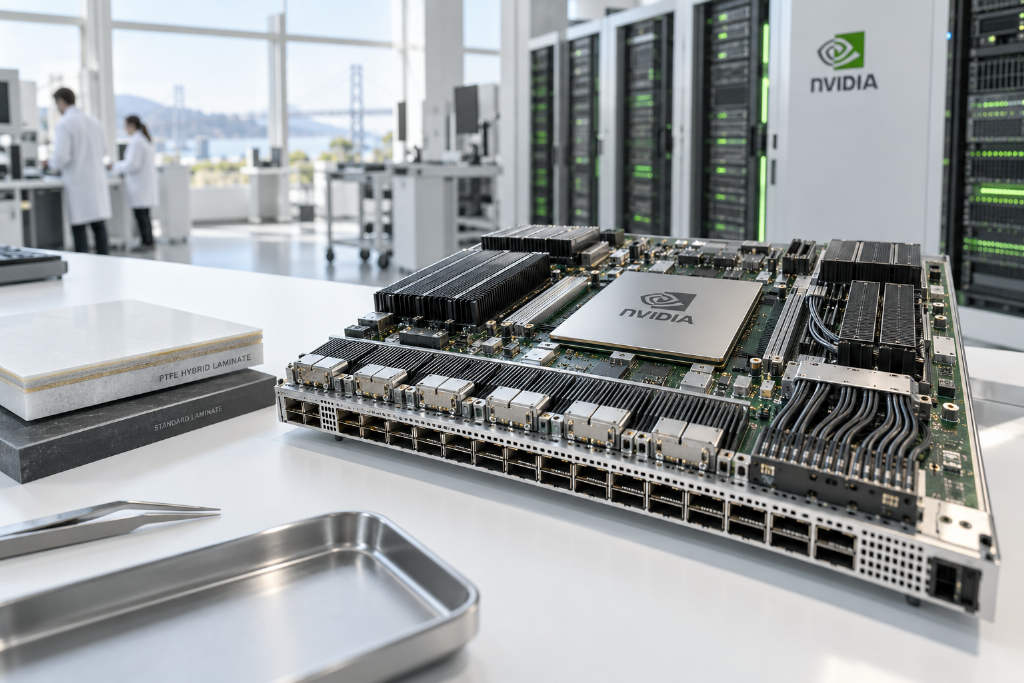
Nvidia’s next round of AI server PCB material decisions is drawing fresh scrutiny. GF Securities Managing Director Jeff Pu said PTFE hybrid stack-up remains the most likely PCB solution for Nvidia’s VR300 NVL576 switch board.
Pu said the hydrocarbon resin, or HC, hybrid approach has already passed signal integrity, or SI, testing. Even so, its qualification timeline is still about three months behind PTFE hybrid stack-up, and PCB mass-production testing has yet to begin. Nvidia is expected to make its final material choice by the end of 2026.
Pu keeps PTFE as the leading option for NVL576 switch boards
In his latest note, Pu said PTFE hybrid stack-up is still the most likely PCB solution for Nvidia’s VR300 NVL576 switch board. He argued that PTFE remains difficult to displace in the near term for high-end, high-speed AI PCB applications, and he maintained a positive view on the material.
Pu also drew a clear line around HC’s role: 「Even if some customers or projects adopt HC in the future, it is more likely to be transitional in nature rather than a long-term solution replacing PTFE.」 That view offers a restrained answer to recent market questions over whether Nvidia is moving away from PTFE.
HC clears SI testing, but qualification still trails PTFE
On technical progress, Pu estimated that the HC hybrid route, using HC with ABF or M9-grade materials, has recently passed SI testing. That suggests HC has met the basic electrical threshold required for high-speed signal transmission.
Still, he said HC hybrid qualification is running about three months behind PTFE hybrid stack-up and has not yet moved into PCB mass-production testing. For an AI server supply chain working on a tight schedule, that gap is meaningful. Nvidia plans to make its final material decision by the end of 2026, leaving HC with more validation work to complete if it wants to catch up.
Yield remains a central issue
Pu also pointed to manufacturing yield. He said a leading Chinese PCB company has already achieved considerable yield results with PTFE hybrid stack-up.
That matters because much of the market discussion around HC has been tied to the idea that it could improve PCB manufacturing yield and efficiency. PTFE is widely seen as difficult to process, but if a leading supplier is already producing solid yields, one of HC’s main replacement arguments becomes less compelling.
At the same time, some analysts have said HC substrate material is relatively soft, has a higher coefficient of thermal expansion, or CTE, and carries greater warpage risk. Its low polarity also makes copper foil adhesion more difficult, leaving open the question of whether mass-production yield can actually surpass PTFE.
Ming-Chi Kuo’s supply-chain checks fueled the HC debate
Recent market talk around testing of HC glass-free copper clad laminate, or CCL, has driven volatility in PTFE-related stocks. Earlier, TF International Securities analyst Ming-Chi Kuo said in a supply-chain survey that Nvidia had started testing glass-free CCL based mainly on HC, replacing the glass-free PTFE CCL tested before. The goal, he said, was to stay on schedule for mass production of Rubin Ultra NVL576 switch trays in the second half of 2027.
According to that survey, the electrical performance of glass-free HC CCL was still below the PTFE option, but better than M9 grade and even above the published specification for M10. On the supplier side, China’s Shengyi Technology was described as the current leader in material evaluation for NVL576 switch trays.
Taiwan-based senior PCB industry analyst kokycpcb said Nvidia appears to be using a dual-track testing strategy: PTFE CCL as the first choice because it offers the best electrical performance despite difficult processing, and HC CCL with HC PP as a transitional option because the process window is easier to control. That first-choice-plus-transition framework broadly matches Pu’s positioning of HC.
Attention now turns to Nvidia’s end-2026 decision
On the market side, Taimide Tech. (8039) and Asia Electronic Material (4939) fell 3.99% and 4.71% after the HC testing rumors surfaced. On the latest trading day, they turned up 2.53% and down 0.76%, respectively. Meanwhile, traditional CCL names ITEQ (6213), EMC (2383), and TUC (6274) all hit their daily limit up.
Investors are now watching Nvidia’s final material decision before the end of 2026, whether HC can close the gap in mass-production testing, the actual adoption rate of NVL576, and progress on Kyber-type rack designs using orthogonal backplanes. Ming-Chi Kuo said the long-term trend for PTFE in advanced PCB materials remains intact, though shipment growth over the next two years is still uncertain.