HBM4 Bottleneck Resolved, Data Center Revenue Could Beat Consensus by 20%
Semiconductor research firm SemiAnalysis released a bullish forecast via its Accelerator Model, predicting that Nvidia's data center computing revenue for the second half of fiscal 2027 (calendar H2 2026) will exceed Wall Street consensus by approximately 20%. The key driver: HBM4 memory supply constraints, which previously limited Rubin platform volume shipments, have now been resolved. Front-end wafer capacity has also been secured in advance, clearing the path for rapid ramp-up of the Rubin platform.
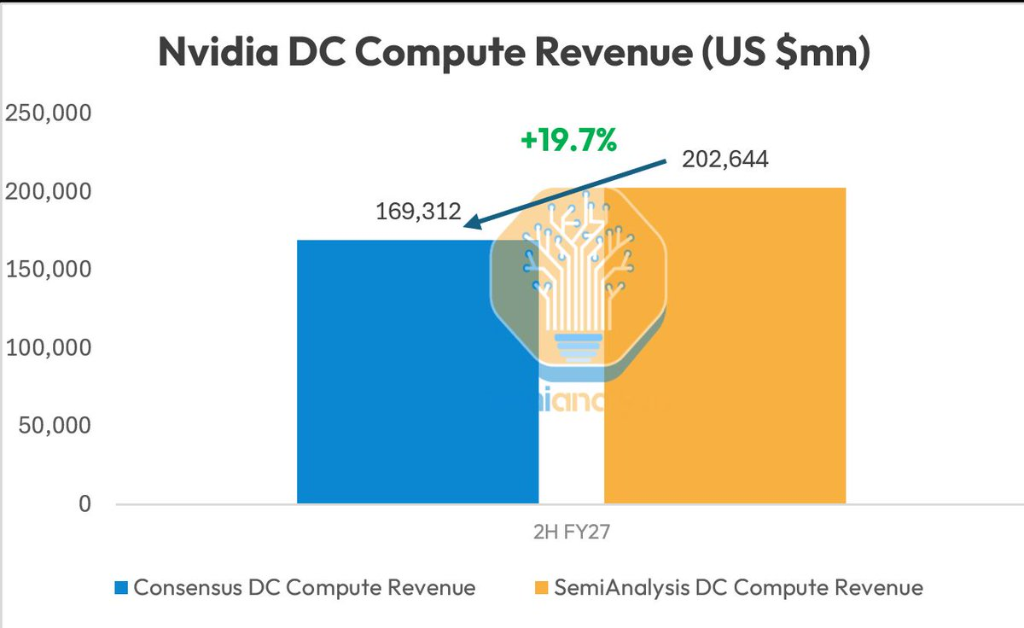
SemiAnalysis stressed that its forecasting methodology differs significantly from traditional sell-side analysts. Most Wall Street institutions tend to build conservative earnings models to leave room for future 'beat' expectations. In contrast, SemiAnalysis's conclusions are grounded in deep supply chain research, drawing data from material suppliers, wafer fabrication, key components, and server OEMs, triangulated with actual procurement and deployment data from hyperscale cloud providers and frontier AI labs.

Flagship Product Downgrade: Rubin Ultra Cancelled, Halved in Size
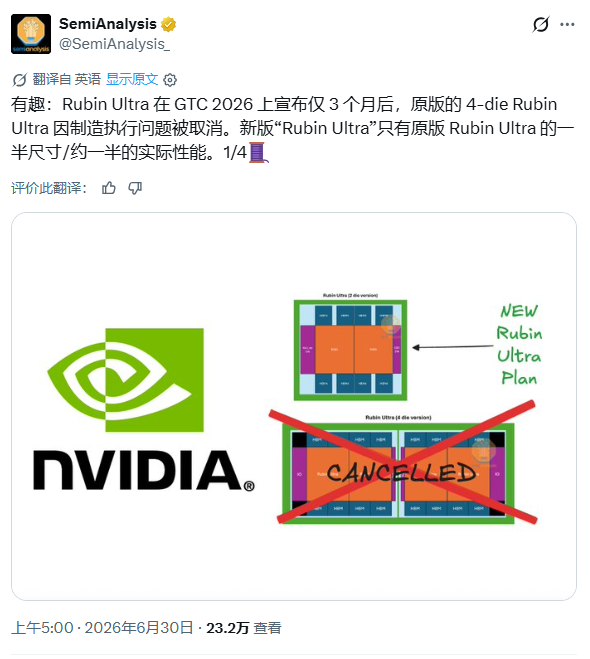
However, the same firm released another note earlier on June 30 that dampened sentiment: Nvidia's original Rubin Ultra design, featuring four compute chips, has been cancelled roughly three months after its GTC 2026 announcement. A new 'Rubin Ultra' version has been reduced to half the original size, with performance effectively halved as a result. SemiAnalysis attributed this revision to challenges in advanced packaging manufacturing.

The contrasting narratives — a supply-chain-driven revenue upgrade and a product-design-driven downgrade — paint a dual picture of opportunity and risk for Nvidia. SemiAnalysis's two reports anchor Nvidia's story on two different axes: near-term earnings delivery and long-term technological moat.

Accelerator Model: Full-Chain Cross-Validation
SemiAnalysis's Accelerator Model extends beyond Nvidia to cover Broadcom, AMD, MediaTek, Marvell, and other AI chip players. The model continuously tracks the entire AI computing ecosystem through its HBM Model and supply-chain cross-validation (materials → wafers → components → systems) combined with cloud deployment data. It correctly identified the HBM4 constraint resolution timing, enabling its revenue upgrade call on Nvidia.

Cuda Moat Eroding, Multi-Platform Computing Emerges
More concerning for the long term is the slow erosion of Nvidia's CUDA moat. SemiAnalysis highlighted that Anthropic now runs a multi-platform architecture comprising Google TPU, Amazon Trainium, and Nvidia GPUs: a large portion of Claude model training runs on TPUs, Claude Code inference is increasingly deployed on Trainium, while Nvidia GPUs handle frontier R&D and general-purpose tasks. A year ago it would have been unimaginable for TPU and Trainium to reach present scale, but today these alternatives are penetrating from the edge into core workloads. While Nvidia still dominates data center GPUs, the competitive landscape is quickly maturing, posing risks to its pricing power and technological differentiation over time.