Semiconductor research firm SemiAnalysis has published two separate assessments that paint a contrasting picture of Nvidia's Rubin platform—one of opportunity and one of challenge. The first predicts a significant revenue upside driven by resolved supply constraints, while the second reveals a major downsizing of the flagship Rubin Ultra product, raising questions about Nvidia's technical execution.
Supply Constraints Eased, Revenue Outlook Upgraded
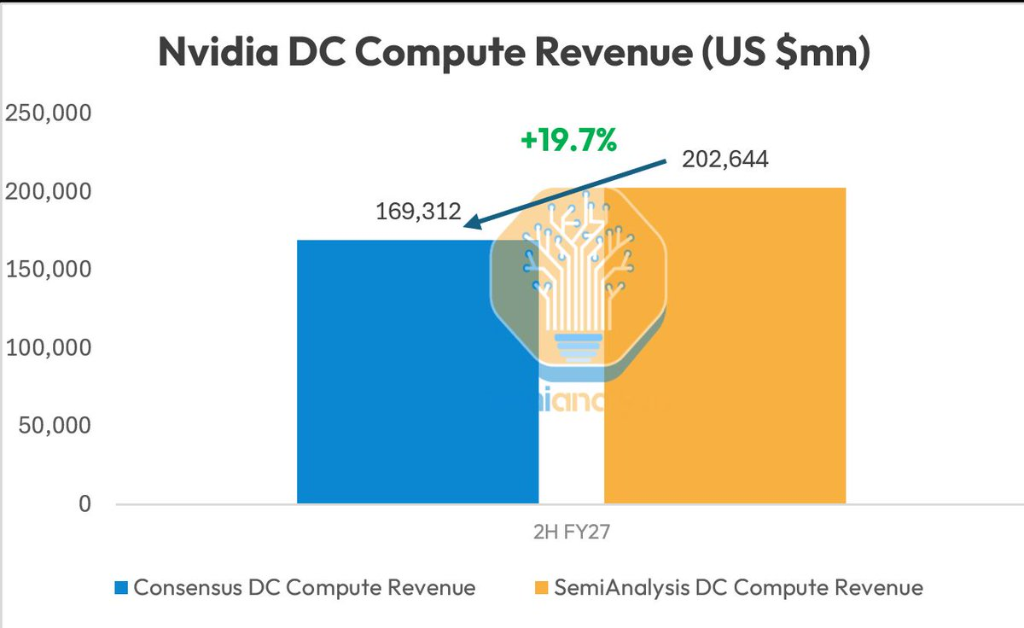
On June 30, SemiAnalysis posted on X that its Accelerator Model projects Nvidia's data center compute revenue for the second half of fiscal 2027 to be roughly 20% above Wall Street consensus. The key drivers are the resolution of HBM4 memory supply issues that had previously hampered Rubin platform mass shipments and the advance preparation of front-end wafer capacity. These factors remove substantial barriers to a rapid ramp-up of the Rubin platform later this year.

SemiAnalysis emphasized that its forecasting methodology differs significantly from traditional sell-side analysts. Most Wall Street firms tend to build conservative earnings estimates to leave room for future 'beat' surprises. In contrast, SemiAnalysis relies on primary research across the supply chain, including material suppliers, wafer fabrication, key components, server OEMs, and actual procurement data from hyperscale cloud providers and leading AI labs. The Accelerator Model cross-validates supply-demand dynamics across multiple dimensions and covers not only Nvidia but also other AI chip players such as Broadcom, AMD, MediaTek, and Marvell.

Flagship Downsized, Technical Path Shadowed
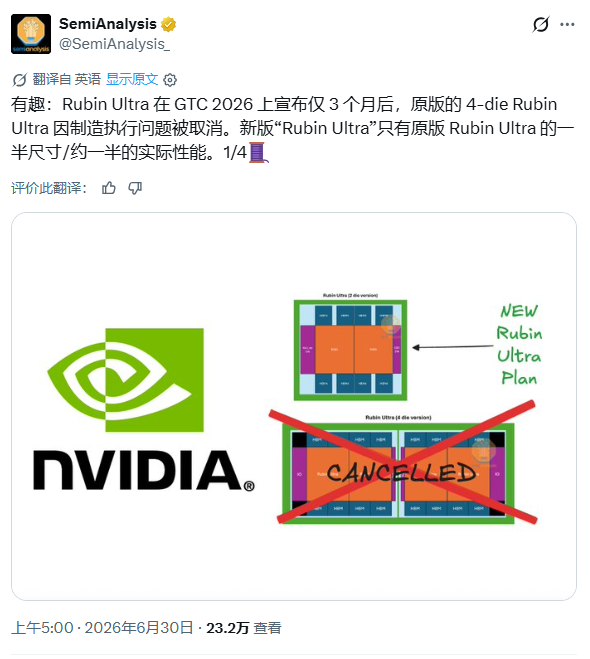
However, earlier the same day, SemiAnalysis disclosed another piece of news that sparked widespread market discussion: Nvidia's original 4-chip Rubin Ultra design was canceled about three months after its unveiling at GTC 2026. The new 'Rubin Ultra' is reduced to half the size of the original, and its performance is correspondingly halved. The firm attributed the design change to difficulties in advanced packaging manufacturing.

This bearish signal stands in stark contrast to the bullish revenue forecast, suggesting that Nvidia still faces execution hurdles on the technology front. While the overall Rubin platform ramp schedule has accelerated due to the HBM4 resolution, the competitiveness of the flagship product may be compromised, potentially affecting Nvidia's positioning with hyperscale customers.

Supply Chain Insights and the CUDA Moat Challenge
SemiAnalysis's model also sheds light on broader competitive dynamics. For instance, Anthropic has built a multi-platform compute architecture comprising Google TPUs, Amazon Trainium, and Nvidia GPUs. A substantial portion of Claude model training now runs on TPUs, while Claude Code inference is increasingly deployed on Trainium, with Nvidia GPUs primarily handling frontier research and general-purpose tasks. SemiAnalysis noted that a year ago it was hard to imagine TPU and Trainium reaching their current scale, and now the CUDA moat is being slowly eroded. This trend indicates that Nvidia's once-unassailable dominance in high-end AI chips may face growing challenges from custom ASICs and competitors like Google and Amazon.