Revenue Upgrade of 20%: HBM4 and Wafer Supply Cleared
On June 30, SemiAnalysis released its latest forecast via the Accelerator Model, predicting Nvidia's data center compute revenue for the second half of fiscal 2027 to be about 20% above the Wall Street consensus. The core support for this optimistic view: the HBM4 memory supply issue that previously constrained Rubin platform mass shipments has been resolved, and front-end wafer capacity has been prepared in advance, removing substantial obstacles for a production ramp in the second half.
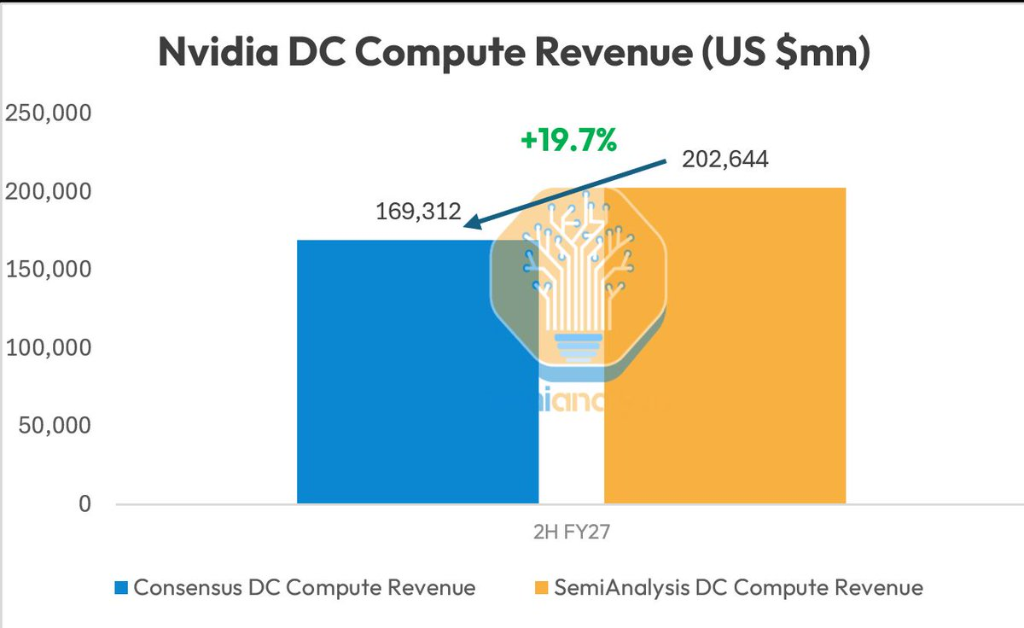
Notably, SemiAnalysis's forecasting logic differs significantly from traditional sell-side analysts. Most Wall Street institutions tend to build relatively conservative earnings forecasts to leave room for subsequent beats. In contrast, SemiAnalysis's conclusions are more grounded in on-the-ground supply chain research, striving to reflect real market dynamics. Its Accelerator Model establishes a cross-verification system covering material suppliers, wafer fabrication, key components, server OEMs, and other supply chain tiers, combined with actual procurement and deployment data from hyperscalers and frontier AI labs, to multi-dimensionally validate supply-demand relationships.

Flagship Shrinks: Rubin Ultra Canceled, Performance Halved
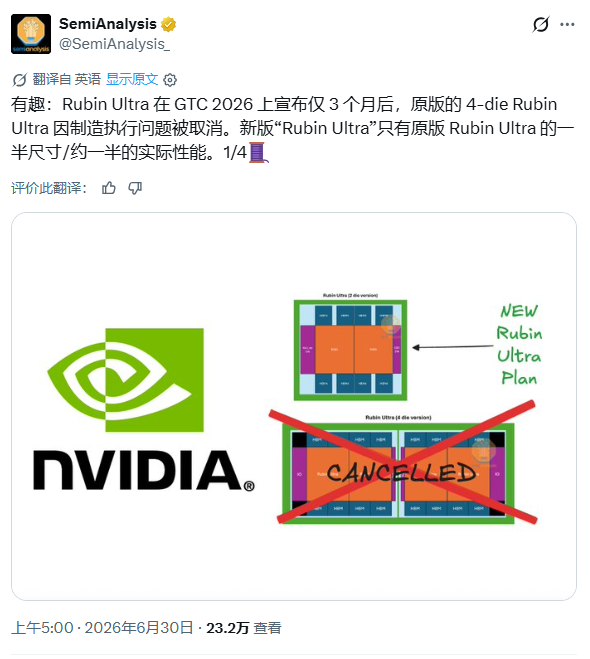
However, another piece of news disclosed by SemiAnalysis on the same morning sparked widespread market discussion: Nvidia's original 4-chip design for Rubin Ultra, launched at GTC 2026, was canceled about three months later. The new version is reduced to half the size, with actual performance also halved. The cancellation is attributed to difficulties in advanced packaging manufacturing, reflecting Nvidia's short-term bottlenecks in its technical roadmap.

On one hand, the removal of supply constraints leads to an optimistic revenue revision; on the other hand, the flagship product's shrinkage prompts a pessimistic correction regarding the technology trajectory. These two opposite judgments anchor Nvidia in contrasting narratives from the dimensions of earnings delivery and technological moat.

CUDA Moat Is Eroding: Multi-Platform Compute Architecture Becomes Trend
SemiAnalysis pointed out that Anthropic has already built a multi-platform compute architecture composed of Google TPU, Amazon Trainium, and Nvidia GPU. A large portion of Claude model training runs on TPU platforms, while Claude Code inference is increasingly deployed on Trainium. Nvidia GPUs are more used for general-purpose computing tasks like frontier research. A year ago, the scale that TPU and Trainium have reached today was unimaginable. Now, the CUDA moat is being slowly eroded.

SemiAnalysis's Accelerator Model not only focuses on Nvidia but also covers AI chip players like Broadcom, AMD, MediaTek, Marvell, etc., and combined with the HBM Model, continuously tracks the overall evolution of the AI computing chain. For crypto investors, Nvidia's technology roadmap and market expectations directly impact the underlying infrastructure of AI+ crypto tracks (e.g., decentralized compute networks, AI agent protocols), making it a key area to monitor closely.