
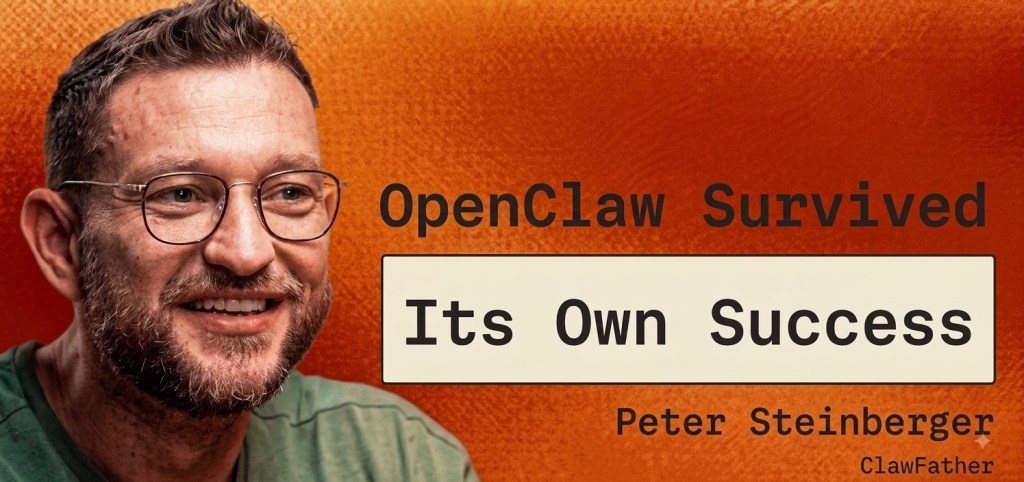
OpenClaw founder Peter Steinberger told a Y Combinator startup school audience that the project began as a way to solve a personal annoyance and later turned into an open-source AI agent project that hit 4.7 million downloads in a single week. He also described the cost of that growth: harassment, hacking pressure, leaked personal details and a period of extreme anxiety that left him close to deleting the project altogether. Steinberger said NVIDIA later reached out on its own and assigned a team to take over most of OpenClaw’s security protection work.
A hungry moment led to the first version
Steinberger said the idea surfaced on a rainy day while he was working with an AI agent. He got hungry and went to the kitchen, but ran into a simple problem: he could not send a prompt from his phone to his computer to check the agent’s progress. By the time he got back to the machine, the coding agent had stopped, and he said the interruption made him furious.
He opened a fresh terminal window, typed in the idea and decided to “let the model cook.” Roughly an hour later, he had built a WhatsApp Relay that allowed two-way messaging between a Mac and WhatsApp. That tool became the early form of what would later become OpenClaw.
Steinberger used that story to make a point for founders. In his view, startups should go after areas that are “hard and boring.” Once a real pain point is solved, the result can become difficult to replace, and the problems that feel annoying enough to follow on instinct may be the ones that eventually turn into the next breakout product.
From WhatsApp Relay to a product people wanted
After building the relay, Steinberger said he was struck by how unusual the tool felt. It could proactively check in, reply in a concise way and strip away complexity. But when he tried to promote it on X, nobody paid attention.
He then pulled the WhatsApp Relay into a group chat with friends and let people interact with it directly. The response changed fast. Some people were amazed, some were unsettled, and some non-technical friends were upset because he would not let them use it more broadly. That reaction, he said, was the moment he realized the product might have real market potential.
Discord support led to the Claudius name
Steinberger spent another month refining the project after the first relay was done. Then a user submitted a pull request through WhatsApp asking for Discord support. He said the request made him laugh because the project had been built around WhatsApp, but he accepted it anyway.
Once the product was no longer limited to WhatsApp, he renamed it Claudius. To make the Discord version work, he spent New Year’s Eve writing a rough history-message compaction system so the service could keep operating.
A Ctrl + C mistake turned into viral growth
The project’s breakout moment was not planned. Steinberger set up a Discord server and dropped Claudius into it. Through the night, a crowd of geeks joined, watched him code in public and chatted with the bot at the same time.
By morning he was exhausted. He hit Ctrl + C in the terminal because he wanted to force the bot offline for safety and go to sleep. What he had not realized was that the software had been configured as a launch daemon. The Ctrl + C stopped it for only five seconds, and then it restarted on its own.
When he woke up 10 hours later, the bot had kept replying to everyone the entire time. His Discord had filled with about 800 messages attempting to hack the system. That accident helped send the project through a rapid viral cycle overnight.
Anthropic asked for a rename
As the project took off, Steinberger said his inbox exploded and Mac Mini inventory was pushed into shortage. Around the same time, Anthropic, the company behind the Claude model, emailed him and asked that he drop the existing name. He first renamed the project Claudebot, and it was later formally reintroduced as OpenClaw.
Hacking pressure and harassment nearly ended the project
Steinberger said the technical challenge was not the hardest part of the surge in attention. The personal fallout was worse. He told the audience that he was close to a mental breakdown and repeatedly considered deleting the entire project.
His inbox was flooded. His phone number and details from his private life were maliciously exposed. He was labeled things such as “AI God” and “enemy of humanity,” and reporters were sending him messages in the middle of the night. He said the pressure became so intense that he was afraid to look at his phone.
NVIDIA took over most of the security work
During that low point, Steinberger said NVIDIA contacted him and offered help. The company then sent specialists who took over most of OpenClaw’s security protection work.
He described that intervention as the moment he was pulled out of the mud. It allowed him to regain his footing and reconnect with the reason he had started building in the first place.
His message to founders after burnout
Steinberger also spoke about an earlier stretch in his career. After selling his previous company, he said he went through burnout and spent nearly three years drifting without much direction. For months at a time, he did not touch a computer. He focused on living, going to parties and trying to reclaim the parts of life he had missed in his twenties and thirties because he had worked so intensely.
That distance eventually helped him reset. He said the process clarified that what he truly loved was not just coding, but creating. That experience shaped the advice he now gives to other founders: after burning out, leave some blank space for recovery and reflection.