
“Raised by more than 20% across the board.”
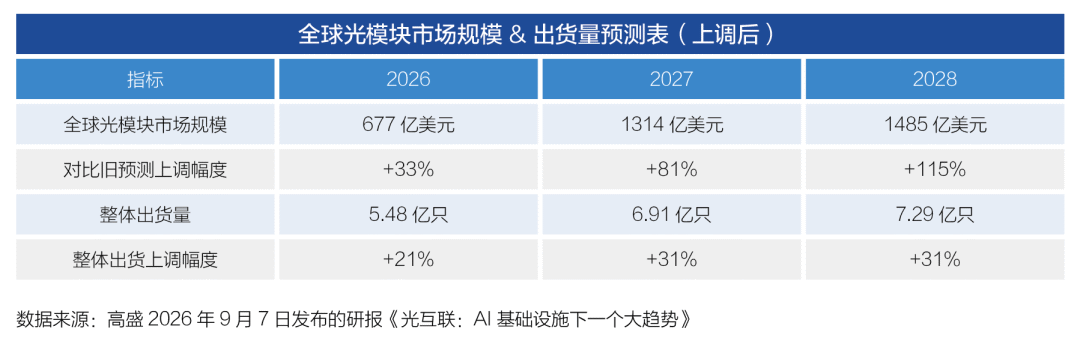
On Sept. 7, Goldman Sachs published a research note raising its forecasts for global optical module shipments from 2026 to 2028. It lifted projected shipments for 800G-and-above modules by 31%, 39% and 36%, and for 1.6T-and-above modules by 29%, 61% and 50%.
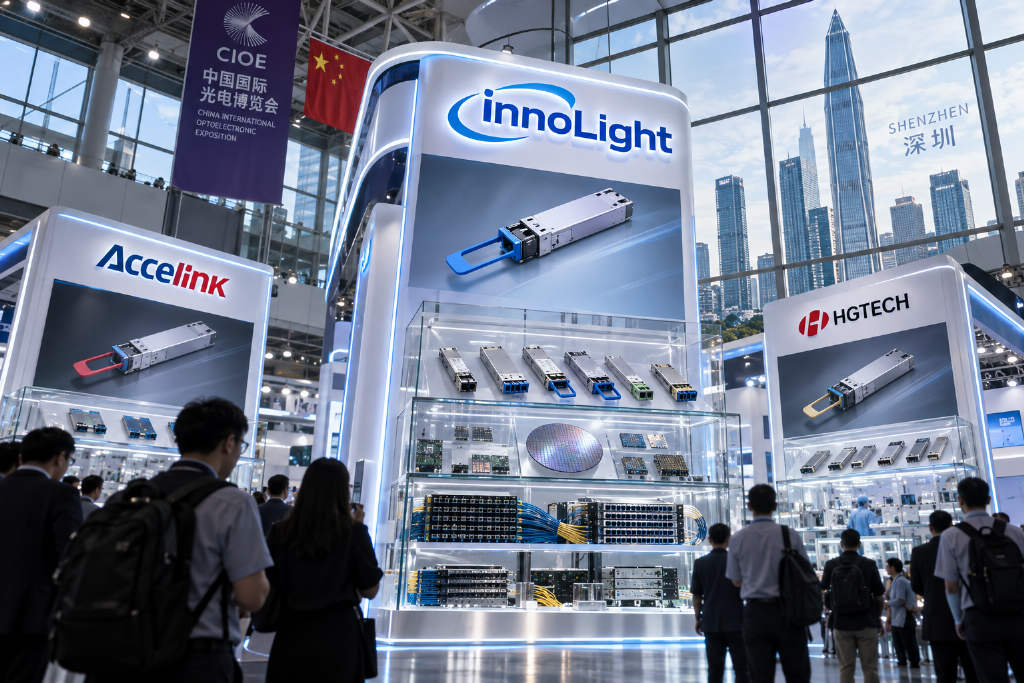
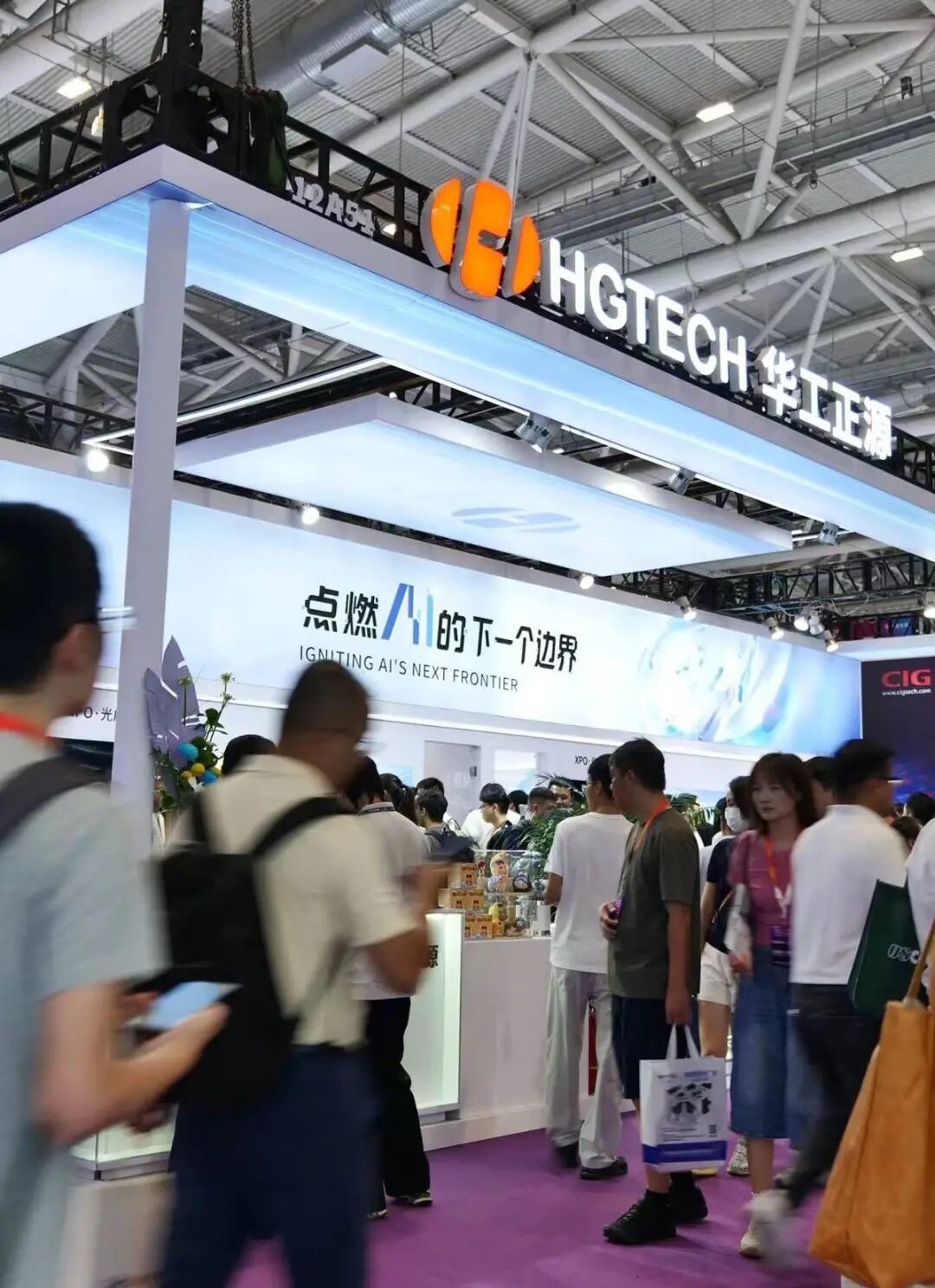
At the 27th China International Optoelectronic Exposition, held in Shenzhen from Sept. 9 to 11, Zhidian Finance reporters said Hubei companies had already shifted their technical focus beyond 800G, which has become a standard configuration, toward 1.6T and faster products. HG Genuine Optics, a unit of HGTECH, displayed a 6.4T NPO near-packaged optical engine and a 12.8T XPO ultra-high-density pluggable optical module. Accelink showed a 6.4T silicon photonics single-mode NPO optical engine.
Four Hubei leaders still earned less than Zhongji Innolight alone
Optical modules are a core component in AI servers and data centers, handling photoelectric signal conversion between servers and between servers and switches. In the sector, G and T refer to transmission bandwidth. An 800G module can transmit 800 gigabits of data per second, while 1.6T means 1,600 gigabits per second.
During the 4G and 5G era, optical modules were largely treated as accessories in networking equipment, with a relatively small market and thin margins. That changed with the buildout of computing infrastructure. The report said a single 1.6T optical module can sell for $1,000, while the industry is moving quickly toward 800G, 1.6T and 3.2T products. By 2028, global shipments of 3.2T optical modules are expected to jump from 23 million units in the previous year to 68 million units.
At the Shenzhen expo, 1.6T pluggable modules, 3.2T and 6.4T near-packaged optical engines, 12.8T liquid-cooled pluggable modules and co-packaged optical switches occupied the most prominent positions at many booths.
Xu Qijian, deputy general manager of HG Genuine Optics, said the company’s 3.2T and 6.4T NPO products perform far better than 800G products and support higher-density, higher-bandwidth connections. He said the products have already been commercialized. Liu Qing, product line manager at Linktel Technologies, said the company’s 6.4T optical module is undergoing joint debugging and validation with North American customers.
Reporters said interviews with multiple exhibitors showed that optical module makers across China are now running at full capacity, with some companies booked through 2027. As 800G and 1.6T modules scale up, several Optics Valley companies have posted strong results.
In the first half, Accelink generated about 6.6 billion yuan in revenue from its data, access and transmission business, where optical modules are a representative product, up about 27% year on year. Omdia data showed that in the first quarter of 2026, Accelink ranked fifth in the global optical device industry with a 5.1% market share.
HGTECH, whose optical interconnection business generated 6.1 billion yuan in revenue in 2025 and held a 3.8% global market share, posted about 3.8 billion yuan in related revenue in the first half of this year. Its 800G and 1.6T high-speed optical modules have entered global, large-scale delivery. Ma Xinqiang, chairman of HGTECH, told Zhidian Finance that revenue from the company’s connection business, represented by optical modules, had grown by more than 100% in each of the past few years and now accounts for nearly half of total revenue. He said 800G modules are the core growth driver, while 1.6T modules can achieve large-scale commercial use this year.
Linktel Technologies reported 690 million yuan in first-half revenue from optical modules and entrusted processing, up about 39%. Huilv Ecology posted 655 million yuan in revenue from optical module products, more than tripling from a year earlier.
Even so, the comparison with Zhongji Innolight is stark. In the first half, Zhongji Innolight recorded 41.355 billion yuan in optical module revenue, up 186.56% year on year. That was nearly three times the combined optical module revenue of Accelink, HGTECH, Linktel Technologies and Huilv Ecology.
Profit showed a similar gap. Zhongji Innolight earned more than 13 billion yuan in the same period, well above the combined profit of the four Hubei companies. Their corresponding profits were more than 500 million yuan, more than 1.1 billion yuan, more than 9 million yuan and more than 20 million yuan.
Hubei companies were late to the first high-speed module window
The report said a large part of the performance gap comes from insufficient capacity.
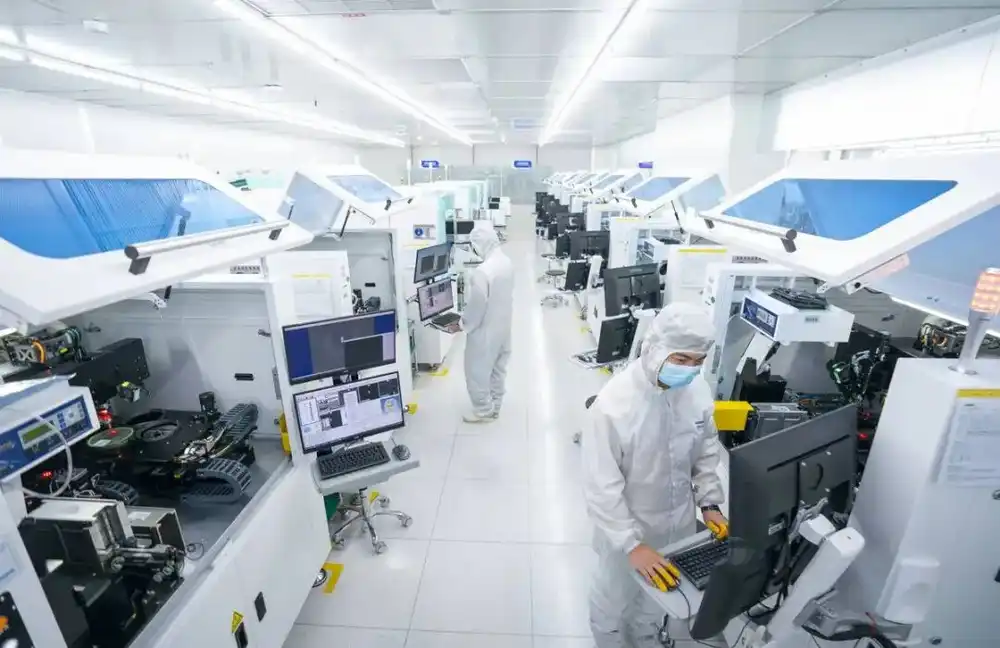
In the first half of 2026, Zhongji Innolight kept expanding capacity and delivery capability. It has production bases in Suzhou, Tongling, Chengdu and Thailand, with total optical module capacity reaching 22.15 million units and a production-sales ratio above 100%. By the end of the first quarter, its designed annual capacity had reached 43.3 million units.
Hubei companies remain much smaller. HGTECH has been expanding its optical module bases in Optics Valley and Chonburi, Thailand. In a September reply to investors, the company said phase one of its overseas base has monthly capacity of 200,000 optical modules, including about 20,000 units of 1.6T and about 180,000 units of 800G. Phase two added nearly 100 mu of land and is expected to complete plant construction in the second half of 2027. Its domestic base is also expanding, and monthly capacity for 800G products is expected to rise to 800,000 to 1 million units by the end of 2026. On that basis, HGTECH is expected to produce more than 10 million 800G and 1.6T modules annually in 2026.
In May, Accelink completed a private placement of nearly 3.5 billion yuan to expand 800G and 1.6T high-speed optical module production. Under the plan, the project will reach 100% utilization in its fifth year of construction, with annual output of 4.992 million high-speed optical modules. Accelink also has a production base in Malaysia, though it has not disclosed that site’s capacity.
Huilv Ecology disclosed in September that its Wuhan headquarters has annual optical module capacity of about 3 million units. Including planned new capacity in phase one of Ezhou, total domestic annual capacity is about 4.5 million units. Overseas, its Malaysia factory, which started production in April, is expected to add 1 million to 1.5 million units of annual capacity and is still ramping up through equipment tuning and workforce adjustment.
Linktel Technologies had total optical module capacity of 2.83 million units in Wuhan and Malaysia in the first half, and produced about 3 million units in all of 2025.
Xia Liang, director of the Institute of Economics at the Hubei Academy of Social Sciences, said Hubei companies fell behind in optical module capacity because they were slower to secure a position in the first wave of high-speed optical module demand.
In both 800G and 1.6T modules, Zhongji Innolight was the first company in the world to develop and mass-produce the products, according to the report. It launched the industry’s first 800G optical module in 2020 and began volume shipments in 2022. In 2023, when the industry started pushing 800G products, it also launched the first 1.6T optical module and mass-produced it the following year. HGTECH did not achieve large-scale delivery of 800G modules until 2025, and only started batch delivery of 1.6T modules this year. Accelink’s 1.6T modules also only gained the ability to scale this year.
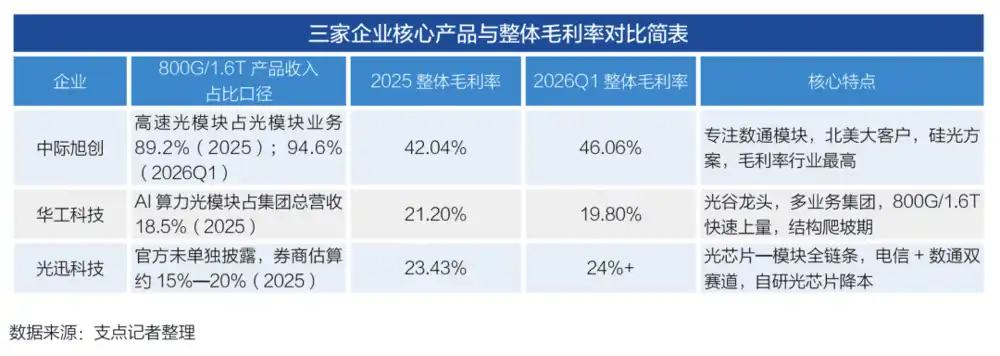
That timing gap has fed through to product mix and margins. In 2025, revenue contribution from 800G and 1.6T products was 89.2% for Zhongji Innolight, 15% to 20% for Accelink, and 18.5% for HGTECH. In the first quarter of 2026, overall gross margin was 46.06%, 24%+ and 19.80%, respectively.
Private-sector flexibility and North American ties helped Suzhou firms pull ahead
In optical modules, the report grouped Zhongji Innolight, Eoptolink and TFC Communication under the shorthand “Yi Zhong Tian.” Industry participants said AI computing clusters require extremely high consistency and reliability from optical modules. Once a supplier enters the chain early, customer certification barriers can turn into a long-term moat.
Zhongji Innolight is deeply tied to North American customers including NVIDIA and Google, and is a core optical module supplier for NVIDIA AI servers. Eoptolink is a major supplier to Meta and Microsoft and is Google’s second-largest 800G supplier. TFC Communication is a core company in NVIDIA’s CPO supply chain.
Suzhou’s private companies stand out in the sector. The report said Zhongji Innolight’s market value exceeded 1 trillion yuan during the first-half rally, while TFC Communication, Lianxun Instrument and other Suzhou companies also crossed the 100 billion yuan mark.
Several industry sources told Zhidian Finance that Suzhou optical module companies, represented by Zhongji Innolight, were able to post explosive growth in this AI-driven cycle not only because they secured an early position, but also because private-sector governance gave them stronger momentum.
By incomplete statistics, among nearly 20 A-share optical module upstream and downstream companies in Suzhou, the overwhelming majority are controlled by private entrepreneurs. In Hubei, by contrast, leading optical module companies are mostly led by central or state-owned capital. Accelink is controlled by state-owned China Information and Communication Technologies Group, while HGTECH is controlled by the Wuhan State-owned Assets Supervision and Administration Commission. Although Hubei private firms such as Linktel Technologies and Huilv Ecology have grown quickly in recent years, they still lag Suzhou leaders in size and scale.
Lan Pengfei, deputy director of the Laser Science and Technology Department at the Wuhan National Laboratory for Optoelectronics of Huazhong University of Science and Technology, said Suzhou’s mature industrial system and business environment have provided fertile ground for local optical module companies. That environment also produced private firms with sharp market instincts and decisive management. He said Hubei can learn from Suzhou in fostering private enterprise.
Ye Mao, secretary-general of the Optical Intelligence Committee of the Chinese Optical Society and founding vice chairman of the Hubei Laser Industry Association, said Wuhan should cultivate a more diversified set of market players. On one side, state-owned leaders should improve market-based decision-making and speed up responses to overseas demand. On the other, the city should focus support on specialized private optical module companies. He also said Hubei can improve venture capital and industrial fund support to create a positive cycle of “technology-product-market-capital-R&D.”
Gao Quansheng, vice chairman of the Hubei Industrial Economics Society, said optical communication companies with central or state-owned backgrounds can face pressure from Europe and the U.S. when expanding overseas. He described 2026 as a “big year for light,” with high-speed optical modules entering a period of full-scale 1.6T expansion and initial 3.2T adoption. He said Hubei could actively support one or two fully private optical communication companies to accelerate growth.
The next task is winning top North American customers
The report said energizing private optical module companies is only the first step. The second is to secure orders from high-end North American customers as quickly as possible. More than 70% of global orders for high-end optical communication products now come from North American cloud companies during the current AI cycle.
Xia Jinsong, a professor at the Wuhan National Laboratory for Optoelectronics of Huazhong University of Science and Technology, told Zhidian Finance that optical module capacity expansion has to match orders from major customers, and North America accounts for the largest share of demand for high-speed optical modules.
At the main forum of the 2026 China Computing Power Conference on Sept. 12, Wu Hequan, an academician of the Chinese Academy of Engineering, said China currently accounts for 21% of global computing power, while the U.S. accounts for 46%. A report titled “A Look Through China AI Financing” from U.S. consulting firm Rhodium Group said total U.S. data center investment this year is about $800 billion, while China’s current AI buildout is only 15% to 20% of the U.S. level.
One core reason Zhongji Innolight and other giants have surged in this AI infrastructure wave is that they secured access to major North American customers. In the first half, Zhongji Innolight posted 39.615 billion yuan in overseas revenue, while Eoptolink posted 20.47 billion yuan. In both cases, overseas revenue contributed more than 90%.
HGTECH, by comparison, has managed to place high-speed optical module products into the North American supply chain, but its first-half overseas revenue was only 1.648 billion yuan, accounting for 21% of total revenue, far below the leading optical module companies. Hubei optical communication companies such as Accelink still mainly serve domestic and overseas telecom customers, with relatively few major orders from top North American AI companies including NVIDIA, Google and Microsoft.
Ma Xinqiang said HGTECH will focus this year on higher value-added products. Its 800G and 1.6T high-speed optical modules are continuing to scale in overseas markets, with a larger breakthrough in North America in particular. He also said the company will speed up iteration of 3.2T and 6.4T products and seek global first launches for a batch of leading technologies.
Ye Mao said Zhongji Innolight spent years running alongside major overseas customers and used mature solutions to deliver high-speed optical modules quickly to North American cloud companies. By contrast, several leading Optics Valley companies mainly rely on self-developed chips and full-stack delivery to serve China’s three major telecom operators. He said the former model offers greater elasticity, while the latter has stronger counter-cyclical and self-reliance characteristics. Ye added that Optics Valley has one of China’s rare complete “optics-chip-display-device-network” industrial chains, gathering 16,000 optoelectronics companies and a strong base of research and talent. In his view, Hubei’s weakness is not in foundational technology, but in overseas customer development, commercialization, industrial coordination and market-oriented mechanisms.
Gao Quansheng said local optical module companies now need to secure market position quickly, concentrate resources on top North American customers, improve global capacity layout, and treat entry into the first-tier supply chains of leading North American cloud companies as a core objective while pushing product certification and factory audits.
Ye Mao also said Hubei companies should do more to “go out and bring in,” actively joining mature industry platforms such as European and U.S. optoelectronics exhibitions, while proactively connecting with and inviting leading global optical interconnect companies and internet giants to participate and build a broader optoelectronics ecosystem.