
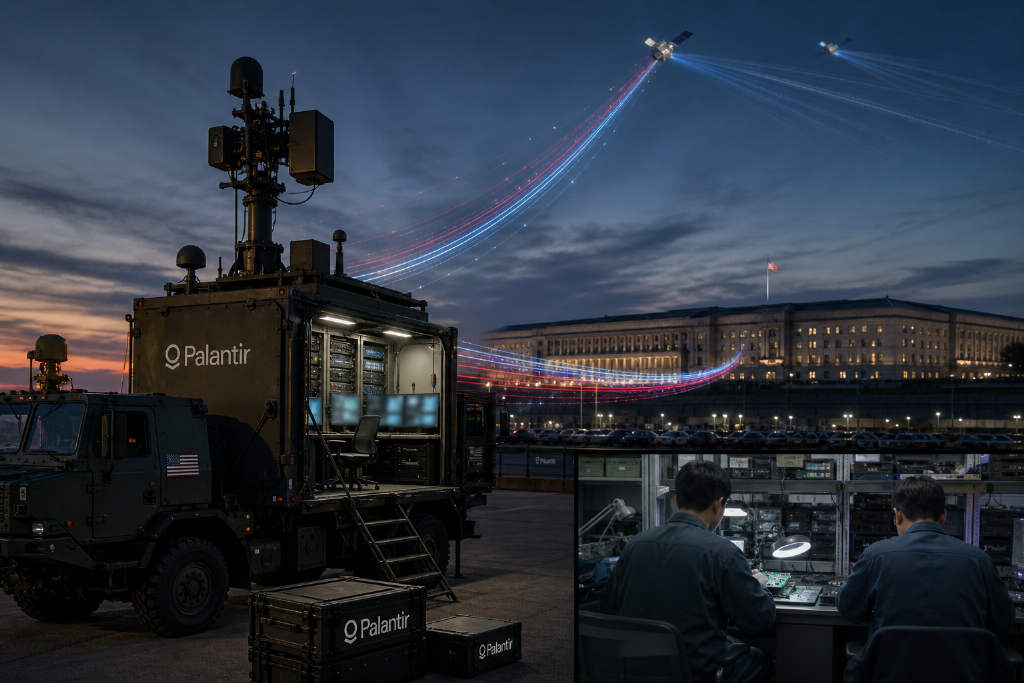
Palantir has won a U.S. Army contract to produce and deliver TITAN, the Tactical Intelligence Targeting Access Node, a next-generation battlefield intelligence system that ABMedia described as a sign of the Pentagon’s turn from traditional heavy equipment toward software-defined defense.
Palantir to deliver eight TITAN ground systems
Under the contract, Palantir will serve as the prime contractor for eight new TITAN ground station systems. That includes four Advanced units with high-end computing capability and four Basic units designed for greater mobility. The company will also take on key technology integration and fielding.
ABMedia said contracts for major defense ground systems like this have historically been dominated by traditional military hardware groups such as Lockheed Martin, RTX, and General Dynamics. This time, a Silicon Valley company that started in software won the bid and will lead hardware manufacturing and delivery.
Akash Jain, Palantir’s president of U.S. government and chief technology officer, said: “TITAN was built together with the frontline soldiers who actually use it, under harsh battlefield conditions and to real operational standards. That is the only path for systems like this to earn their place on the battlefield.”
TITAN is built to shorten the kill chain
TITAN is described as a core node in the U.S. military’s Combined Joint All-Domain Command and Control, or CJADC2, architecture. Its job is to deal with intelligence overload in multi-domain operations by merging data in real time from space satellites, high-altitude reconnaissance aircraft, unmanned vehicles, and ground radar.
With built-in edge AI and machine learning models, the system can filter background noise, identify high-threat targets within seconds, and send precision strike coordinates to Long-Range Precision Fires, or LRPF, systems. The report said this sharply reduces the time once spent moving information through manual reporting layers.
In the project, Palantir is also acting as a platform coordinator, bringing together defense technology company Anduril along with communications and avionics firms including L3Harris and Sierra Nevada Corporation to form a software-centered defense ecosystem.
Taiwan suppliers may see closer market attention
ABMedia said the U.S. military’s push to upgrade ground intelligence systems could lift market attention on Taiwan companies that supply related hardware and components. It pointed to ground control and embedded computer suppliers with U.S. military vendor qualifications, including Sysgration Technology, identified in the report as 4916, as among those most directly tied to ground station and digital upgrade demand.
The report also noted that TITAN partner Anduril reflects the rising importance of integrating drones and edge sensors. For Taiwan, one bottleneck in developing its “national drone team” has been real-time video transmission and target recognition, an area that could accelerate efforts by local manufacturers to combine hardware with software and AI algorithms.
ABMedia said control over software architecture means control over battlefield data flows and decision-making, giving that layer stronger pricing power, while much of manufacturing still sits in structural parts and board assembly. As TITAN moves into deployment, the report said asymmetric warfare thinking is likely to place more emphasis on C4ISR and anti-jamming communications, and that electronics manufacturers with high cybersecurity standards and hardware reliability could improve their standing in the international supply chain by deepening modular and system integration capabilities.