



Pearl is trying to turn AI inference into a mining task.
The Layer 1 network, built around Proof of Useful Work, or PoUW, reuses GPU matrix multiplication needed for AI inference in blockchain mining. The idea is simple on paper: one batch of compute, two revenue streams. The same hardware could produce cryptographic proofs for mining while also serving AI workloads.
That pitch has helped push PEARL into the spotlight. As the token kept climbing, the market’s "AI Bitcoin" narrative around the project gained traction, with several crypto firms and industry figures publicly pointing to Pearl as a project worth watching.
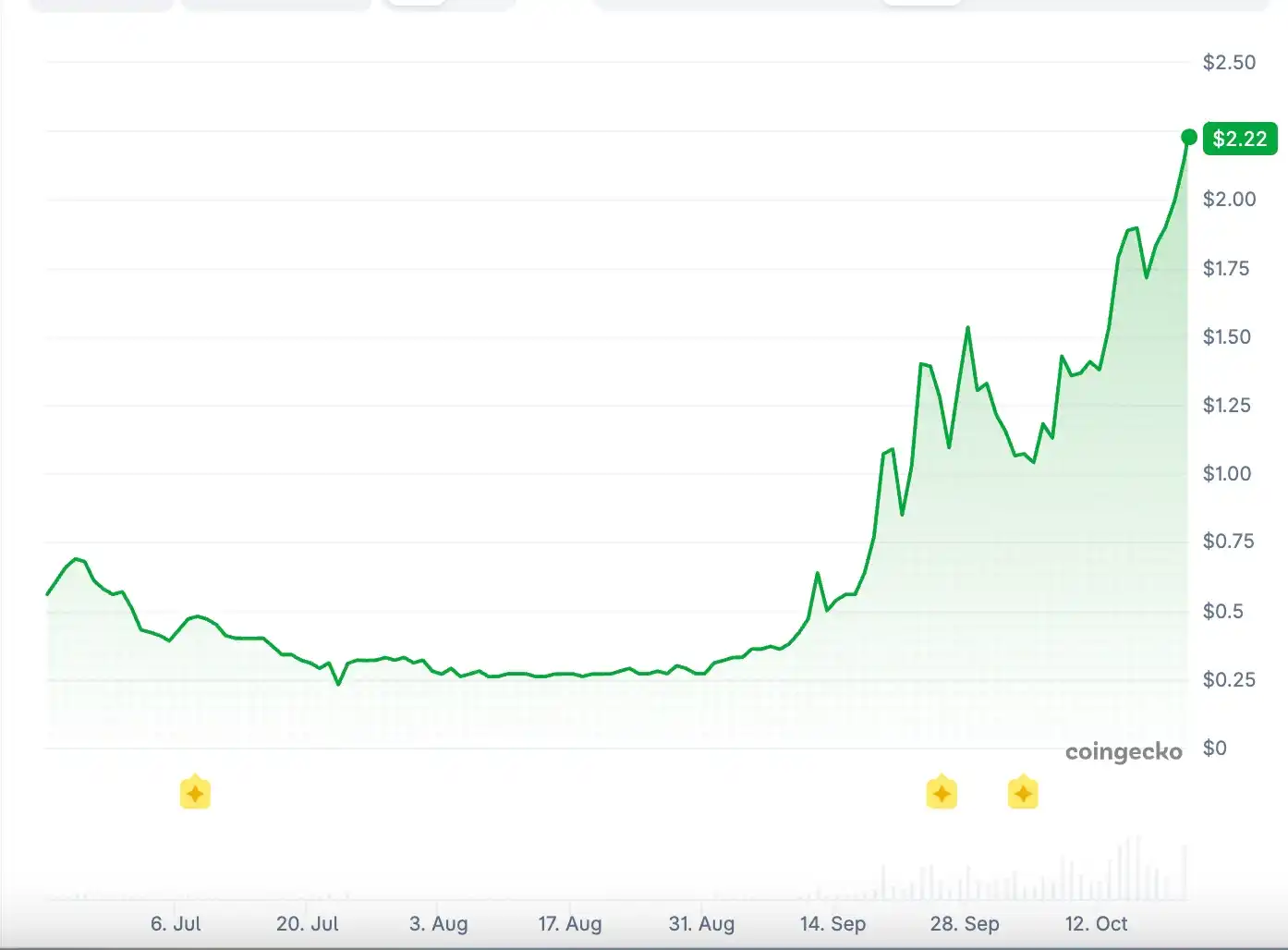
PEARL rose from $0.23 to $2.2 in four months
PEARL has been one of the stronger performers in the crypto market in recent months. CoinGecko data shows the token rose from a low of $0.23 to $2.2 over the past four months, a gain of nearly 9.5x. Its market capitalization has reached $760 million, placing it among the top 100 crypto assets globally by market value.
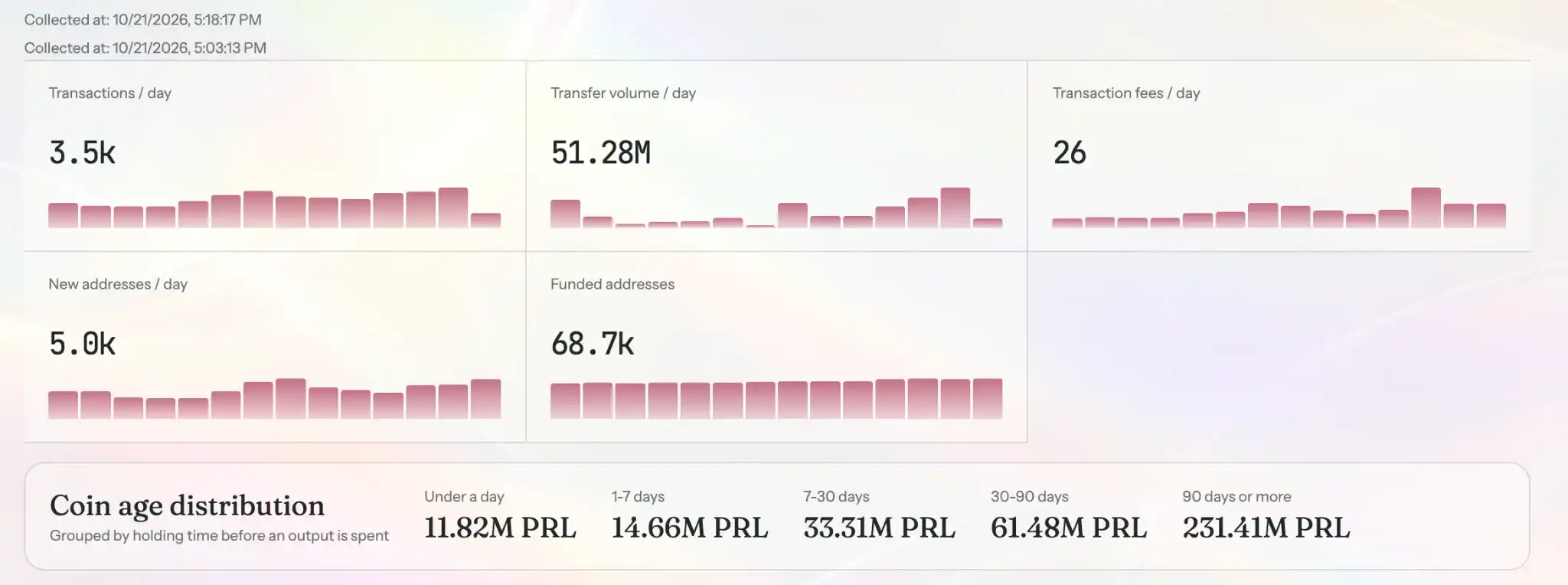
On-chain activity has also picked up. Data from Pearlhub.ai shows that, as of Oct. 21, the number of active PEARL holding addresses had exceeded 68,000. Daily new addresses have continued to rise, with the latest figure at 4,982.
Ownership, though, remains relatively concentrated. The top 100 addresses hold 42.12% of the token supply, while the top 10 addresses account for 14.15%. So even as the holder base expands, a large share of tokens is still controlled by a small number of wallets.
Transfer activity has accelerated as well, with both daily transfer value and transaction count recently reaching new highs. By holding period, about 65.8% of transferred tokens had been held for more than 90 days. Tokens held for 30 to 90 days made up 17.5%, while those held for 7 to 30 days, 1 to 7 days and less than one day accounted for 9.5%, 4.4% and 3.1%, respectively. That suggests recently moved tokens have mainly come from longer-held positions rather than short-term inventory.
Transaction value is concentrated too. Over the past 30 days, PEARL recorded more than 180,000 transactions, but the top 1% of those trades, or 291 transactions, contributed 96.3% of total transferred value.
Liquidity is still thin in the secondary market
Despite the price rally, PEARL’s secondary-market liquidity remains limited. CoinGecko data shows about $9.86 million in trading volume over the past 24 hours, with 98.8% concentrated on three relatively smaller exchanges: SafeTrade, BigONE and Ourbit.
There have been some signs of broader market access. Prep DEXLighter and HIP-3 market deployer Entropy have listed PEARL contracts, with daily trading volume in the millions of dollars. Entropy also spent 500 HYPE to secure the PEARL trading code. Coinbase and Kraken have each added PEARL to their listing roadmaps, and digital asset custodian BitGo has partnered with Pearl. Those moves have raised expectations that the token could gain more trading channels and better liquidity over time.
Pearl also changed its ticker from PRL, which had overlapped with another project, to PEARL. In the community, that has been viewed as a positive signal ahead of possible future listings.
Part of the liquidity issue comes from the network’s architecture. Pearl uses an independent UTXO model similar to Bitcoin rather than issuing an ERC-20 token on Ethereum. That means exchanges need to integrate support at the chain level, and decentralized markets need extra technical work and time to build liquidity around the asset.
Token distribution is another factor. Pearl had no premine and no dedicated allocation for the team or venture capital investors. All tokens are produced through mining. That structure avoids concentrated sell pressure from large pre-allocated holdings, but it also means the project lacked early liquidity support from professional market makers or institutional investors. Public-market trading depends more on miners selling tokens and on naturally formed order flow. Over-the-counter activity has partly filled that gap, with cumulative volume on Pearl OTC approaching $33 million.
Pearl’s pitch: useful compute instead of pure hash power
Pearl positions itself as a PoUW Layer 1 that combines AI compute with blockchain mining. Its mainnet went live in April this year.
Unlike Bitcoin, which secures the network through hash computation, Pearl uses matrix multiplication, or GEMM, a common operation in AI training and inference, as the core mining task. The network then verifies those results with cryptographic proofs. In theory, the same GPU resources can both generate mining proofs and provide compute services for AI inference.
The design targets a long-running economic issue in traditional proof-of-work systems. As Bitcoin block rewards decline over time, miners need transaction fees or other revenue sources to offset mining costs. At the same time, the rise of AI compute has created a new way for GPU operators to monetize hardware. Pearl wants miners to earn token rewards while serving AI customers, using business revenue to share hardware and operating costs and reducing reliance on selling newly mined tokens. That is why parts of the market have framed Pearl as an "AI Bitcoin."
The team’s academic background has also drawn attention. Founders include Omri Weinstein, a Princeton mathematics PhD and professor of computational complexity theory at Columbia University, as well as cryptography researcher Ilan Komargodski.
On the application side, Pearl’s longer-term goal is to build a market for useful compute by connecting supply and demand and exploring on-chain settlement for compute contracts. The project has already pushed several related efforts, including inference services with Together AI, an inference platform compatible with the OpenAI API, and cloud-based compute mining services.
In its work with Together AI, Pearl is trying to attract users through pricing. It has offered discounts of more than 25%, with part of that price advantage supported by expected PEARL token emissions.
Price is not the only angle. Pearl is also trying to differentiate through privacy and verifiability. The protocol already uses zk-SNARKs to protect mining proofs so matrix data is not exposed during verification. It is also working with Attestable on a privacy-preserving inference proof system intended to let users verify that inference services were executed as expected without exposing their data.
Public endorsements have added to the momentum. Brian Breslow, partner at No Limit Holdings, called Pearl the "next-generation Bitcoin," said it was one of his highest-conviction investments, and floated a price expectation above $30. Dragonfly partner Tom Schmidt also spoke positively in an interview about the project’s mechanism design and its attempt to bring AI compute into proof-of-work. Stripe’s CEO mentioned Pearl on social media. DWF Ventures said the project was a major topic among institutional funds and retail traders during TOKEN2049 Singapore, adding that its early mystique and relatively high barrier to participation reminded some observers of Bittensor in its early days.
Open questions remain around useful demand and token value capture
For all the attention Pearl has received, the project still faces several unresolved tests across technology and economics.
The first is whether useful compute can actually be delivered at scale. Pearl was designed so miners could complete mining while running AI inference tasks. But verifying that matrix multiplication was executed correctly does not prove that the work served real AI demand. Miners can still run random matrices and earn token rewards without providing inference services to paying customers. So while the protocol creates a path for useful computation, it has not yet shown that most mining activity is tied to AI services with real economic value.
The second issue is value capture. Pearl wants PEARL to be used in the future to pay for AI inference through a compute services marketplace. At the moment, though, users mainly buy services through prepaid balances denominated in U.S. dollars, while miners receive PEARL through mining. There is not yet a clear mechanism linking service growth to token purchases, payments or token burns. That means even if AI inference demand keeps growing, PEARL demand does not automatically rise with it. Without a direct value-capture mechanism, the token’s valuation still depends to a large extent on market expectations around the project’s technical narrative and on the balance of miner selling.
Ongoing issuance and mining concentration add pressure
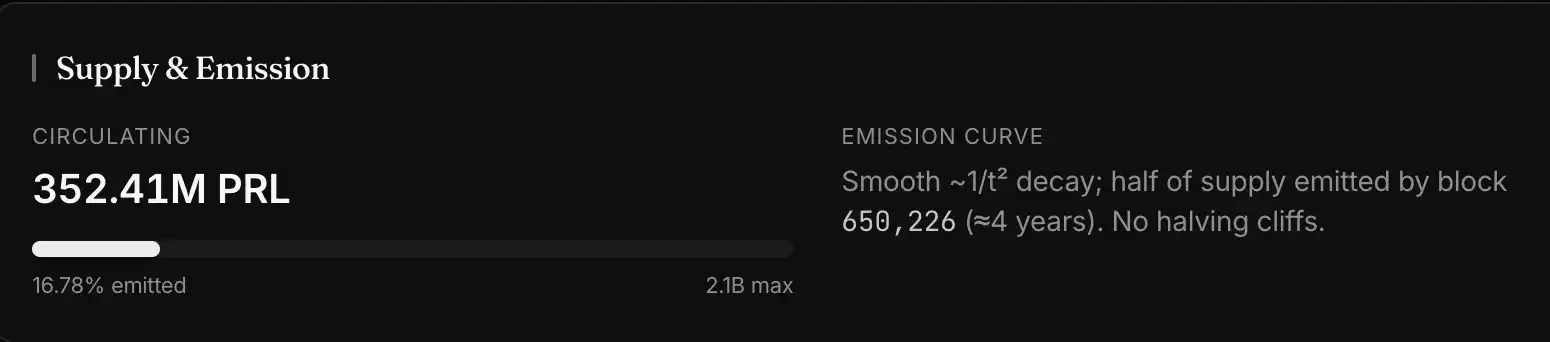
Supply growth is another major variable. PearlTrack data shows that, based on the current block reward and block production pace, Pearl is issuing about 1.2 million new tokens per day. At the current PRL price, that implies a nominal daily issuance value of about $2.628 million, equal to 26.7% of the past 24 hours’ $9.86 million trading volume.
On an annualized basis, PEARL issuance is about 438 million tokens per year. At the current price, that translates to nearly $960 million in annualized issuance value, or about 126% of the project’s current $760 million market capitalization. That figure does not equal actual sell pressure. Miners may sell part of their holdings to cover electricity and hardware depreciation, but they may also hold or sell gradually.
The longer-term issuance structure matters as well. Pearl has a maximum supply of 2.1 billion tokens, all generated through mining. Because early mining difficulty was very low, the first 40,000 blocks were mined in just six days, producing about 121.7 million PEARL. Based on the current cumulative mined supply of about 340 million tokens, that early issuance accounts for roughly 35.8% of all tokens mined so far.
At present, about 16.7% of the maximum supply has been mined. Pearl uses a smooth polynomial decay model rather than Bitcoin-style periodic halvings. Based on the current issuance curve, roughly half of total supply is expected to be mined by around the end of 2029. That leaves a large amount of future supply still set to enter circulation over the next several years. If growth in AI inference demand, real PEARL usage and market liquidity does not keep up with new issuance, miner selling pressure could remain in place. If the market narrative cools, supply-demand imbalance could amplify price swings.
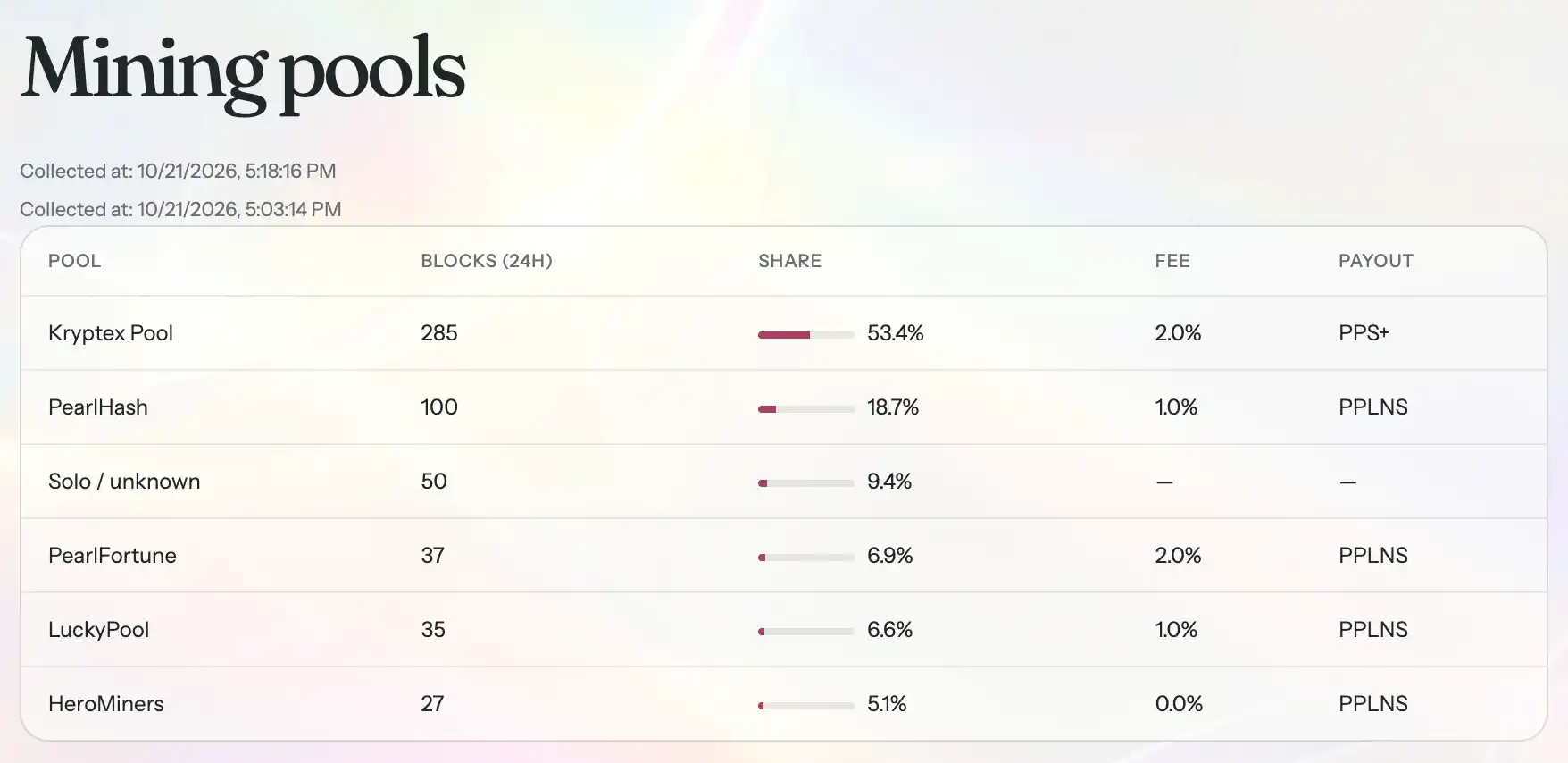
Mining power concentration is another concern. Pearlhub.ai data shows that the two main mining pools, Kryptex and PearlHash, control 72.2% of the market share, concentrating network hash power in the hands of a small number of pool operators. That raises questions around decentralization and network security.
Pearl’s core innovation is its attempt to combine AI inference with blockchain mining. Whether that idea can become a durable economic model will depend on growth in real compute demand, a clearer token value-capture framework and the market’s ability to absorb continued supply.