

Researchers at Stanford University and Singapore Management University found that Polymarket’s 5-minute Bitcoin prediction market gave traders an incentive to manipulate the settlement price, allowing more sophisticated participants to profit at the expense of retail users.
The contract structure examined in the study was straightforward: traders bet on whether Bitcoin would be above or below a preset level five minutes later. Settlement relied on a Chainlink oracle price taken at the end of each trading window.
Why the 5-minute format stood out
The issue, according to the paper, was the use of a single price point at settlement. If the contract only cares about one instant, traders holding a position have a clear reason to push the spot price in a favorable direction just before settlement, then let it snap back once the contract is resolved.
The researchers analyzed trading activity around the launch of the contract on Polymarket in July 2024 and said they found a clear pattern: spot-market order flow jumped before settlement, then prices reversed quickly afterward. The paper says that behavior is highly consistent with settlement-price manipulation.
About $1.28 million shifted from regular traders to manipulators
The study estimates that roughly $1.28 million was transferred from ordinary traders to manipulators during the sample period. It describes the behavior as systematic rather than isolated, with traders exploiting a structural weakness in the settlement design during the most sensitive 5-minute window.
Two fixes proposed in the paper
The authors do not present the findings as evidence that prediction markets are inherently vulnerable. Their argument is narrower: market fairness depends heavily on settlement design.

One proposed fix is to extend contract duration from 5 minutes to 15 minutes. A longer window would force anyone trying to move the price to maintain that distortion for more time, raising both cost and risk.
The second option is to use a time-weighted average price, or TWAP, instead of a single end-point reading. In that setup, brief price spikes or drops near settlement would have far less influence on the final result.
- Extend the settlement window from 5 minutes to 15 minutes
- Use TWAP rather than a single instant price
Both proposals aim at the same point: make it much harder for one actor to control the settlement price in a brief moment.
The paper says this is not an indictment of prediction markets
The researchers stress that the results should not be read as proof that prediction markets are inherently easy to manipulate. Their conclusion is that fairness rises or falls with contract design. The shorter the settlement window and the more heavily it depends on a single spot price, the more room there is for targeted exploitation.
The implications, they argue, reach beyond crypto. The paper notes that Nasdaq and the Chicago Board Options Exchange, or Cboe, have proposed event contracts tied to asset prices. As prediction markets move from DeFi into regulated financial venues, settlement mechanics become a central market-structure question rather than a technical footnote.
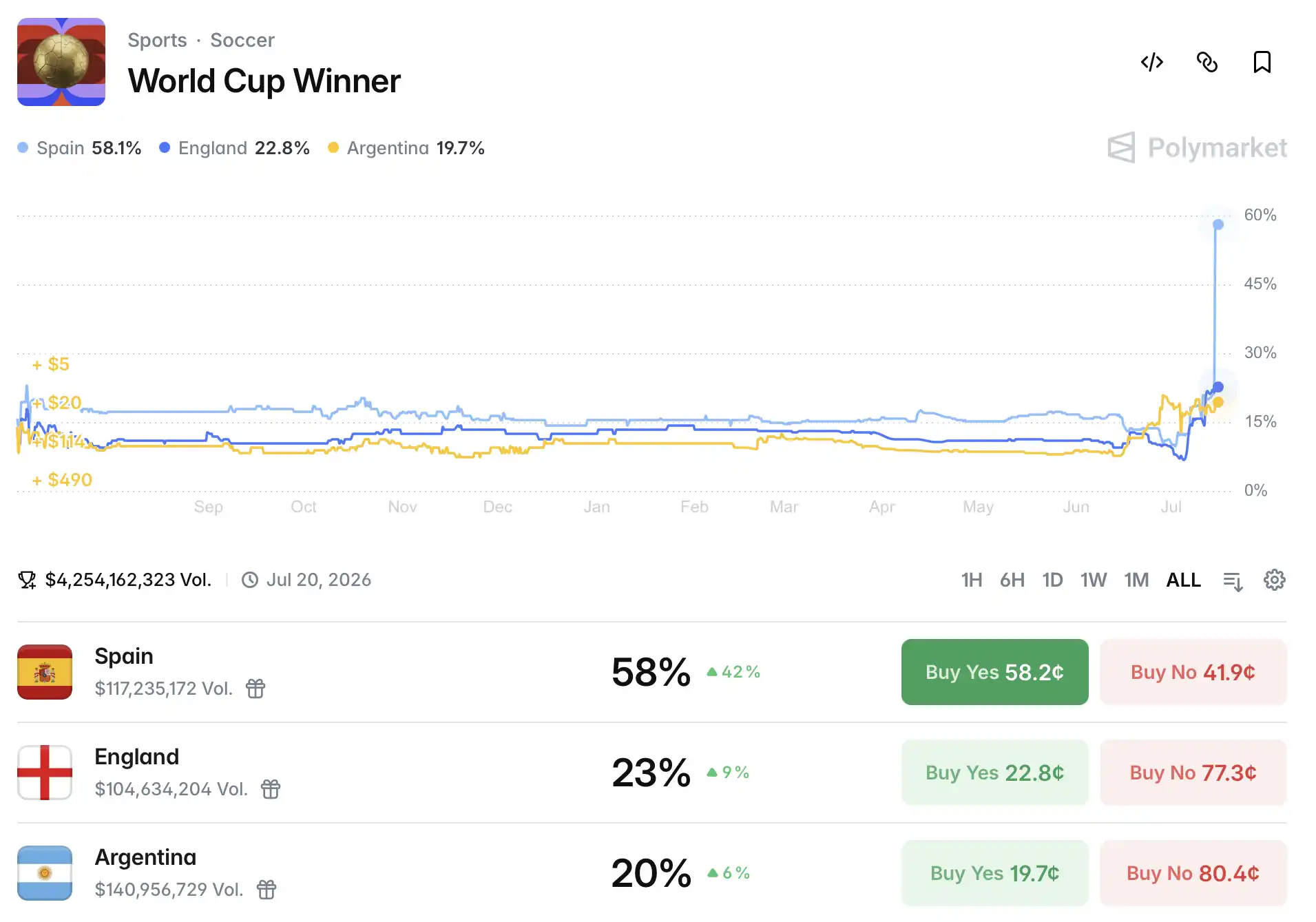
World Cup activity pushed prediction-market volumes higher
The report also points to rapid growth in the sector. Prediction markets hit a record trading volume in June, helped by activity around the expanded 2026 FIFA World Cup. Data from DefiLlama showed Kalshi handled about $9.4 billion in volume that month, while Polymarket International handled about $4.3 billion.
Taken together, the two platforms’ World Cup winner markets generated more than $5.4 billion in volume, including about $4.25 billion on Polymarket and about $1.2 billion on Kalshi.
Jurisdiction fight has reached federal court
Regulatory pressure is building alongside that growth. The report says several US states challenged Kalshi and Polymarket this year, while the Commodity Futures Trading Commission, or CFTC, maintains that federally regulated event contracts fall within its exclusive authority rather than state gambling law.
The dispute is now in federal court. Legal observers cited in the report say conflicting appellate rulings could eventually push the question to the US Supreme Court: who has primary jurisdiction over prediction markets?
The answer could shape whether prediction markets in the US keep expanding as a form of financial innovation or face restrictions state by state under gambling rules. The fairness of contract design, the paper suggests, is likely to remain central to that debate.