
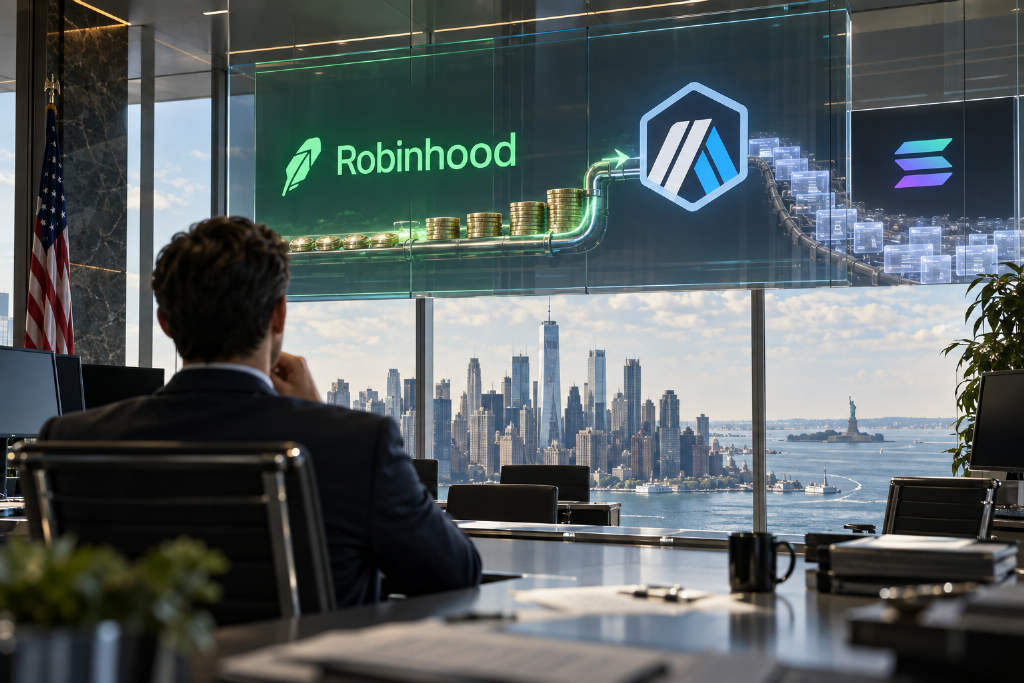
Robinhood Chain has quickly turned into one of the biggest cash-flow drivers around the Arbitrum ecosystem. Since the mainnet went live in early July, the chain’s fee revenue has risen fast enough that Arbitrum’s revenue share from the partnership is now close to what Arbitrum’s own network has collected in fees for the year so far.
The rise in activity has also opened a broader argument over how public blockchains should make money. As Robinhood Chain’s gas costs climbed, Solana co-founder Anatoly Yakovenko and Arbitrum co-founder Steven Goldfeder began trading criticism in public, turning the debate into one about infrastructure pricing, sequencer control and who gets to keep the value created on-chain.
Robinhood Chain has generated enough fees to send about $3.75 million to Arbitrum
According to the latest data from arbdata, Robinhood Chain has generated $37.56 million in cumulative fee revenue since its mainnet launch in early July. That total marked a new high, with the past seven days up 362.6%. Based on the annualized average of fee income over the last 30 days, the chain is running at roughly $406 million on an annualized basis.
Under the licensing agreement between the two sides, Robinhood Chain returns 10% of net protocol revenue to the Arbitrum ecosystem. Based on the current cumulative total, that would send roughly $3.75 million to Arbitrum.
That is striking because Arbitrum’s own network has generated only slightly more than that over the same period. DeFiLlama data cited in the report shows Arbitrum itself has collected about $3.87 million in fees so far this year. In other words, just two months of Robinhood Chain revenue sharing have nearly matched Arbitrum’s own 2026 fee income.
The gap looks even wider on a daily basis. Over the past 24 hours, Robinhood Chain recorded $2.9 million in daily fees. At a 10% share, Arbitrum would receive about $290,000. Over the same period, Arbitrum’s own network generated just $12,000 in daily fees. That puts the single-day “rent” from Robinhood Chain at about 24 times Arbitrum’s own daily network fee revenue.
ARB has climbed 135.8% in 30 days as the market prices in a “picks and shovels” story
The income narrative has fed expectations that Arbitrum may eventually capture more value from activity built on top of its stack. That expectation has been a major part of ARB’s recent move.
CoinGecko data cited in the article shows ARB has gained more than 135.8% over the past 30 days, reaching its highest level since January this year. During that stretch, ARB at one point outperformed a range of major crypto assets on a single-day basis and became one of the stronger tokens in the market.
Still, the report notes that the revenue coming from Robinhood Chain is not being used for token buybacks or burns. Under the agreement, 8% of the 10% revenue share goes to the Arbitrum DAO treasury, while 2% goes to the Arbitrum Developer Guild.
That means Robinhood Chain is creating real cash flow for the Arbitrum ecosystem, but the cash does not yet translate into a direct return mechanism for ARB itself. The market, as framed in the report, is effectively trading on an expectation of future value capture that has not been realized yet.
ARB still faces token unlock pressure, with the next release due on Sept. 16
The token also continues to face supply-side pressure. According to Token Unlocks data cited in the report, ARB’s unlock schedule runs through March 2027, and the next unlock is expected on Sept. 16.
That event is projected to release about 92.65 million ARB. At current prices, the report estimates the batch at roughly $17.1 million, equal to about 1.59% of total supply.
Goldfeder has recently argued that the market may be misreading how much new circulating supply is still ahead. He said token unlocks for ARB investors and team members are close to completion and will be fully finished by March next year. The still-locked portion from that group now accounts for about 7.7% of total supply.
He also said the Arbitrum DAO treasury holds 2.84 billion ARB, but those tokens are not “locked” in the traditional sense. They are controlled by circulating token holders, and any transfer would require approval through token-holder voting.
That leaves ARB with two narratives running in parallel: stronger ecosystem revenue from Robinhood Chain on one side, and an ongoing unlock schedule on the other. Whether Robinhood Chain can sustain its current transaction pace and fee levels, whether the shared revenue eventually finds a way back to ARB holders, and how the remaining unlocks affect supply are all still open questions in the market.
Yakovenko attacks the high-gas model
As Robinhood Chain activity accelerated, its gas costs became a flashpoint. The article says Robinhood had considered Arbitrum, Ethereum and Solana when it decided to build its own layer 2, and ultimately chose Arbitrum.
With transaction activity rising, average fees per transaction on Robinhood Chain reportedly climbed to about $0.4, more than 100 times higher than Solana over the same period. Yakovenko shared the data and argued that the 10% revenue share Robinhood Chain sends to Arbitrum alone would already be enough to cover more than four times the cost of equivalent transactions on Solana.
In his view, if Robinhood Chain had been built on Solana, Robinhood could have paid users’ gas on their behalf and offered near gas-free trading. He argued that frontend applications should monetize their users and products directly, rather than relying on the base infrastructure to make money by pushing up transaction costs across the network.
Yakovenko went further and called Robinhood Chain’s current setup “brain dead.” He asked why Robinhood could not simply charge users in the app while using a lower-cost base layer to reduce its own operating costs. He also questioned whether lower congestion and greater scale really have to come at the expense of revenue.
Goldfeder says Robinhood chose to be a landlord, not a tenant
Goldfeder rejected that framing and called Yakovenko’s view “absurd.”
His argument is that Robinhood keeps 90% of gas revenue on Arbitrum’s setup. If it had used Solana directly, the base-layer fees would go to the Solana network and its validators. In that case, if Robinhood wanted to offer users fully gasless transactions, it would have to pay for them itself.
Goldfeder described Robinhood’s choice as a decision to become a “landlord” rather than a “tenant.” By controlling its own sequencer, Robinhood can keep most fee revenue inside its own system. He also argued that most on-chain fee income does not come only from transactions initiated directly through Robinhood’s frontend. If Robinhood merely brought users and order flow onto a public chain without controlling the rails, it would not participate in the extra transaction revenue created there.
Yakovenko pushed back on that model as well. He said the true cost of transacting on Arbitrum is not limited to visible gas fees, because users also bear hidden costs such as spreads and MEV. By his estimate, the cost represented by Arbitrum’s 10% revenue share, once translated into basis points, already exceeds losses from sandwich attacks and could be around 10 times larger, even before factoring in spread.
He also argued that a single sequencer designed to maximize shareholder value cannot beat permissionless competition over the long run.
Goldfeder responded that comparing only posted fees misses the point. He said Arbitrum One and Robinhood Chain actively defend against front-running and most harmful forms of MEV, while some chains that advertise lower fees may expose users to higher MEV costs, including front-running aimed at retail traders. His position is that paying a clear, visible fee upfront may be preferable to facing hidden losses from front-running or sandwich attacks.
Sept. 29 may become the real stress test
Goldfeder also said running a chain is itself a profitable business, and that Robinhood has already shown it does not need Solana’s traffic and distribution. He added that Robinhood also does not need the traffic and distribution of Ethereum or Arbitrum One. What the Arbitrum-plus-Ethereum combination provides, in his telling, is the ability for Robinhood to own and operate its own chain.
That is why the argument is bigger than the sticker price of a single transaction. The article frames it as a dispute between two value-capture models. Yakovenko’s model treats the chain as low-cost backend infrastructure while applications monetize users directly. Goldfeder’s model gives the application its own chain, its own sequencer and more control over fee pricing, allowing more of the economic value generated on-chain to stay inside that app’s ecosystem.
On the technical side, the report notes that layer-2 gas fees are mainly made up of layer-1 data availability, or DA, costs and layer-2 execution costs. DA costs have dropped sharply in recent years, while execution fees are largely determined by the sequencer. That gives an L2 substantial freedom in pricing. It can lower costs through subsidies or fixed low pricing, or choose a higher-fee structure if that suits its business model. In that sense, Robinhood Chain’s fee level is presented as an active commercial choice, not a technical inevitability.
A more concrete test is now on the calendar. The report says gas subsidies for Robinhood Wallet users will end on Sept. 29, and fee waivers and subsidies offered by centralized exchanges are also expected to phase out over time. Once users begin paying more of the real transaction cost themselves, the market will get a clearer read on whether Robinhood Chain can maintain its current trading activity and ecosystem momentum under a higher-cost environment.