

Robinhood Chain’s first two weeks on the market have produced a set of numbers that cut straight into one of Ethereum’s longest-running arguments: if Layer 2 networks keep growing, how much of that value does ETH actually capture?
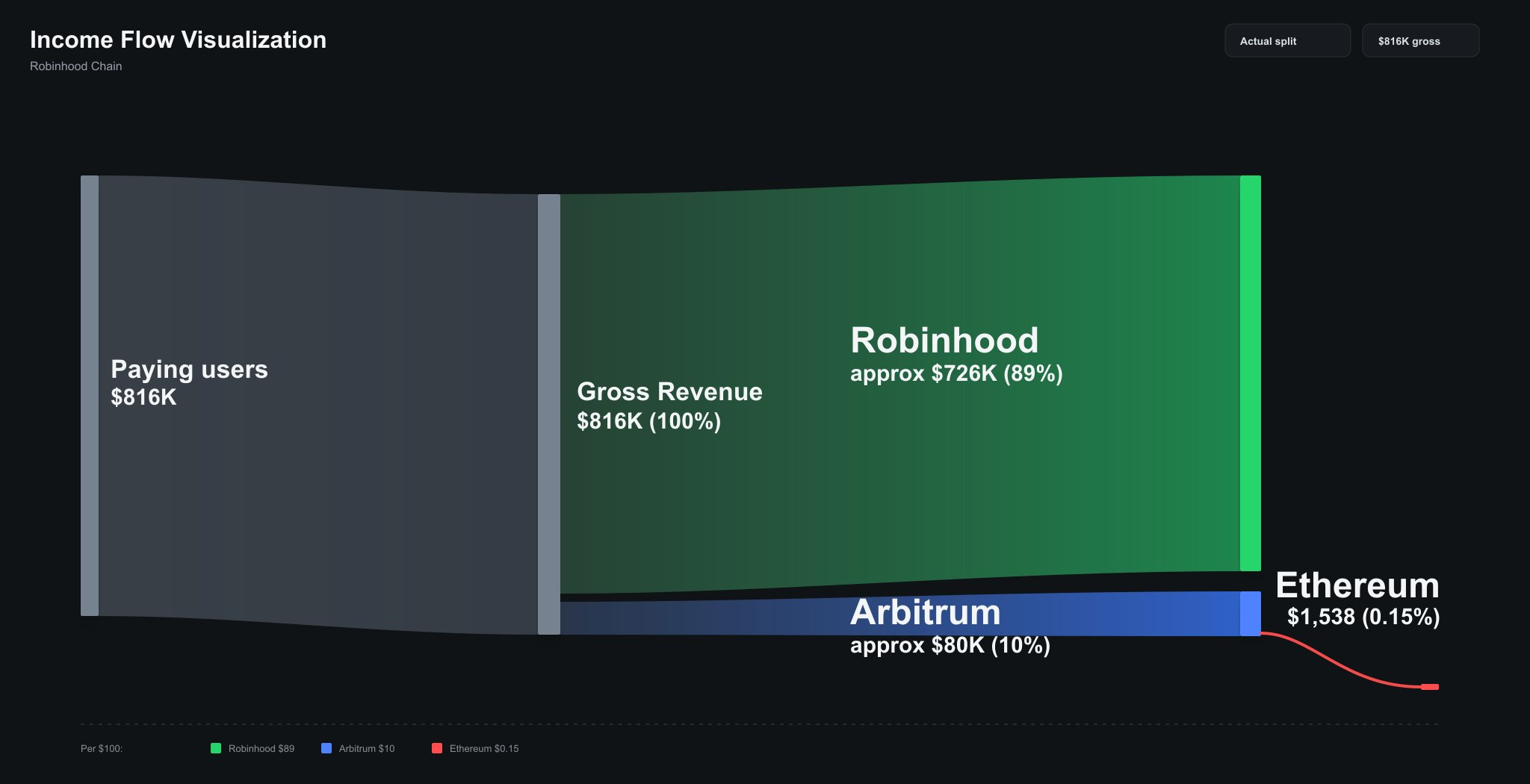
On July 13, Lorenzo Valente, ARK Invest’s director of crypto research, posted on X that Robinhood Chain had generated about $816,000 in total revenue since its July 1 launch. His breakdown was stark. Robinhood kept 89% of that total, Arbitrum as middleware captured about 10%, roughly $80,000, and Ethereum, serving as the base settlement layer, received just $1,538, or 0.15%.
Valente called Robinhood Chain “the cleanest case study” of the shift in Ethereum’s economic model.
Trading activity ramped up quickly after launch
According to DefiLlama data cited in the report, as of July 13 Robinhood Chain recorded about $791 million in 24-hour DEX volume, ranking third across networks behind only Solana and BNB Chain. Total value locked had passed $160 million, while more than 82,000 ETH, worth about $147 million, had already been bridged to the network.
The report said that a Layer 2 chain built by a traditional brokerage had, in less than half a month, caught up with or even overtaken Hyperliquid and Ethereum mainnet in onchain trading volume.
One set of figures, two very different investment cases
Valente did not present the revenue split as a simple bullish or bearish signal. Instead, he said it points to two different ways of thinking about ETH.
If the thesis is that ETH is money, then Robinhood choosing to build on Ethereum is highly positive. More activity means more ETH used as collateral and gas, which strengthens the network effects around ETH as a monetary asset. Valente said Robinhood never seriously considered Solana, Sui, or any other monolithic Layer 1. In his words, “They want to be landlords, not tenants.” The point, as he framed it, is that Robinhood wants control over the full stack, and Ethereum’s modular design allows that.
If the thesis is that ETH is a productive asset that should generate revenue, then the picture looks very different. Ethereum provides what Valente described as the most valuable settlement layer in crypto, yet captures almost none of the fees. He suggested a healthier split would look like this: 75% to Robinhood, 10% to Arbitrum, and 15% to Ethereum. He ended his post with a direct message to the Ethereum ecosystem: “Things need to change.”
Joe Lubin defended the low-fee model
The post drew a response from one of the best-known figures in Ethereum. ConsenSys founder Joe Lubin replied in the comments that Layer 1 fees are supposed to stay low. In his view, that is a strategy for attracting developers and companies, not a flaw in the system.
According to CryptoTimes, Lubin said that over the next two to three years, tens of thousands of companies could deploy applications across Ethereum Layer 1, different Layer 2 networks, and private permissioned EVM chains, with interoperability protocols linking those environments. His argument is that once the network reaches sufficient scale, ETH’s monetary premium should rise, staking and lockups should keep reducing liquid supply, and EIP-1559’s burn mechanism should support value accrual through supply and demand rather than settlement fees alone.
Valente was not persuaded. In his reply, he questioned whether the assumption of “tens of thousands of Robinhood-sized companies” is realistic. Robinhood’s market capitalization is close to $50 billion, and companies of that size are rare globally.
The discussion then widened. Kyle Samani, managing partner at Multicoin Capital, repeated his long-held position that Layer 2 networks are “parasitic” on Layer 1. HashKey Capital has argued the opposite in earlier research, describing Ethereum as the “ultimate settlement layer.”
The current data comes with a 90-day subsidy window
The activity on Robinhood Chain also comes with an important caveat. Robinhood is currently covering all gas fees for users, and that subsidy period lasts 90 days from launch. It is expected to expire in late September.
Research from Bernstein analyst Gautam Chhugani’s team said Robinhood Chain posted $3.1 billion in DEX volume in its first week. About 65,000 users held roughly $300 million in stablecoins and $13 million in tokenized stocks on the network. Bernstein also said the first week’s activity was mainly speculative. On July 9 alone, daily volume reached $568 million, helping push ARB up 19% in a single day.
FalconX estimated in an April report that Robinhood Chain could generate about $1.1 million in fee revenue over six months, though that projection assumed the subsidy would gradually roll off. The firm also gave a longer-range forecast: annualized revenue could reach $60 million by 2030 if users expand beyond tokenized equities into DeFi and other onchain applications.
That leaves one major open question. User retention after the subsidy ends is likely to determine whether Robinhood Chain becomes a durable Layer 2 network or just a short burst of traffic.
An old Ethereum problem is back in focus after Dencun
What made Valente’s breakdown resonate is that it touches a deeper concern inside the Ethereum community, one that has been building for roughly two years: after the rise of Layer 2s, how much value can ETH still capture?
The report points back to the March 2024 Dencun upgrade, which introduced EIP-4844, or blob transactions. After that change, the data availability fees paid by Layer 2s to Ethereum Layer 1 fell sharply. Ethereum’s fee revenue and ETH burn both declined as well. Robinhood Chain’s numbers put that trend into a single concrete example. The same pattern, the report argues, has already shown up with Coinbase’s Base, application-specific chains built on Arbitrum, and now Robinhood Chain. Ethereum’s settlement security still attracts the largest players, but the settlement fee itself has become almost negligible.
As of publication, ETH was trading at about $1,780.