

Robinhood said on July 1, 2026, in London at its The World is Flat event that Robinhood Chain is now live on mainnet. The move stands out because the company is not just adding another crypto feature. It is launching its own Ethereum-compatible Layer-2 network while serving nearly 28 million funded customers and holding more than $370 billion in platform assets.
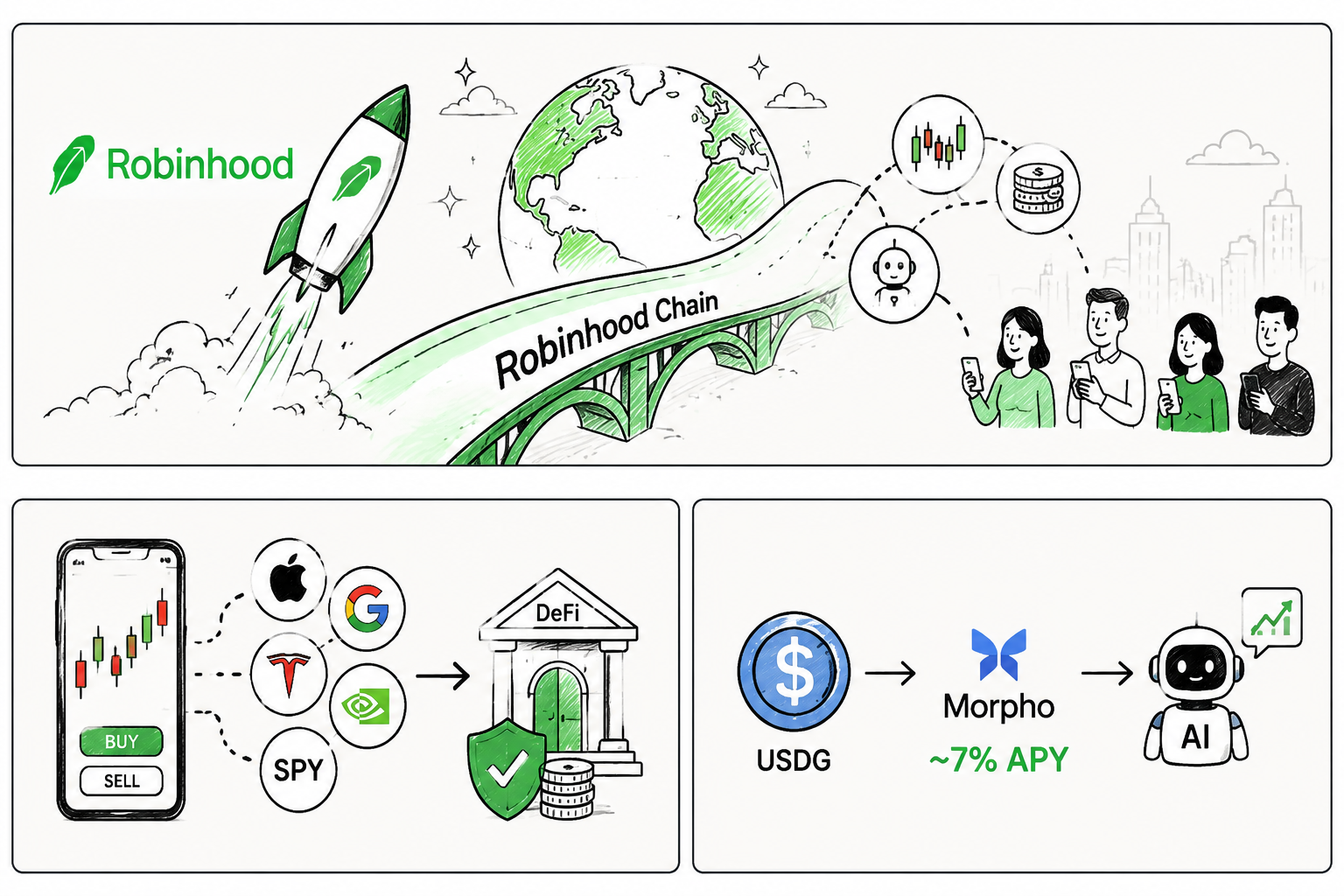
According to the source text, Robinhood Chain is built on Arbitrum and is aimed at real-world asset tokenization. On day one, the network launched with integrations involving Uniswap, Morpho, Chainlink and BitGo. Robinhood also rolled out tokenized stocks for 24/7 trading across more than 120 countries, onchain self-custody yield of about 7% on USDG, and AI agent trading for crypto and other onchain assets.
From trading app to chain operator
The source frames this as a sharp shift in Robinhood’s role. In earlier years, the company was seen by many crypto users as a retail gateway that introduced beginners to BTC and ETH, while also drawing criticism over outages, withdrawal restrictions and payment-for-order-flow disputes.
By 2026, that picture had changed. The text says Robinhood’s strategy has moved beyond being a retail trading tool and now centers on three goals: becoming the top platform for active traders, taking the top share of next-generation user wallets, and building the world’s leading financial ecosystem. To pursue that third goal, it chose to build its own chain.
Robinhood Chain is described as a permissionless, EVM-compatible Layer-2 built for RWA and AI-native finance. Its technical base is Arbitrum Dedicated Blockchains. The chain inherits Ethereum security, offers high throughput and low fees, supports ERC-4337 account abstraction, uses ETH for gas, follows first-in-first-out ordering, and is fully open to developers who want to deploy smart contracts.
The source is explicit on one point: this is not a closed consortium chain. It is presented as a public blockchain.
Three launch-day products drew the most attention
Stock Tokens put tokenized equities into trading
The most visible product in the rollout is Stock Tokens. Through Robinhood Wallet, users in more than 120 countries can trade tokenized U.S. stocks and ETFs, with the source naming NVDA, AAPL and GOOG among the examples.
These instruments are not direct shares. The text says they are tokenized debt securities issued by a Jersey entity. They give users economic exposure, but not legal ownership or voting rights.
The source highlights several features attached to the product:
- 24/7 trading instead of traditional market hours
- Use as collateral in DeFi
- Ability to be deposited into lending protocols
- Trading through decentralized exchanges such as Uniswap
That structure brings equity-linked liquidity into an onchain setting. The source notes that even without full shareholder rights, tokenized stocks move beyond a concept and become tradable, composable assets.
Robinhood Earn offers about 7% on USDG
Robinhood Earn is another core piece of the launch. Based on the source, the product runs on Morpho and lets users lend out USDG, a dollar stablecoin issued by Paxos, for an estimated APY of about 7%.
The article also says coverage is provided by Lloyd’s of London and RELM. It describes this as Robinhood’s first real attempt to place self-custody and DeFi yield products in front of mainstream users, rather than limiting the experience to centralized finance style products.
AI agent trading moves onchain
The source says Robinhood first introduced AI agent trading for stocks and options in May. It has now expanded that model to crypto and onchain assets. Users can authorize an AI agent to execute trading strategies while still keeping control of their funds.
Combined with account abstraction and session keys, the setup points to a more direct path for AI-driven traders to operate onchain. In the source article, that is presented as a possible entry point for an agentic economy.
Partner lineup shows how broad the stack is
Robinhood’s partner list at mainnet launch covered multiple layers of the onchain finance stack. The source names the following companies and protocols:
- Uniswap for a dedicated AMM and public liquidity pool
- Morpho as the lending layer
- Chainlink for oracle services and cross-chain data
- BitGo and Fireblocks for institutional custody
- Alchemy for RPC and account abstraction infrastructure
- LayerZero for cross-chain bridging
- Lighter, Arcus, 1inch and Rialto for spot and perpetual trading
The article argues that this is more than a loose set of ecosystem partnerships. It places Robinhood Chain as a base layer for financial primitives.
The source also says Robinhood has made clear that it wants to gradually replace parts of its own infrastructure with blockchain-based systems. In that framing, the chain is not an add-on. It is part of a long-term architecture.
Why the move matters to Web3 users
A large user funnel may be coming onchain
Robinhood has nearly 28 million funded customers, according to the source, with an average age of about 36. The article says this cohort is moving into peak earning years. Users who may have previously bought small amounts of crypto inside the app could now be introduced to self-custody wallets, DeFi yield and tokenized stocks onchain.
The source presents this as one of the closest attempts yet to moving traditional retail users into the onchain world at scale.
RWA gets a more concrete trading use case
The article contrasts Robinhood’s launch with earlier RWA projects that focused on putting Treasury products onchain but struggled with thin liquidity and limited user activity. Here, Robinhood is tokenizing U.S. stocks and adding 24/7 trading plus DeFi composability. That gives the RWA narrative a more direct product example.
Competition in the chain market could shift
The source also raises a broader market question. Crypto discussions once focused on whether Coinbase could lose ground to Binance. Robinhood’s move adds another layer: if firms such as Schwab and Fidelity eventually build their own Layer-2 networks or purpose-built chains, the distribution of traffic and liquidity could change again.
Robinhood Chain runs on the Arbitrum stack and, according to the article, Robinhood has committed to returning part of protocol fees to the ecosystem. The source treats that as a meaningful signal in the existing Layer-2 market.
Risks remain despite the launch
The article does not ignore the limitations around the rollout.
- Stock Tokens are not actual shares. They are debt instruments without shareholder rights, and their structure could change if regulation tightens.
- U.S. users cannot use Stock Tokens for now, leaving the company’s most important domestic market outside the product.
- Even if Robinhood Chain is positioned as a public chain, its early liquidity and ecosystem activity still depend heavily on Robinhood’s own product flow and user base. How permissionless it becomes in practice remains an open question.
- AI agent trading introduces security and accountability questions. If users hand execution rights to an AI system and things go wrong, responsibility is not yet straightforward.
A direct TradFi push into core Web3 functions
The source’s conclusion is that Robinhood Chain marks a point where a traditional finance giant is entering core Web3 territory through its own chain, covering issuance, trading, lending, yield and AI-assisted execution.
It also points to three metrics worth tracking over the next few quarters: actual trading volume and holder counts for Stock Tokens, deposit scale in Robinhood Earn, and the growth curve for independent developers and TVL on the chain. If those three indicators keep rising, the article argues that 2026 could be remembered as the year in which TradFi and crypto began to merge more deeply.