


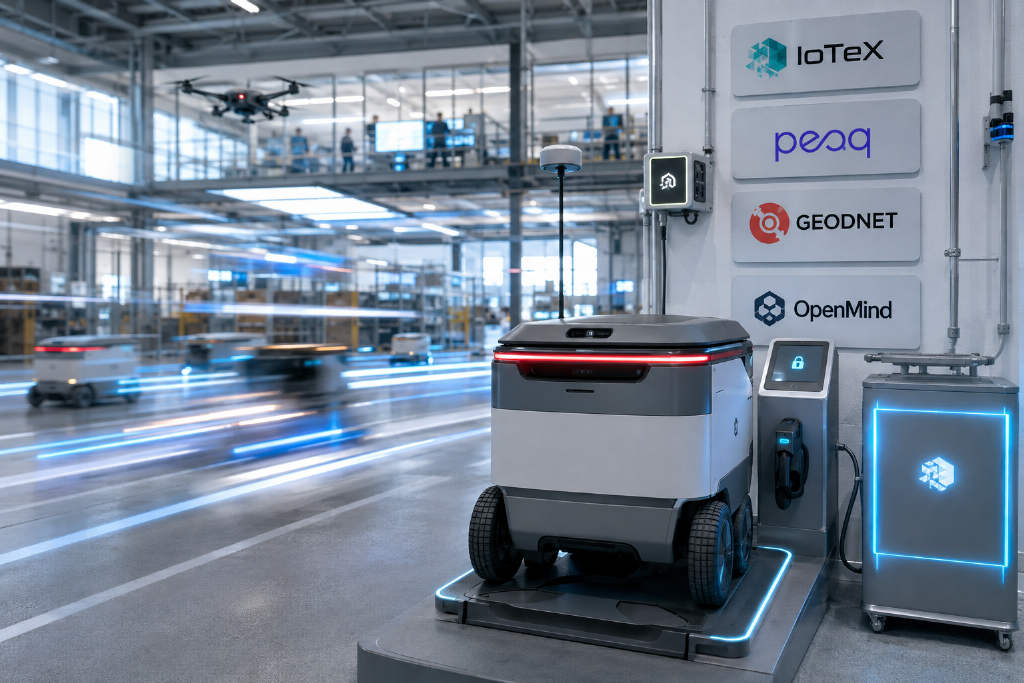
Robotics does not need crypto to grow. The case for crypto assets sits elsewhere: they can fill the coordination gap that appears when physical machines owned by different parties need to buy services, prove identity, and settle small transactions outside a closed platform.

Written by Thejaswini M A
Translated by Chopper, Foresight News
The question sounds strange at first: why would a robot need money? This is not about an AI agent calling APIs. It is about a machine with a body, one that moves through the world and performs work. Why would that machine need a wallet or its own credential set?
The article says the idea is no longer theoretical. More than a dozen crypto companies are already building products around it. The commercial logic is not to make robots “human-like,” but to let devices obtain services cheaply, settle instantly, and be recognized by counterparties that do not know them in advance.
Closed systems already work without robot wallets
There are established examples in the market. Starship Technologies operates about 3,000 six-wheeled delivery robots across 8 countries, mainly in European city centers, and has logged more than 10 million commercial delivery orders. Serve Robotics, which is listed on Nasdaq, has expanded to 44 cities including Los Angeles, Chicago, Atlanta, Miami, and Dallas, handling delivery orders from Uber Eats and DoorDash.
These wheeled delivery boxes can carry about 20 kilograms and travel several miles per trip. In those cities, they are already visible pieces of infrastructure rather than abstract prototypes.
Whether a robot needs its own payment stack depends on the setting. The article asks readers to imagine buying one delivery robot to run a neighborhood service. It works 12 hours a day. From the owner's perspective, it is a low-cost labor asset that generates revenue, and full ownership sits with the buyer.
Using Starship-style specifications, the machine can run for as long as 18 hours on a full charge. At some point, it needs electricity. Starship solves that by sending robots back to company-built charging stations. That works because the company has thousands of units and the capital to build charging infrastructure across its operating footprint.
A single-owner robot faces a different reality. It would need to rely on third-party charging points. Operators could deploy them as EV charging firms do, local shops could offer sockets, and other delivery fleets could open spare charging ports. Since the battery is closer to an e-bike than a car, each charging session is cheap. The article places the cost anywhere from a few cents to under $1, then uses $0.40 as the working example.
That leads to the payment problem.
Traditional payment rails are expensive for tiny transactions
The simplest option would be to attach a payment card to the robot and let it tap to pay. Card payments, however, usually include a percentage fee plus a fixed charge. The article uses a fixed fee range of $0.10 to $0.30. That fixed part does not change much whether the transaction is $0.40 or $400.
At a $0.40 charging fee, a $0.30 fixed charge consumes 75% of the transaction. The math gets worse at scale. The article sketches a scenario in which machines complete $1 billion in small service transactions per year, with an average payment size of about $0.32. That would mean 3 billion transactions. At $0.30 per payment in fixed fees, processing costs would total $900 million on $1 billion of revenue.
Wire transfers are even less suitable. A cross-border SWIFT payment can cost $15 to $50, with intermediary banks charging another $10 to $30 each, plus FX costs. The piece says that setup only makes sense for transfers above $5,000.
The core argument is blunt. Today’s payment system was designed for a small number of larger transfers. Machine-initiated payments look very different: high frequency, low value, and often made on demand.
Identity is an even harder problem than fees
Even if payment costs fall, another issue remains. A charging station still cannot really charge “the robot.” Payment accounts belong to people or companies and come with established dispute processes. In substance, the human or company behind the account is still liable, while the robot only triggers the tap. The article says this is how robot payments work globally today.
For a service provider, granting power to an unfamiliar device in a two-second window requires answers to several questions. Is the request coming from a real physical machine or from a script pretending to be one? Does the device have a usable operating record, or is it likely to leave mid-charge? If the device causes damage, is there a trail that supports accountability?
That is where an independent machine identity matters. It is not about giving robots personhood. It is about answering those practical questions without paper contracts.
Right now, people handle these issues manually. A provider invoices the owner at the end of the month. If something breaks, the provider contacts the owner or sues. That can work when there are only a handful of devices. It breaks down in a world with 2,000 operators and 40,000 robots meeting on city streets, where counterparties need a shared record before deciding whether to serve a machine.
The article treats this as the center of the thesis.
Most robots will never need independent asset accounts
The piece is careful not to overstate the case. It says most robots will never need autonomous payment systems. A machine only needs an independent account if all four conditions hold at once:
- the devices are owned by different parties;
- the orders are small and scattered;
- there is no centralized platform clearing payment between both sides;
- service authorization has to be granted on the spot within seconds.
That rules out much of the robotics industry. Amazon has deployed more than 1 million self-developed robots across more than 300 warehouses, all run through its own scheduling system, so the first condition does not hold. Platform businesses such as Uber Eats fail the third condition. Precontracted service relationships also fail the second and fourth tests.

That means the addressable niche is not “all robotics.” It is the subset of open coordination scenarios where machines interact outside vertically integrated systems.
The article runs through several examples. Tesla has deployed about 1,000 Optimus humanoid robots inside its factories, but management has said on earnings calls that the devices remain in a learning and data-collection phase and are not yet open for outside commercial services. FANUC, one of the largest industrial robot makers, sells hardware and offers its FIELD monitoring platform for fault alerts. That stack does not involve capital flows.
China’s Unitree Robotics has pushed humanoid robot purchase costs down to a more accessible range. The company completed its listing in Shanghai in August 2026, raising about $619 million, and delivered more than 5,500 humanoid robots in the prior year. Unitree has said buyers use the machines in a wide variety of ways. In May 2026, it also launched UniStore, an app store for humanoid robots.
In the article’s framing, these large players are following an Apple-style model: scheduling, collaboration, and payment all stay inside proprietary systems, with the profits retained inside the platform. Open protocols survive only in the gaps between those closed systems, such as cross-brand cooperation, public charging, and open labor marketplaces.
That is why the article warns readers to keep the scale in perspective. The robot segment described by CoinGecko under the DePIN label is much smaller than the broader robotics industry.
Layer one: a robot has to know where it is
Autonomous payments begin with location. Standard GPS can be off by several meters. Starship’s CEO has said publicly that ordinary GPS is not precise enough for the company’s operations, where robots need inch-level navigation.
Closing that gap requires correction signals. Ground reference stations first determine their own exact coordinates, calculate positioning errors, and then push correction data to nearby devices. This is RTK-GPS, or real-time kinematic positioning. The article puts the useful coverage radius at about 30 kilometers, which means the network requires a large number of base stations.
GEODNET uses token incentives to persuade users to install positioning stations on rooftops. According to the article, the network has deployed more than 21,000 devices across over 150 countries and generates about $11 million in annual recurring revenue. Multicoin Capital led an $8 million token acquisition deal.
GEODNET sells centimeter-level RTK services to delivery robots, drones, and agricultural machinery. The article is explicit that this service does not depend heavily on crypto tokens at the user level; a traditional subscription model could also work. The token model matters more on the infrastructure side, where GEODNET is presented as proof that incentives can accelerate global physical deployment. Building the same network conventionally could take decades and cost billions of dollars.
Layer two: robots need a shared software language
Robots from different manufacturers still run on isolated software stacks. Devices often cannot communicate with one another. Buyers usually pick a single hardware brand because mixed deployment requires custom integration software that does not already exist.
OpenMind is trying to address that layer. The project raised $20 million in a funding round led by Pantera, and its founder Jan Liphardt is a Stanford professor. The team is building an open-source general operating system called OM1 and a coordination layer called FABRIC, effectively aiming to give robots a common software substrate.
Under that approach, developers write business logic once and can deploy it across Unitree humanoids, quadrupeds, and wheeled delivery robots. The long-term goal is a common interaction language that lets devices identify each other across brands, cooperate, and settle payments automatically.
OpenMind builds machine identity on the ERC-7777 standard and uses it to define behavioral boundaries. If a robot is designated as an “assistive service” device, the software can reject tasks that fall outside that role. Robots can also cross-check sensor data with one another to reduce the chance that one machine’s faulty perception causes a safety incident.
On payments, OpenMind has partnered with Circle to test gasless USDC micropayments using the x402 standard, targeting the high fixed costs of small transactions. In the project’s published demo, a robot successfully paid for electricity on its own. The article notes that this ran on a testnet and that there are no real on-chain trade records yet.
Still, the demonstration matters. It shows that a physical machine can custody a wallet, recognize purchasable physical resources, and complete a full transaction flow without requiring preexisting trust between counterparties.
Layer three: verifiable device identity
IoTeX has been working on blockchain infrastructure for physical devices since 2017. The article highlights two products aimed at identity and proof.
- ioID embeds a cryptographic fingerprint into a physical device, allowing it to sign records of its own actions.
- W3bstream turns real-world execution into digital credentials that can be verified on-chain.
Even so, the article argues that identity and proof alone are not enough. IoTeX addresses who the device is and what it has done, but not the credit and financing systems that may be required once robots begin transacting in open markets. That is where peaq enters the story.
Layer four: peaq is building identity, credit, and settlement rails
If robots are going to pay unfamiliar third parties, verify eligibility, and leave a transaction trail, they need something closer to a commercial trust stack than a simple wallet. The article compares the required role to business registration systems or the SWIFT network in cross-border finance.
peaq’s setup is described through four main modules. peaqID serves as a registration credential. Machine NFTs record ownership and can be split using the ERC-3643 standard. The article describes ERC-3643 as a token standard that only permits transfers between approved holders. In August 2026, peaq added support for P256 chip signatures, moving verification into hardware security chips.
peaq also maintains a machine credit score from 0 to 100 based on revenue data, activity, and fulfillment reliability, with ratings ranging from AAA to unrated in a Moody’s-style framework.
The article gives a simple example. If a robot pays $0.40 for charging, the charging provider might want settlement on Solana or Ethereum. peaq’s value proposition is not that every transaction must settle on peaq itself. It is that the robot can connect to whichever settlement route the provider specifies.

That model appeared in a May 2026 demonstration where a Serve delivery robot paid autonomously and the funds settled on Solana rather than on peaq’s own chain.
From January through the end of August 2026, the project completed 49 development milestones and launched 20 ecosystem integrations. Those included GEODNET for positioning, NAVER for maps and navigation, and World ID for separating human and machine identity. It also connected to compute resources from Akash, Acurast, and Arcium, while bringing in hardware endpoints such as Unitree humanoids and LG CLOi commercial service robots.
The article is also clear about the limits. Business registration works because regulators back it. Courts can inspect those records. Banks use SWIFT because the industry accepts the same message formats. If peaq wants to operate outside traditional compliance structures, it still needs to engage regulators in Dubai and seek official licenses. Until formal approvals exist, financial institutions are unlikely to treat machine credit scores as legally meaningful.
On the asset side, peaq and CoinList have launched Initial Machine Offerings, through which users can buy shares of robot-linked revenue streams structured by DualMintRWA. The article points to a tokenized vertical farm in Hong Kong, with 80% of its workflow automated, as a flagship case. It later added 20 tokenized claw machines. So far, the farm has distributed about $3,600 to token holders.
AI agents paying robots may be more viable than robots paying each other
Even with location, operating systems, identity, and credit in place, robots still need someone to finance the hardware. One market answer, according to the article, is that the buyer may be an AI agent rather than a person.
Virtuals has connected about 17,000 on-chain AI agents to Solana’s BitRobot network. In that model, the AI agent pays a physical robot to complete an offline task. Funds sit in a smart contract and are released automatically after the work is confirmed.
The article argues that software agents paying robots is more commercially sustainable than robots transferring funds among themselves. AI agents have digital capital, goals, and compute but cannot act in the physical world. Physical robots have mobility and execution capacity but do not natively possess capital or their own demand. By contrast, when one robot pays another, the machines often belong to the same company, making internal accounting easier and cheaper than an actual on-chain transfer.
A niche inside a much larger robotics market
On market size, the article stays measured. Using CoinGecko’s robot-token segment, GEODNET carries a market capitalization of about $100 million, while peaq is around $55 million. That is still a niche inside a niche.
The underlying robotics market is far larger. Citing the International Federation of Robotics’ World Robotics 2025 report, the article says 542,000 industrial robots were newly installed worldwide in 2024, with an installed base of about 4.66 million units. More than 2 million of those were deployed in China.
It also cites a July 2026 external report from JPMorgan. That report estimated the global robotics market at about $100 billion in sales in 2025 and projected annual sales of $2.5 trillion by 2035 in its base case. The downside scenario was $500 billion, and the upside scenario reached $8 trillion. The same report put the humanoid robot market at $2 billion in 2025, growing to $300 billion by 2035 in the base case.
Crypto’s machine-economy builders are trying to position themselves beneath that larger market as an identity and payment layer rather than as the growth engine of robotics itself.
IoT promised something similar years ago
The idea of autonomous machine-to-machine commerce is not new. The article goes back to 2015, when IBM and Samsung demonstrated a washing machine that could buy its own detergent through Ethereum in a project called ADEPT. A few months later, IBM committed $3 billion to the internet-of-things business.
That wave did not produce a broad machine payment market. IoT shifted toward telemetry instead. Billions of devices now send operational data back to vendor servers. The technical stack landed, and devices obtained communication credentials from manufacturers, but automated machine-to-machine commerce never reached scale and traditional payment systems were left largely untouched.
The article says robots are different from ordinary IoT endpoints. A thermostat may cost $200 and perform a fixed task. A robot is expensive and can generate revenue. Once a device earns income, credit and insurance become practical necessities, and outside parties care more about its ability to perform and pay.
IOTA spent years pursuing a machine-economy chain, but its business direction shifted over time. The article says its real-world use cases ended up concentrated in government record systems such as customs documents in Kenya, port trade credentials in the UK, and organ donation registration in Argentina. Governments will buy blockchain identity tools for authentic records. Automated machine-to-machine payments, however, still failed to break into a large market.
Crypto fills the coordination gap, not the growth gap
The article closes where it began. Robotics can expand without crypto. The role of crypto assets is narrower: to provide publicly verifiable identity, self-controlled wallets, and cheap micropayment rails for devices that must collaborate across organizational boundaries.
If an open robot labor market ever takes shape, where anyone can rent a robot they do not own to complete a task, the surrounding infrastructure has to exist. Machines need verifiable identities, cheap settlement for small transactions, and performance records so users do not rent devices with failing batteries or poor reliability. They also need adjacent services such as precise location, cloud compute, remote human operation, and access to idle charging stations. In the article’s view, DePIN can host all of those functions.
That outcome is far from guaranteed. If Tesla, Amazon, and other large hardware companies keep the full stack inside proprietary ecosystems, an open market may never become meaningful. And if it does emerge, a new set of questions appears immediately: who finances robots that can earn on-chain revenue, who underwrites insurance, how a robot fleet becomes collateral, and who builds the marketplace that matches warehouse orders with bids from machines.
The conclusion is restrained. Once identity exists, asset securitization becomes the next issue. Tokenization only unlocks real value if those assets can move freely.
Seen through that lens, DePIN is a lightweight foundational rail for the non-closed parts of robotics rather than a universal layer for the whole industry. Large incumbents have no obligation to route business into it.
