
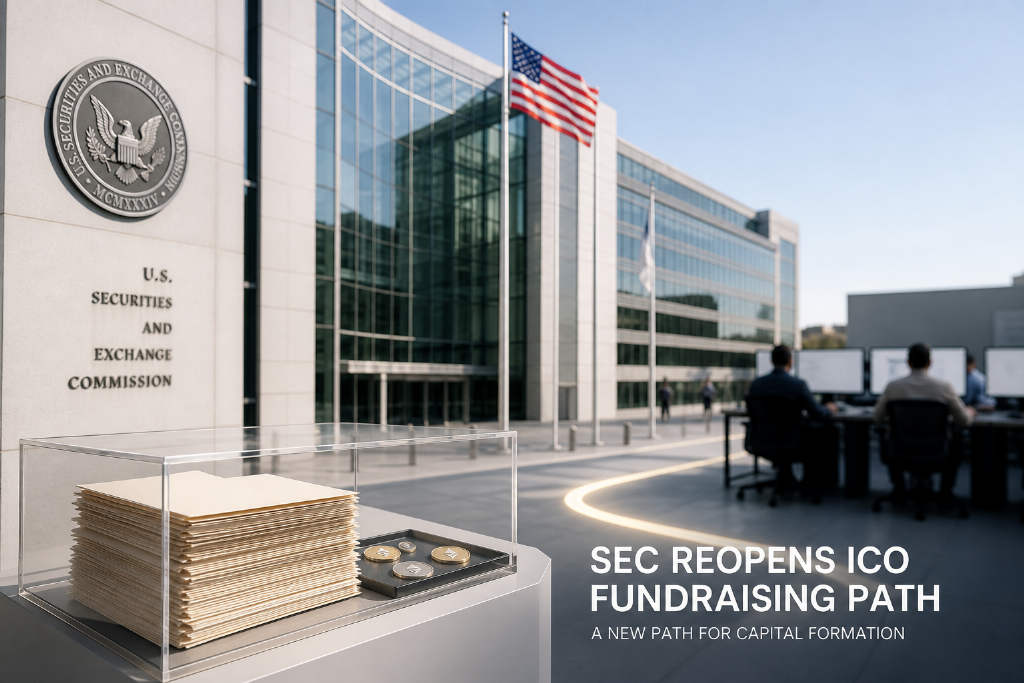
The U.S. Securities and Exchange Commission wants to open the door for initial coin offerings in America again. But the bigger issue is simpler: are there even enough buyers left for something a lot of investors already moved on from?

A proposal released earlier this month would let public token sales return for U.S. investors. Crypto startups could raise up to $5 million a year without full SEC registration, while bigger projects could raise as much as $75 million annually. After years of pressure in the wake of the 2017 ICO boom, that is a real policy turn.
The analysis was written by Muyao Shen of Bloomberg and translated by Saoirse for Foresight News. Its argument is blunt: the SEC is trying to fix a problem that mattered a lot more a few years ago, namely how legitimate crypto projects could legally raise money from the public. Since then, the market has changed.
The rules may be easing up, but this is not the old market
Back in the early ICO growth days, almost a decade ago, a project could often raise money with barely more than a white paper, a crypto wallet, and investors willing to bet newly issued tokens would just keep going up. The SEC's proposed framework is not a trip back to that period. It brings disclosure duties and real compliance costs.
And there is another uncertainty hanging over it. The proposal makes fundraising for token issuance easier, yes, but the rules for trading those tokens after issuance are still messy. Raising capital more easily does not mean the rest of a token's life has been sorted out by regulators.
Investors have changed too. The speculative crowd that once chased hundreds of fresh coins is far pickier now. Bitcoin and a small group of top tokens take most of the market's attention. Traders hunting quicker, larger gains have drifted toward products like perpetual futures and prediction markets. Lately, some of that speculative cash has also gone into artificial intelligence-related stocks.
So the piece treats the SEC's move as a late answer to an older version of the market.
Venture capital has stepped back, and ICOs are nowhere near the top
The ICO model let crypto startups sell newly created tokens straight to investors, usually in exchange for assets like Bitcoin and Ether. At the industry's high point in January 2018, monthly ICO fundraising hit about $3 billion.
That surge was built on cheap money, limited supply, and a broad faith that there would always be someone ready to buy any new token at a higher price. Then it cracked. Falling crypto prices, regulatory lawsuits, project blowups, and pump-and-dump scams brought it down.
The pullback is visible among professional investors as well. The article says venture capital token deal volume has dropped sharply since 2025, and the number of ICO transactions has continued falling since the 2018 peak. Some leading crypto venture firms have also widened their focus beyond digital assets, backing artificial intelligence, robotics, and other frontier technologies.
That means new tokens are now fighting not just against thousands of existing crypto assets, but also against speculative products with better liquidity and cleaner stories.

Dragonfly general partner Tom Schmidt, commenting on the stalled CLARITY Act in Congress, said: "This is obviously better than nothing (this is obviously better than nothing), but the bill would have been more valuable if it had come out several years ago (the bill would have been more valuable if it had come out several years ago). The most urgent issue right now is what the CLARITY Act was supposed to address, not fundraising channels (the most urgent issue right now is what the CLARITY Act was supposed to address, not fundraising channels)." He called the effort better than nothing, but said it would have mattered more several years earlier, adding that the pressing issue now is what the CLARITY Act was meant to solve, not fundraising access.
Supporters say the proposal still gives serious projects a route
Even with the market backdrop completely changed, some investors still view the SEC proposal as a meaningful reset.
Strobe Ventures partner Winnie Lau said: "The market is stuck in a range-bound, choppy phase (the market is in a sideways, volatile phase), and this proposal makes me cautiously optimistic about the future development of digital assets in the United States (this proposal makes me cautiously optimistic about the future development of digital assets in the U.S.). This is a step in the right direction, giving early-stage teams a workable path to build token networks, raise funds, and innovate in the U.S. (this is the right step, giving early teams a practical path to build token networks, carry out fundraising, and innovate in the U.S.)." She said the market is range-bound and that the proposal leaves her cautiously optimistic about the future of digital assets in the U.S., calling it a workable path for early-stage teams to build token networks, raise funds, and innovate at home.
For projects that are not centered on meme coin speculation and instead want to ship actual products, that shift could matter more.
Pantera Capital general partner and portfolio manager Cosmo Jiang said: "The industry used to be in a very strange position (the industry's past situation was extremely strange): issuing meme coins was legal, but building tokens that could create real value was treated as potentially illegal (issuing meme coins counted as legal behavior, but building tokens that truly create value could instead be seen as unlawful). That runs completely against how a normal business society works (this is completely contrary to normal commercial society)." He said the industry had been stuck in an abnormal situation where issuing meme coins was legal, while building tokens with genuine value creation could be treated as unlawful.
The article also highlights one of the proposal's more important changes: a token would not stay permanently linked to the investment contract created at issuance. Once the issuer has finished, or permanently stopped, the managerial or operational efforts promised to investors, that investment contract could end.
Legal issuance alone does not create investment value
Still, making utility token issuance legal is not the same thing as making those tokens appealing investments.
The piece says the crypto market still has not fully recovered from the sharp selloff in October last year. Even with the recent bounce in token prices, investors are unlikely to commit money just because a project happens to come with a token.
GSR research analyst Carlos Guzman said: "The ICO of 2026 is no longer the ICO of 2018 (the ICO of 2026 is already not the ICO of 2018). The era when a white paper and pure imagination alone could win capital is over (the era of getting capital with only a white paper and fantasies has ended)." He said the 2026 ICO market is nothing like 2018, and that the days when a white paper and an idea alone could pull in capital are gone.
The article ends with a wider market comparison. Using Dec. 31, 2025 as the starting point, gold has still beaten Bitcoin this year. Gold is up more than 7% in 2026, while Bitcoin, even after a rebound, is still down close to 10% for the year. The piece says Bitcoin backers have long sold it as digital gold and an inflation hedge, but that argument has not held up this year.
