SemiAnalysis Issues Two Contrasting Reports on NVIDIA
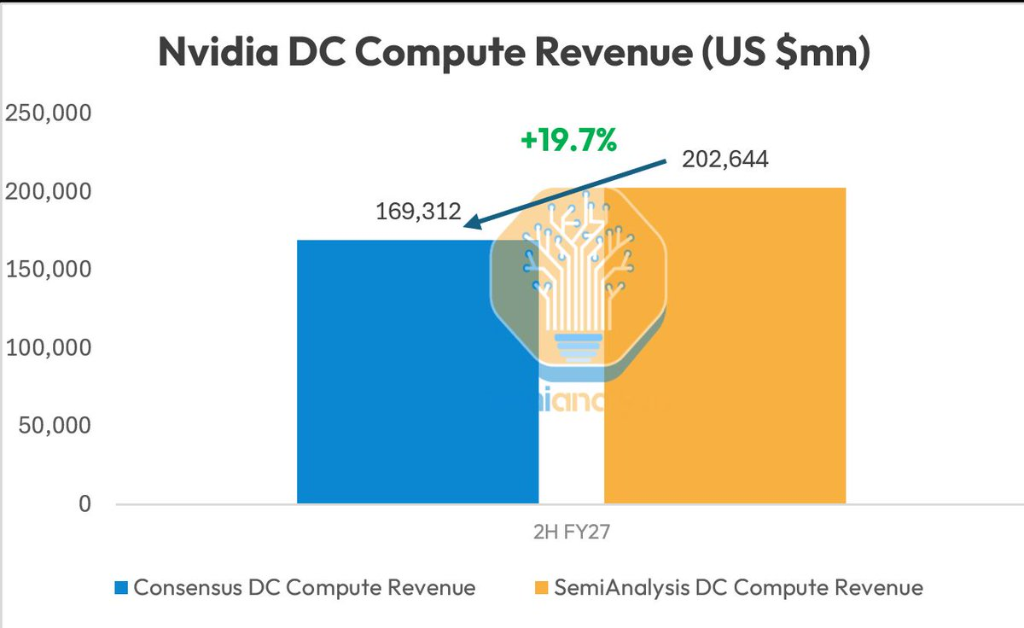
Semiconductor research firm SemiAnalysis released two separate assessments on June 30, outlining both opportunities and challenges for NVIDIA's future. The optimistic forecast indicates that NVIDIA's data center computing revenue for the second half of fiscal 2027 could exceed Wall Street consensus by about 20%, driven by the resolution of HBM4 memory supply issues that had constrained the Rubin platform's mass shipment, along with sufficient front-end wafer capacity reserves that clear the path for a strong second half.
Flagship Product Downgrade: Rubin Ultra Cancelled, Scaled-Down Version
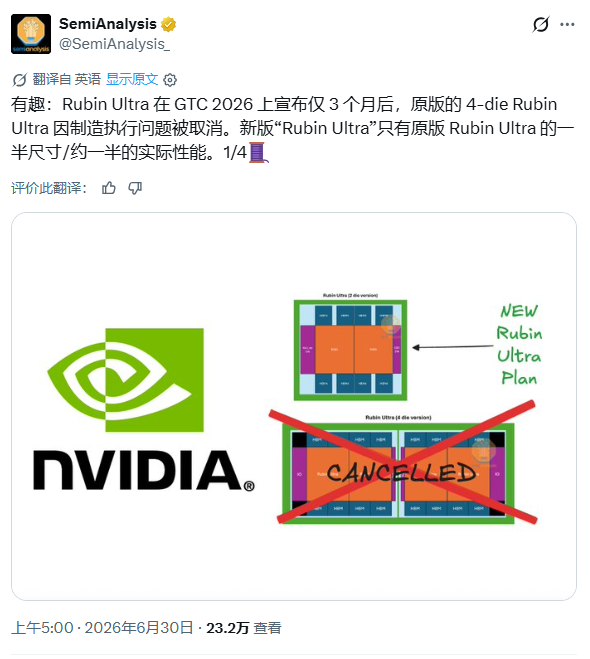
However, earlier the same day, SemiAnalysis disclosed negative news: the original 4-chip Rubin Ultra was canceled about three months after its GTC 2026 launch. The new 'Rubin Ultra' is reduced to half its original size, with correspondingly half the performance, due to advanced packaging manufacturing difficulties. This adjustment represents a pessimistic correction to NVIDIA's technical roadmap.

Accelerator Model Forecast Logic
SemiAnalysis made its latest prediction using its Accelerator Model, which establishes a cross-validation system covering the entire supply chain. Data sources include material suppliers, wafer fabrication, key components, server OEMs, and actual procurement/deployment by hyperscalers and frontier AI labs, enabling multi-dimensional verification of supply-demand dynamics. The firm emphasizes that its forecasting logic differs significantly from traditional sell-side analysts, who tend to maintain conservative earnings projections to leave room for subsequent 'beat' surprises. SemiAnalysis bases its conclusions more on first-hand industry supply chain research. The model covers not only NVIDIA but also Broadcom, AMD, MediaTek, Marvell, and other AI chip firms, and tracks the evolution of the AI compute industry via the HBM Model.

CUDA Moat Under Siege
In a separate commentary, SemiAnalysis pointed out that NVIDIA's CUDA moat is slowly eroding. For instance, Anthropic now uses a multi-platform architecture comprising Google TPUs, Amazon Trainium, and NVIDIA GPUs. A large portion of Claude model training runs on TPUs, while Claude Code inference is increasingly deployed on Trainium. NVIDIA GPUs are mainly used for general-purpose computing like frontier research. SemiAnalysis notes that a year ago, it was hard to imagine TPU and Trainium reaching their current scale, but the competitive landscape has shifted significantly.