NVIDIA Rubin Platform: Supply Bottleneck Lifted, Revenue Estimates Revised Up
Semiconductor research firm SemiAnalysis has issued a bullish forecast for NVIDIA's data center computing revenue in the second half of fiscal 2027, projecting it to be approximately 20% above Wall Street consensus estimates. The optimism is underpinned by the resolution of HBM4 memory supply issues that had previously constrained the Rubin platform's mass production, along with adequate front-end wafer capacity reserves. SemiAnalysis leverages its Accelerator Model, a cross-validation framework incorporating data from materials suppliers, wafer fabrication, key components, server OEMs, hyperscale cloud providers, and frontier AI labs to calibrate supply-demand dynamics. Notably, the model extends beyond NVIDIA to cover AI chip rivals such as Broadcom, AMD, MediaTek, and Marvell, while also tracking the overall AI compute ecosystem via its HBM Model.
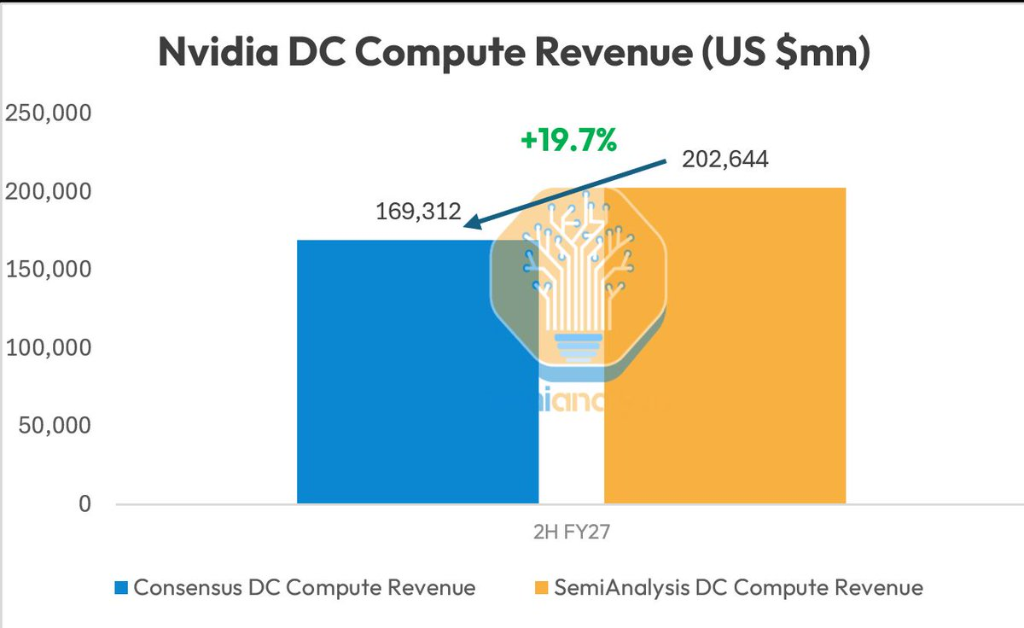
SemiAnalysis highlights that its forecasting methodology differs significantly from traditional sell-side analysts. Most Wall Street firms adopt conservative earnings projections to leave room for future 'beats,' whereas SemiAnalysis grounds its conclusions in front-line supply chain research to better reflect real-time market conditions. Having resolved the HBM4 bottleneck, the firm expects the Rubin platform to ramp up quickly in the second half of the fiscal year.

Flagship Product Shrinkage and Erosion of the CUDA Moat
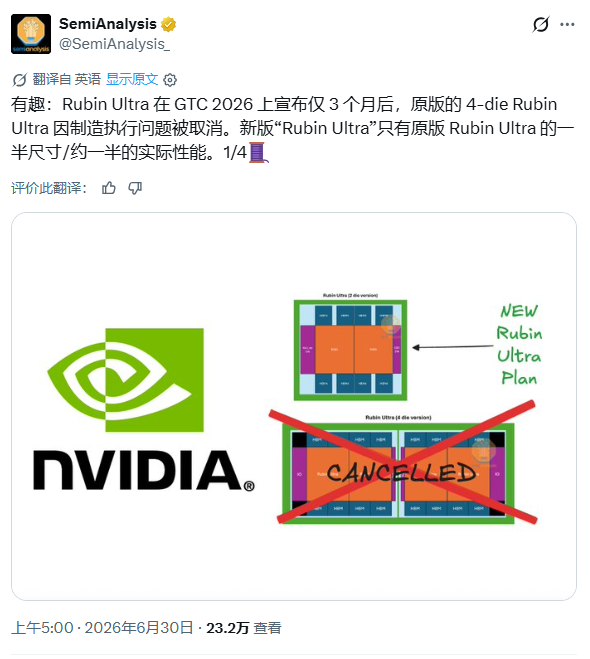
On the same day, SemiAnalysis disclosed a contrasting negative development: NVIDIA's original 4-chip Rubin Ultra was canceled roughly three months after its debut at GTC 2026. The new 'Rubin Ultra' has been downsized to half the original dimensions, resulting in halved performance. The revision is attributed to challenges in advanced packaging manufacturing. This flagship product shrinkage represents a pessimistic signal regarding NVIDIA's technology roadmap.

In parallel, SemiAnalysis warns that the CUDA moat is slowly being eroded. Taking Anthropic as an example, the company now operates a multi-platform compute architecture combining Google TPUs, Amazon Trainium, and NVIDIA GPUs. A large portion of Claude model training runs on TPU clusters, while Claude Code inference is increasingly deployed on Trainium. NVIDIA GPUs are predominantly used for frontier research and general-purpose computing tasks. SemiAnalysis notes that it was hard to imagine TPU and Trainium reaching their current scale just a year ago, indicating that competitive alternatives are gradually chipping away at NVIDIA's ecosystem advantage.

On one side, supply chain improvements fuel upward revenue revisions; on the other, flagship product downsizing and CUDA moat erosion paint a less rosy picture. These two conflicting assessments from SemiAnalysis anchor NVIDIA in a dual narrative: one of robust execution and revenue growth, and another of technological vulnerability in the face of rising competition.