
A crowded catalyst calendar puts multiple altcoin narratives in focus
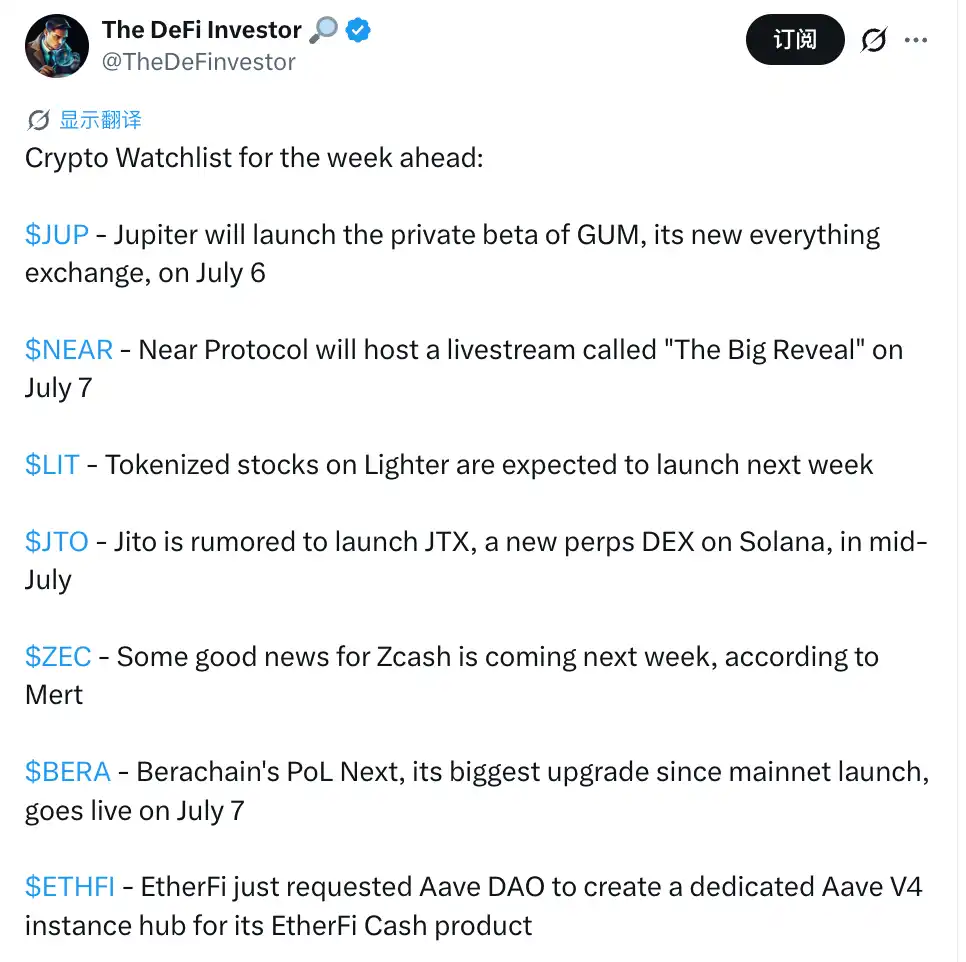
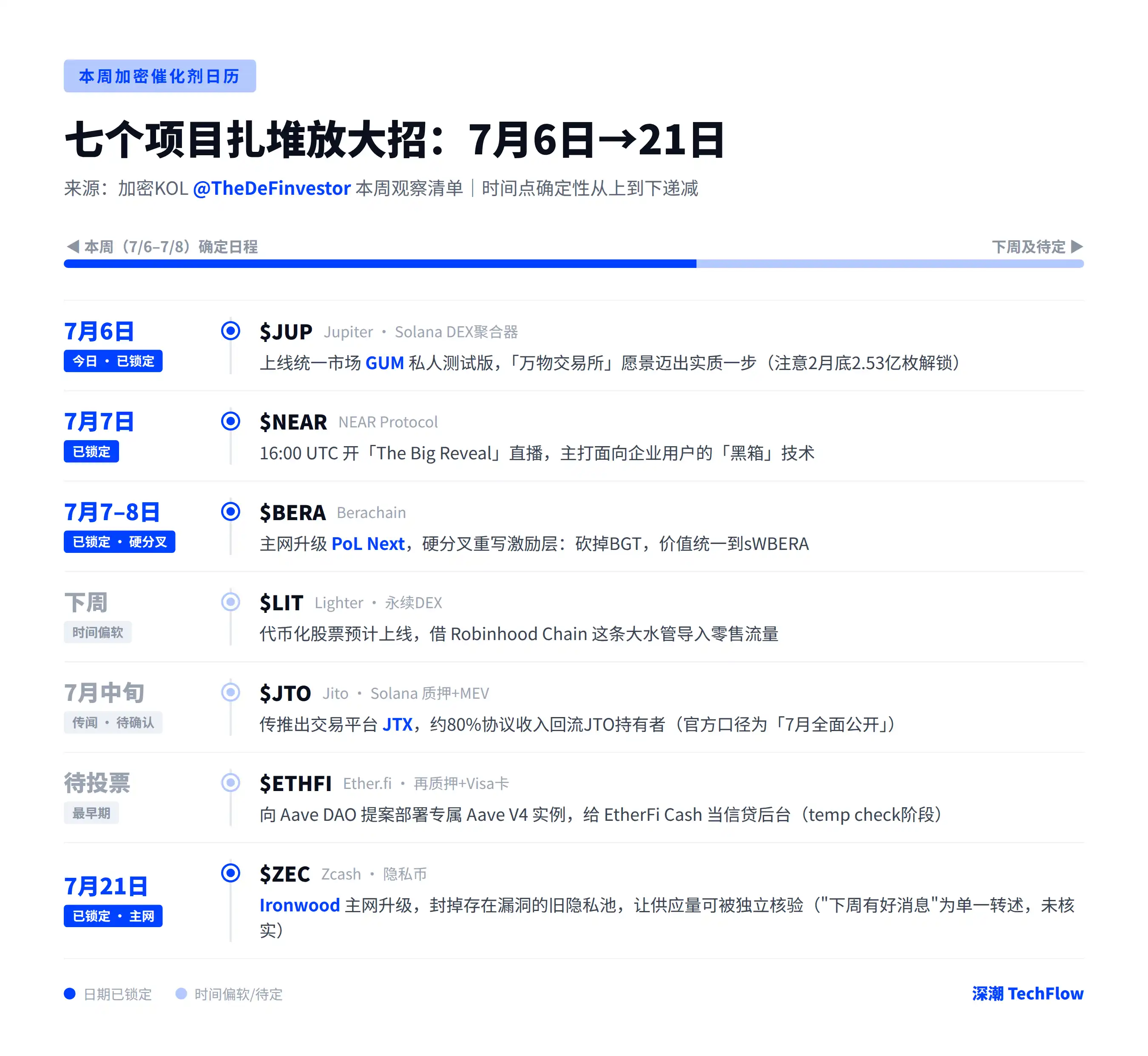
A weekly catalyst list compiled by crypto KOL @TheDeFinvestor is putting seven projects under the spotlight between July 6 and July 21. The projects are Jupiter, NEAR, Berachain, Zcash, Lighter, Jito and Ether.fi, and the expected triggers range from private product tests and public unveilings to hard forks, mainnet upgrades and DAO proposals. For traders already holding these tokens, or looking for a fresh angle on a recovering Solana ecosystem, the timeline is dense enough to matter.
What stands out is the concentration of event risk in infrastructure-heavy segments of the market. Solana trading rails, tokenized real-world assets, incentive redesigns, privacy-chain recovery efforts and DeFi credit integrations are all represented. At the same time, most of these developments are still at the “priced on expectation” stage. Whether they become durable valuation drivers will depend less on headlines and more on execution, user adoption, trading flow and fee generation after launch.
Jupiter starts with GUM private beta as the unified market thesis advances
The most time-sensitive item is Jupiter, which rolled out the private beta of GUM on July 6. Jupiter is the largest DEX aggregator on Solana, and GUM, short for Giant Unified Market, is one of its central strategic initiatives. The stated goal is ambitious: bring meme coins, stocks, FX and even real estate into a single onchain interface where users can swap across categories with very low cost. DinariGlobal has already committed to issuing 1:1 stock tokens on Solana tied to names such as Apple and Coinbase.
This round of testing focuses on the unified market API, which is expected to combine login, deposits, cross-chain spot access and perpetuals under one framework. Traders have already reacted to the narrative. JUP climbed as much as 13% over the past 24 hours, outperforming in an otherwise cautious market. One research estimate also placed Jupiter among the top 15 revenue-generating crypto protocols, with roughly $130 million in revenue over the last 12 months. A governance discussion is also underway over whether a larger share of protocol fees should be directed toward JUP buybacks.
The counterweight is token supply. Based on the public unlock schedule, roughly 253 million JUP is due to unlock in late February 2026. In other words, product milestones may support momentum in the near term, but future circulating supply expansion remains an overhang that could offset speculative upside.
NEAR and Berachain face major event windows on July 7-8
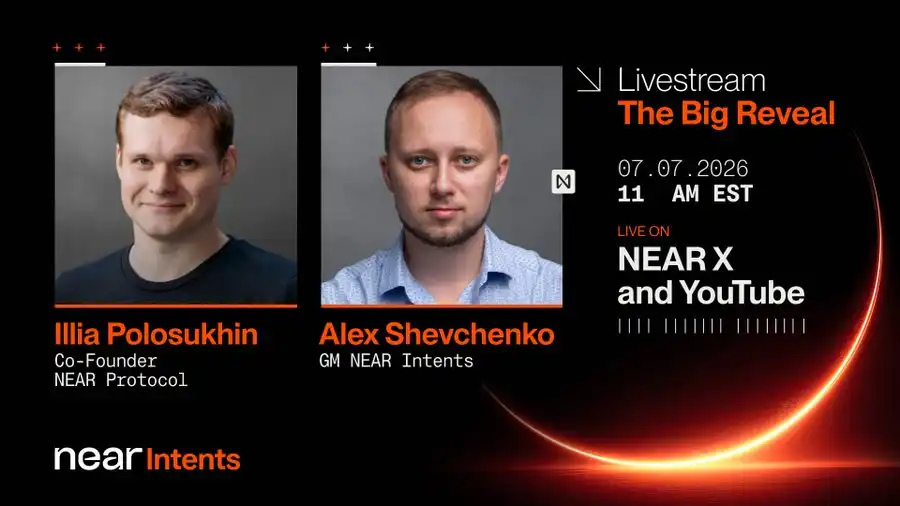
NEAR’s scheduled catalyst arrives on July 7 at 16:00 UTC, when the network will host a livestream titled “The Big Reveal” on X and YouTube. The event will be led by founders Illia Polosukhin and Alex Shevchenko and is framed around “opening the black box for enterprise users.” Recent NEAR narratives have centered on Intents, AI integration and confidential computing. Public data cited by the team shows NEAR Intents has already surpassed $22 billion in cumulative transaction volume.
Market participants expect the stream could be related to SPICE, a previously teased major protocol upgrade, or to a more enterprise-focused black-box product. That said, reveal events are often classic expectation trades. If the announcement ends up being mostly conceptual, with no concrete product release or named partners, the market impact could be limited once the anticipation phase fades.

Berachain enters its own high-stakes window on July 7-8 with PoL Next, the largest upgrade since its independent mainnet launch. This is not a minor patch. It is a hard fork that rewrites the chain’s incentive layer. Berachain’s original Proof of Liquidity model used BGT, BERA and a Boost mechanism, a structure that many traditional investors found difficult to parse. PoL Next aims to simplify the system into a more direct design.
Under the new setup, BGT and Boost will be phased out over time. Emissions will shift to BERA, while value accrual will be concentrated into sWBERA. A new ERA-based emission process is also expected to require projects to demonstrate real onchain revenue and usage metrics, replacing the earlier model where emissions could be influenced more directly through voting dynamics.
From a tokenomics perspective, that simplification is structurally constructive for BERA. But the transition comes with clear risks. Berachain previously showed a mismatch between market capitalization and ecosystem value, with DeFi TVL around $55 million and market cap once hovering near $66 million. As the old incentive recipients reposition, selling pressure may emerge. There is also a seven-day unlock period for redeeming sWBERA back into BERA, reducing flexibility during the migration.
Zcash, Lighter and Jito each offer a different type of catalyst
Zcash has the least precise short-term narrative, but the most clearly defined date remains the July 21 activation of the Ironwood mainnet upgrade. The context is critical. In late May, security researcher Taylor Hornby disclosed a four-year-old vulnerability in Zcash’s Orchard shielded pool. In theory, it could have enabled an attacker to mint unlimited counterfeit ZEC without detection. Because of the privacy design, developers could not easily verify whether the bug had ever been exploited. Following the disclosure, ZEC fell from above $600 to around $250 within two days, and Arthur Hayes exited his entire position.
Ironwood is meant to restore verifiability. The upgrade opens a new shielded pool, shuts down the old Orchard pool and uses the existing turnstile mechanism so any node can independently verify circulating supply. In effect, it gives the market a more auditable answer to the question of whether hidden inflation occurred. Since the remediation path became clearer, ZEC has rebounded more than 50% from its lows. It was quoted at about $462 on July 4, up 13.3% over the previous seven days. Until the actual July 21 activation, however, any “good news next week” framing should still be treated as sentiment rather than confirmed delivery.
Lighter’s catalyst is expected next week with the launch of tokenized stocks on its platform. Lighter is a zero-knowledge perpetual DEX, but the stronger narrative driver is its link to Robinhood. Robinhood Chain, the brokerage’s Ethereum L2, went live on July 1, and Lighter became the default perpetual DEX on that chain. The product thesis is that users will be able to post tokenized shares such as Nvidia or Apple into lending pools as collateral, creating a use case that traditional brokerage accounts do not offer.
Robinhood has roughly 24 million funded accounts, and even a modest migration of users onchain could materially scale Lighter’s addressable flow. The project has also allocated $11 million worth of LIT incentives to the Robinhood community, while Robinhood is subsidizing 90 days of gas costs for users. LIT briefly jumped 24% to $2.14 and printed a local high after the news. Still, the immediate market is narrower than the headline suggests. Robinhood has excluded the UK, US, Canada, Switzerland, the UAE and Singapore from perpetual services, and Lighter is entering a field already contested by Hyperliquid, Aster and dYdX Arcus. Token unlock risk also remains an overhang.
Jito’s catalyst is tied to reports that its new trading platform, JTX, could launch in mid-July. Jito is one of Solana’s core infrastructure providers, active in both liquid staking through JitoSOL and MEV infrastructure. Its MEV client reportedly runs across more than 95% of active stake on Solana, while JitoSOL TVL surpassed $2.9 billion in the first quarter of 2026. JTX represents a shift from backend infrastructure toward a direct application-layer product aimed at professional traders.
According to available materials, JTX opened early access on June 26 and is expected to move into broader release in July, beginning with spot trading before later integrating perpetuals and prediction markets. The main attraction for JTO holders is fee capture: roughly 80% of protocol revenue from JTX is expected to return to holders through buybacks. That narrative, however, depends on whether JTX can actually win order flow in a highly competitive market rather than merely launch with a strong story.
Ether.fi’s Aave V4 proposal is strategic, but still early-stage
The most governance-driven catalyst on the list belongs to Ether.fi. On July 1, the project submitted a proposal to Aave DAO requesting a dedicated, fully managed Aave V4 instance on OP Mainnet. The instance would serve as the backend for EtherFi Cash, a physical Visa card product that lets users borrow stablecoins against yield-bearing assets, including restaked ETH, and spend the proceeds directly.
According to the proposal, the deployment would use an isolated whitelist model, with GHO as the primary borrowing asset and an initial liquidity target of up to $175 million. Revenue would be split 80/20, with Aave DAO receiving roughly 20%. The proposal also references potential support from the Optimism Foundation in the form of $20 million in supply and $1.2 million in incentives. Strategically, this would move Ether.fi away from its in-house Debt Manager stack and toward Aave V4’s deeper liquidity and more mature lending framework.
Even so, this is the earliest-stage catalyst among the seven. The request is still in the temp-check phase and must pass through the rest of the DAO governance process before any deployment occurs. That means approval is not guaranteed, and timing remains uncertain. Compared with a product beta, a livestream or a hard fork already on the calendar, ETHFI’s signal is more directional than immediately actionable.
Key dates traders are likely to watch
- July 6: Jupiter launches the private beta for GUM
- July 7, 16:00 UTC: NEAR hosts “The Big Reveal” livestream
- July 7-8: Berachain deploys the PoL Next hard fork
- Next week: Lighter is expected to launch tokenized stocks
- Mid-July: Jito is rumored to launch the JTX trading platform
- July 21: Zcash activates the Ironwood mainnet upgrade
- TBD via governance: Ether.fi seeks approval for a dedicated Aave V4 instance
Overall, this week offers no shortage of catalysts, but the market is not dealing with clean upside stories. Unlock schedules, DAO uncertainty, regional rollout limits and heavy competition all complicate the picture. For traders, the real test is not whether a narrative sounds compelling, but whether it turns into sustained onchain usage, stronger revenue visibility and durable token value capture after the event passes.