
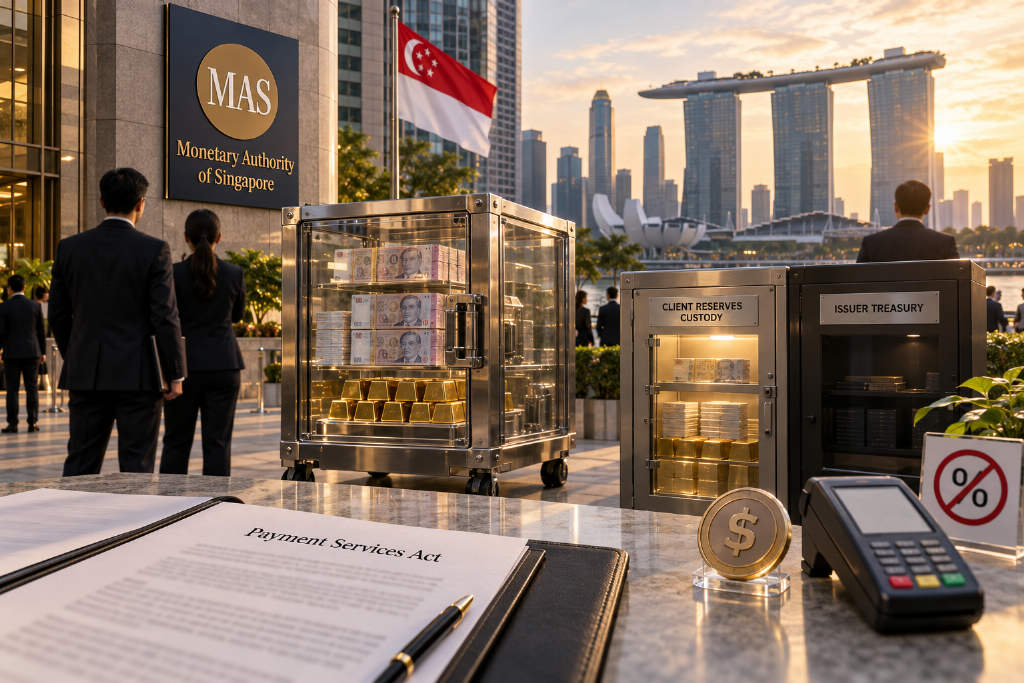
Singapore’s Monetary Authority of Singapore (MAS) released a consultation paper on Sept. 1 proposing changes to its stablecoin framework, including a requirement for issuers to maintain reserves at least equal to the amount of stablecoins in circulation and a ban on paying interest or yield to holders. The consultation period runs until Oct. 16, and the paper also examines whether foreign stablecoins regulated under comparable overseas regimes could receive limited recognition in Singapore.
The proposal would amend the Payment Services Act. Under the draft, stablecoin issuers would have to hold assets equal to 100% of circulating stablecoins in accounts segregated from their own funds, and those reserve assets could only be held with licensed financial institutions.
Key points in the proposal
- 100% reserve backing: issuers must hold assets equal in value to circulating stablecoins.
- Segregated safeguarding: reserve assets must be kept separate from the issuer’s own funds and held with licensed financial institutions.
- No yield for holders: issuers would be prohibited from paying interest or any other return on customer-held stablecoins.
- Redemption protection: issuers must keep sufficient reserve assets and protect customer funds during the redemption process.
MAS said in the consultation paper that 「stablecoins can be used for payments, but should not be regarded by the public as investment products or interest-bearing tools similar to bank deposits.」
Ho Hern Shin, deputy managing director for financial supervision at MAS, said: 「Well-regulated and credible stablecoins can serve as reliable settlement assets in tokenized financial markets while reducing risks to users and the broader financial system.」
Aligned with the U.S. and the EU
MAS’s position on banning yield matches the direction already seen in the United States and the European Union. According to the source material, the U.S. GENIUS Act explicitly prohibits stablecoins from paying interest, while the EU’s Markets in Crypto-Assets regulation, or MiCA, also bans stablecoin-related yield.
That approach places stablecoins in the category of payment and settlement tools rather than investment products.
Limited recognition of foreign stablecoins under review
The consultation also considers the possibility of limited recognition for foreign stablecoins that fall under comparable overseas regulatory frameworks. Several details remain unresolved, including how the recognition mechanism would work, how responsibility would be split for cross-border jointly issued stablecoins, and whether issuers already operating in Singapore would receive transition arrangements.
The source said this is consistent with MAS’s previously reported direction of considering a relaxation of the rule that stablecoins can only be issued by domestic issuers, with a strict framework coming first and room for cross-border cooperation opening later.
RLUSD is already being tested in an MAS sandbox
The framework is not only theoretical. The source said Ripple is exploring the use of its stablecoin RLUSD in an MAS central bank sandbox to test whether it can replace manual payment processes that have long slowed cross-border trade.
The test is part of MAS’s Project BLOOM, which aims to expand settlement capacity for tokenized bank liabilities and compliant stablecoins.
Timeline of MAS’s stablecoin work
MAS has been developing its stablecoin rules for several years:
- October 2022: first public consultation on stablecoin rules.
- August 2023: response to industry feedback was published.
- September 2026: the latest consultation paper was released, with comments due by Oct. 16.
- Next step: MAS said it will consult separately on subsidiary legislation, while the implementation date has not been announced.
Pressure on yield-based business models
The proposed ban on yield directly challenges business models used by some stablecoin issuers. The source noted that firms including Circle, the issuer of USDC, have invested reserve assets in short-term Treasury bills or other highly liquid assets to earn interest, with part of that income then shared with token holders or partners.
With the U.S. GENIUS Act, the EU’s MiCA, and now Singapore’s proposal all moving in the same direction, the source said the three major crypto regulatory jurisdictions are converging on a common view: stablecoins are settlement and payment infrastructure, not substitutes for bank deposits.
What to watch next
The next points to watch are the final form of the bill after the consultation period, especially the mechanism for recognizing foreign stablecoins; the outcome of Ripple RLUSD testing in the BLOOM sandbox; and how existing issuers such as Circle and Tether adjust their compliance structures in Singapore.