

Stablecoin payments are being used more heavily for domestic settlement than for cross-border remittances, according to an analysis by Four Pillars CSO Heechang Kang based on Allium’s geographic payment data.
The dataset covers $15.2 billion in on-chain transfers where both the sending and receiving countries could be identified. The author noted that most on-chain transactions still cannot be mapped to a specific country, so the figures reflect only the identifiable sample.
Within that $15.2 billion, domestic transfers made up 62.6% of the volume. Across all identifiable transactions, 73.0% of funds ultimately stayed within the sender’s home region. On that basis, the report argues that cross-border remittance is only one part of current stablecoin demand, not the dominant use case.
Asia-Pacific led the dataset, accounting for $6.23 billion in outgoing stablecoin transfers, or 41.0% of identifiable volume, and $6.4 billion in incoming transfers, or 42.1%. The region also posted net inflows overall, with Indonesia, Singapore, and South Korea standing out.
Domestic transfers account for most identifiable stablecoin activity
The report defines domestic transfers as transfers between wallets located in the same country. That segment reached $9.5 billion, equal to 62.6% of the $15.2 billion identifiable volume.
Across most markets with outbound activity, domestic transfers were the largest destination for funds regardless of region or market size. Five countries dominated global domestic stablecoin volume:
- Turkey: $2.28 billion
- South Korea: $1.6 billion
- Mexico: $1.53 billion
- Indonesia: $1.09 billion
- United States: $1.07 billion
Together, those five markets contributed 79.5% of global domestic stablecoin transaction volume. The transfers were completed directly between public blockchain wallets, without relying on card networks or bank payment rails.
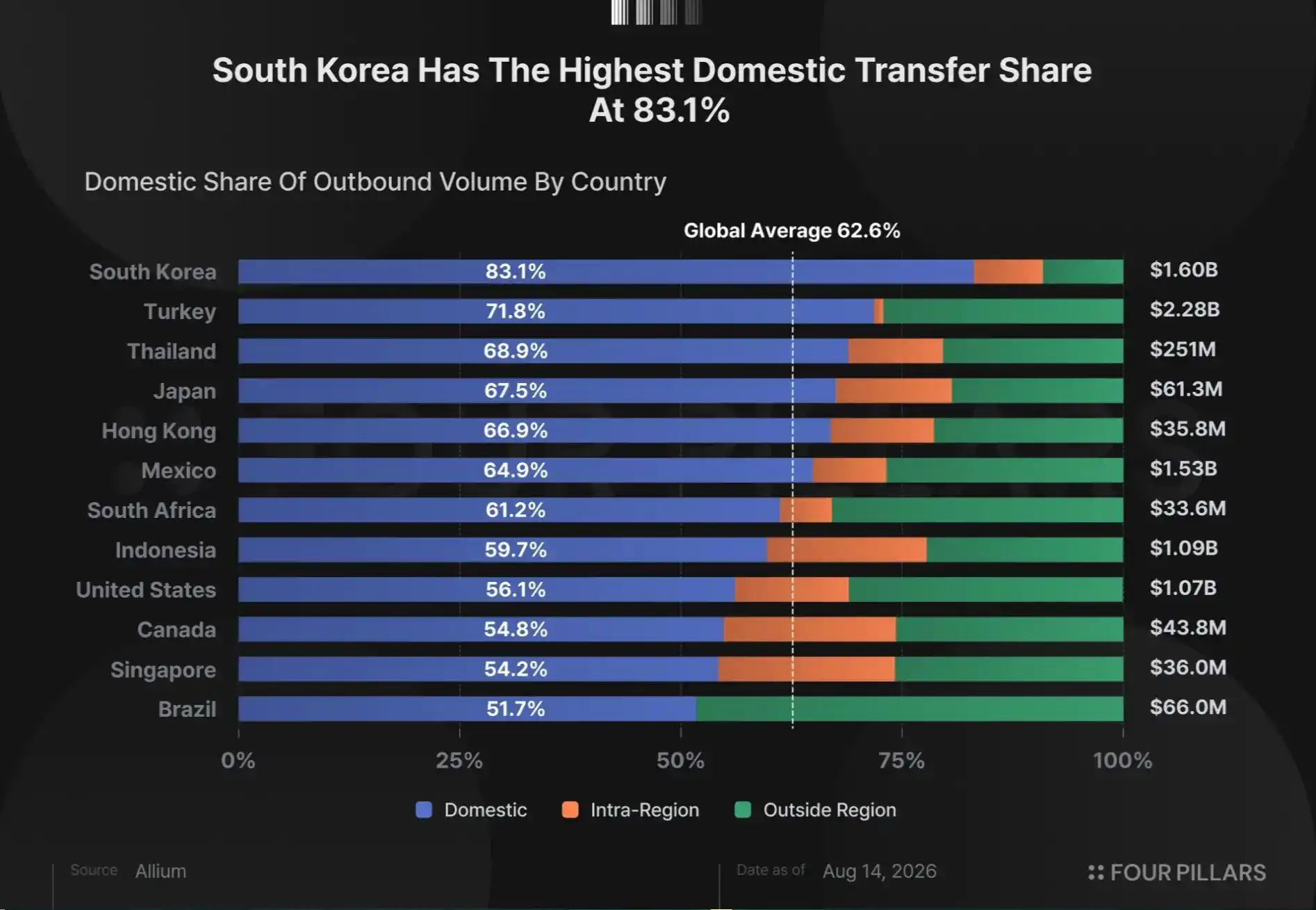
The author said that scale suggests users are already employing stablecoins inside their home markets for payments, trading, and dollar-denominated savings. For institutions building stablecoin services, that points to a larger current opportunity in domestic payments and settlement than in products designed only around remittances.
Even after crossing borders, funds often remain inside the same region
When domestic transfers are included, 73.0% of identifiable transaction volume stayed within the sender’s home region, meaning within the same continent. By region, 79.5% of Asia-Pacific flows remained in-region, compared with 72.0% for the Middle East and Africa, 71.4% for North America, and 49.6% for Europe.
That concentration shows that most identifiable stablecoin flows still take place inside the sender’s broader region rather than moving globally across regions.
If domestic transfers are excluded, the share of in-region activity drops to 27.8% of the $5.68 billion in cross-border volume. Asia-Pacific still stands out. In that region, 43.7% of cross-border flows remained within Asia-Pacific, equal to $995 million out of $2.28 billion in cross-border transactions. North America posted 27.0%, while the Middle East and Africa came in at 6.3%.
The report also notes that Turkey, the largest market in the Middle East and Africa sample, sends most of its cross-border stablecoin flows to Asia and the Americas.
Within Asia-Pacific, several payment corridors have already reached meaningful scale, including Taiwan to Indonesia at $138 million, Indonesia to Taiwan at $124 million, and Indonesia to South Korea at $89 million.
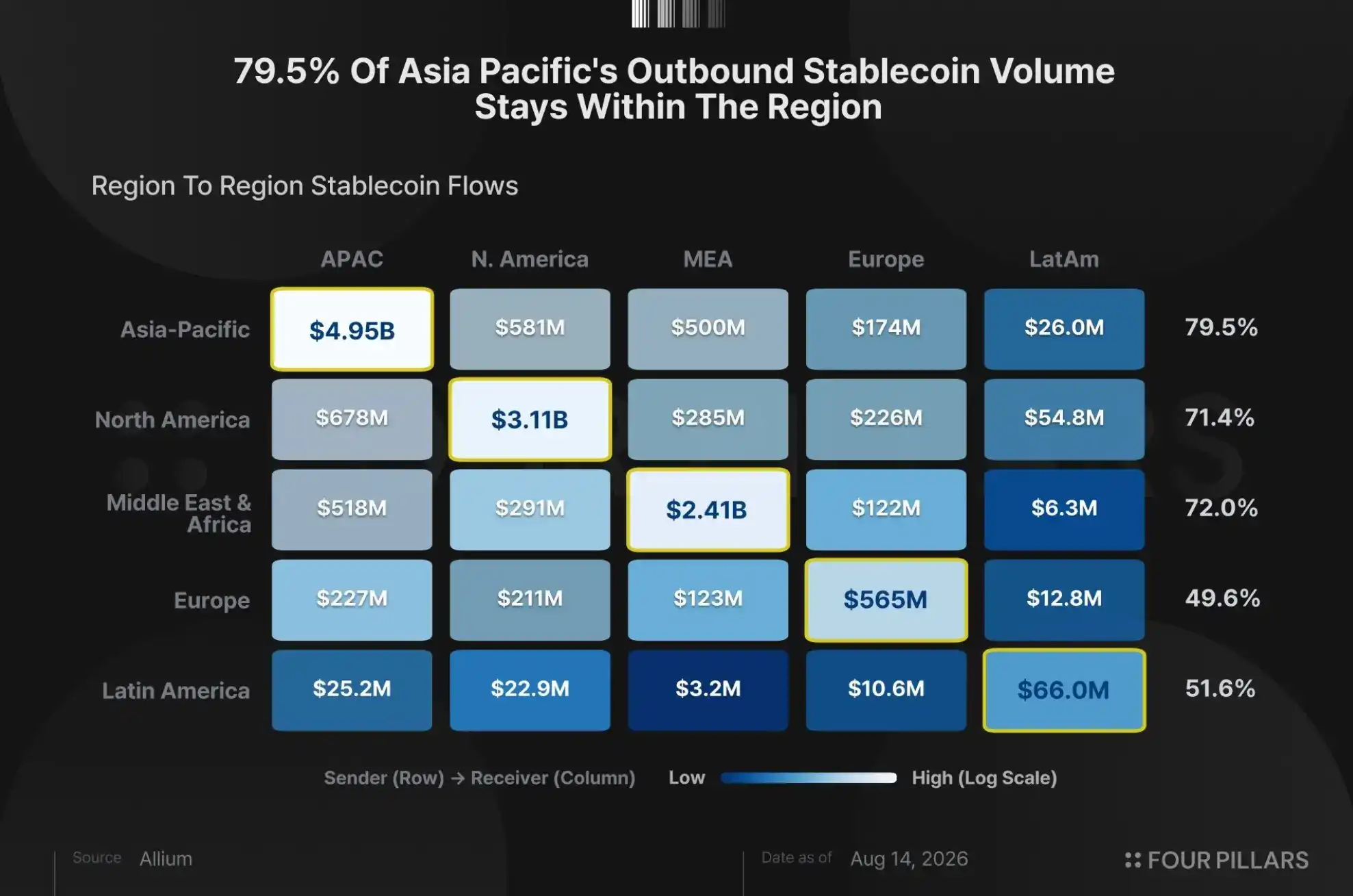
According to the analysis, that existing transaction volume provides a base for regional stablecoin payment infrastructure. Indonesia, Taiwan, South Korea, Australia, and Thailand together were involved in about $1 billion of intra-regional cross-border transfers, while also generating $3.96 billion in domestic transaction volume.
For institutions, those existing liquidity patterns and bilateral flows can help determine which payment corridors deserve priority. The author specifically pointed to Taiwan-Indonesia and Indonesia-South Korea as corridors where quantifiable bilateral demand is already in place.
Allium currently identifies both the sending and receiving countries for only 2.9% of the total observed transaction volume. As more transactions are matched with country-level information, the ranking of these payment corridors could still change.
Asia-Pacific is the largest stablecoin transaction region in the sample
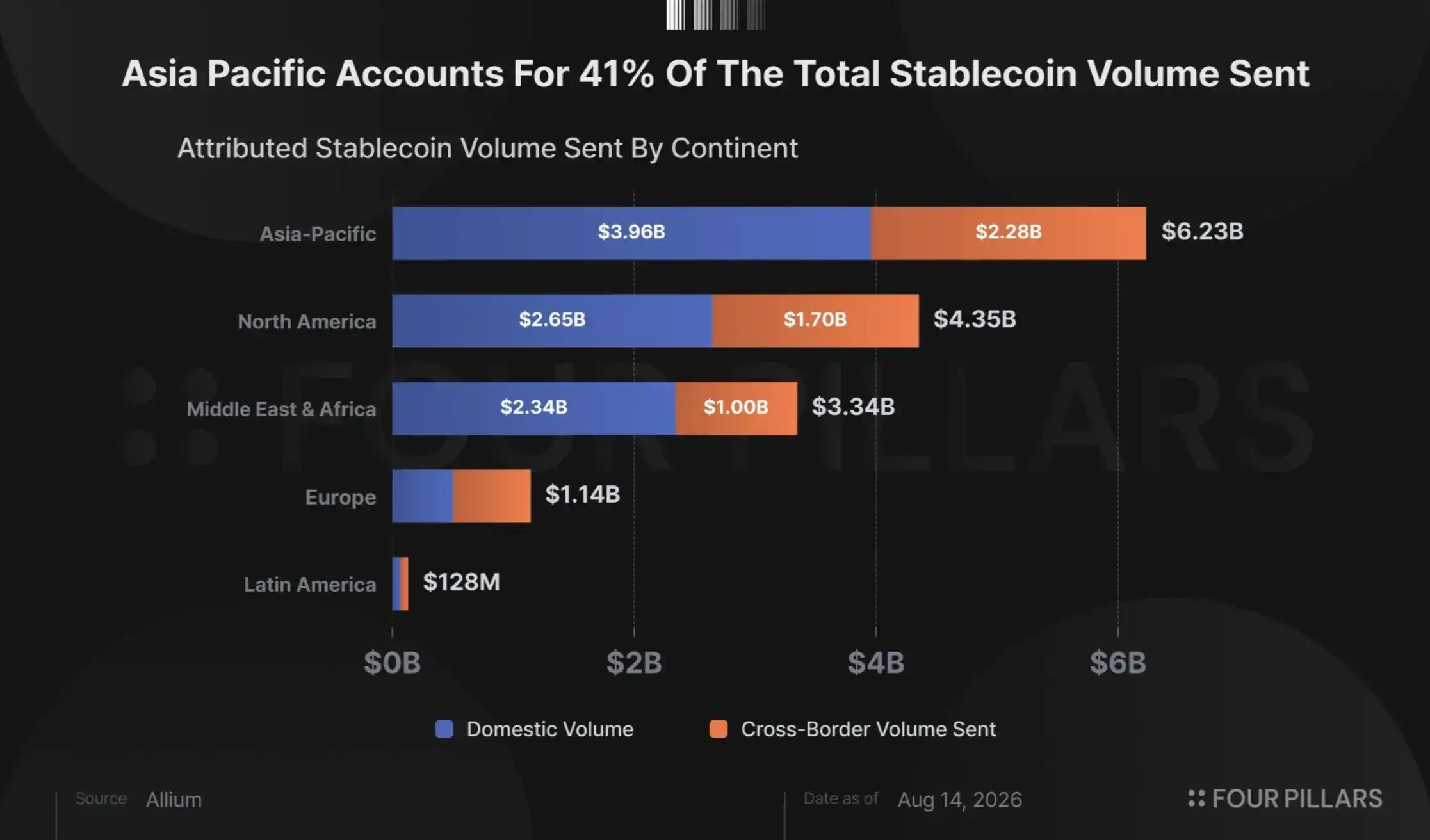
Asia-Pacific was the largest region in the dataset by scale. It sent $6.23 billion in stablecoins, equal to 41.0% of identifiable volume, and received $6.4 billion, or 42.1%.
By outgoing transaction share, Asia-Pacific was well ahead of North America at 28.6%, the Middle East and Africa at 22.0%, Europe at 7.5%, and Latin America at 0.8%.
The region also generated $3.96 billion in domestic stablecoin volume, equal to 41.6% of the global domestic total. The same concentration appears in major cross-border corridors. Of the 15 largest global cross-border stablecoin payment corridors, nine involved at least one Asia-Pacific market, and Indonesia alone appeared in six of them.
On a one-way basis, Turkey to Indonesia and the United States to Mexico were tied as the largest individual cross-border corridors, each at $206 million.
When both directions are combined, bilateral volume between Indonesia and Turkey reached $363 million. Indonesia and Taiwan reached $262 million, while South Korea and Turkey reached $190 million.
Those figures indicate that Asian markets and high-usage stablecoin markets outside Asia have already built sizable transaction links.
Net flow data tells a similar story. Asia-Pacific received $167 million more than it sent, leaving the region in net inflow territory overall. The United States recorded the largest net outflow in the sample.
At the country level, Indonesia posted a net inflow of $111 million, Singapore recorded $57.9 million, and South Korea posted $31.7 million. All three ranked among the largest net inflow markets in the sample.
The report’s conclusion for institutions assessing current stablecoin payment demand is straightforward: domestic settlement services represent a larger identifiable market today, while Asia-Pacific offers the largest observable transaction base, the highest domestic volume, and positive net inflows, alongside regional cross-border corridors that already show measurable demand.