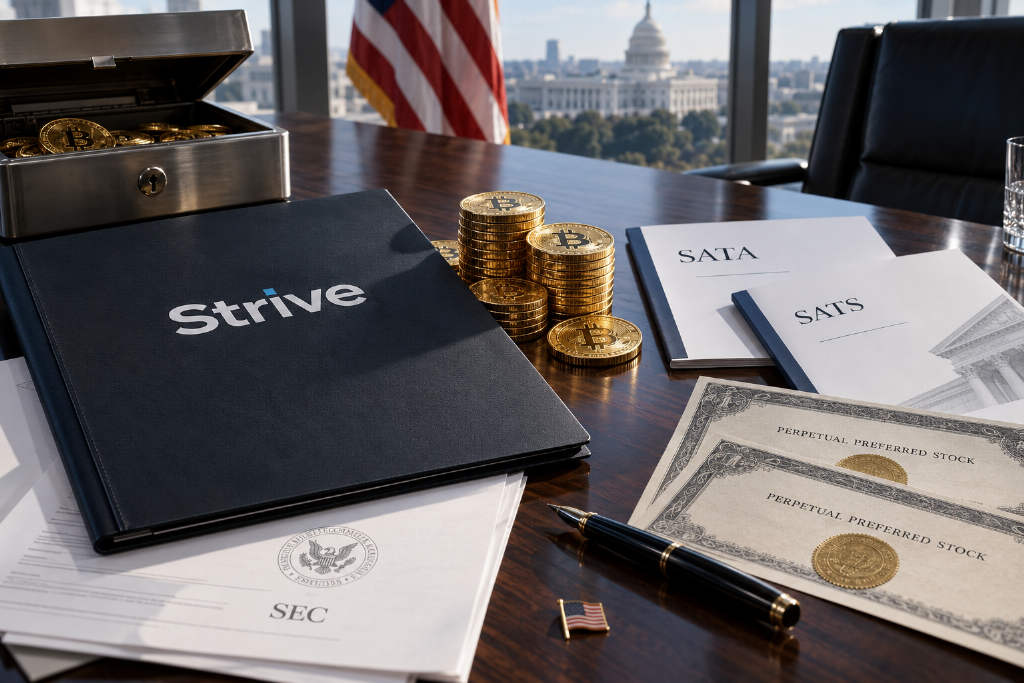
Strive (ASST) is pushing deeper into a Bitcoin treasury model built around perpetual preferred stock.

In an 8-K filed with the U.S. Securities and Exchange Commission on Oct. 13, the company said it bought 3,311 BTC between Oct. 5 and Oct. 9 for about $280 million, at an average price of roughly $84,500 per Bitcoin. That lifted its total holdings to 32,773 BTC. The purchase was Strive’s largest single accumulation since its initial 5,816-BTC purchase in September 2025 and the addition of about 5,048 BTC through the Semler Scientific combination completed in January 2026.
Data from Bitcoin Treasuries shows Strive now ranks fifth among public companies by Bitcoin holdings. The four companies ahead of it are Strategy with 848,250 BTC, Metaplanet with 44,000 BTC, Twenty One Capital with 43,514 BTC, and MARA with 35,577 BTC.
Strive disclosed several capital markets moves on the same day. About $208 million of warrants were exercised. The company also amended the terms of SATA, its first perpetual preferred stock, formally writing in a requirement that issuance be priced at no less than $100 and revising the definition of a business day to leave room for possible weekend dividend payments later on. At the same time, it filed a prospectus for a second perpetual preferred stock, SATS, which carries a fixed 15% annual dividend rate and is designed to raise about $500 million.
From anti-ESG asset manager to Bitcoin treasury company
Strive was co-founded in 2022 by U.S. entrepreneur Vivek Ramaswamy and is headquartered in Dallas. Chief executive Matt Cole previously spent 15 years managing fixed-income assets at CalPERS, the largest public pension fund in the United States.
The firm started in asset management and became known for opposing ESG investing. After shifting into the Bitcoin treasury model, it kept that business under subsidiary Strive Asset Management, which still manages about $3 billion.
In May 2025, Strive announced a public listing through a merger with Nasdaq small-cap company Asset Entities, keeping the ticker ASST. After the merger closed on Sept. 12, the company repositioned itself as a Bitcoin treasury company and set Bitcoin as its internal hurdle rate, meaning any investment must outperform Bitcoin to be considered successful.
Ten days after completing the Asset Entities merger, on Sept. 22, 2025, Strive bought 5,816 BTC in a single transaction and announced an all-stock acquisition of Semler Scientific. Semler, a medical company focused on vascular disease detection equipment, began accumulating Bitcoin in May 2024 and was the second U.S. listed company to do so. That acquisition closed in January 2026, adding about 5,048 BTC to Strive’s balance sheet. Strive described it as the first merger between public Bitcoin treasury companies.
After that, the pace of Bitcoin purchases varied until it accelerated noticeably in late August. Over the eight weeks from Aug. 14 to Oct. 9, Strive added 12,527 BTC, increasing its holdings by about 62%.

The companies ahead of it in the rankings expanded far more slowly over the same period. Strategy went from 840,447 BTC on Aug. 16 to 848,250 BTC on Oct. 11, a gain of less than 1%. Metaplanet sold 10,000 BTC in the third quarter and later bought back 11,000 BTC, for a net increase of 1,000 BTC. Twenty One Capital has not added to its holdings since July 2025. MARA’s holdings have also been largely flat since May.
Using perpetual preferred stock instead of debt
The basic Bitcoin treasury playbook is to raise capital and use it to buy Bitcoin. Issuing common stock is the most direct route, but it dilutes existing shareholders. Strategy opened another path in January 2025 when it launched STRK, its first perpetual preferred stock.
Perpetual preferred stock has no maturity date. The issuer does not have to repay principal and only needs to make scheduled dividend payments, while dividends and liquidation claims rank ahead of common stock. For the company, it functions much like financing that pays only interest and never comes due. Investors seeking stable income receive a high yield, while the issuer gets capital to buy Bitcoin. If Bitcoin’s long-term appreciation exceeds the dividend cost, the excess accrues to common shareholders. In July 2025, Strategy introduced STRC, whose dividend rate adjusts monthly in an effort to keep the price near its $100 par value. Michael Saylor called it “digital credit.”
In November 2025, Strive launched SATA with a structure that was largely similar but with two changes. First, it chose not to use debt and used SATA to replace the convertible notes left behind by Semler, leaving the company with zero debt on its books, while Strategy still carries about $6.7 billion in convertible notes. Second, SATA began paying dividends on every business day starting in June 2026. That feature later influenced Strategy, which has proposed shifting all of its preferred stock to daily accrual and has scheduled a vote for Oct. 28.
Strive is not the only company following this route. Japan’s Metaplanet announced in November 2025 that it would privately place MERCURY, a convertible preferred stock with a 4.9% annual rate, to overseas institutions, but a public listing has yet to happen because of Japanese exchange rules. In the U.K., The Smarter Web Company completed the issuance of MORE on Oct. 12, with an initial 12% annual rate and weekly dividends, raising £10 million. The shares are expected to begin trading on the London Stock Exchange on Oct. 14, though the scale is much smaller than Strive’s.
Strive measures leverage through what it calls an “amplification ratio,” defined as preferred stock plus debt as a share of the market value of its Bitcoin. A higher ratio means common stock can rise more when Bitcoin rises and fall more when Bitcoin falls. ASST’s share price has reflected that dynamic. On a split-adjusted basis after this year’s 20-for-1 reverse split, the stock fell from $169.80 on the merger date to $7.16 on Feb. 24, then recovered to $27.59 on Oct. 13, showing much larger swings than Bitcoin itself.
SATS would add another $500 million of preferred capital
Strive has been active on capital structure over the past week and more. On Oct. 5, it disclosed an additional $500 million SATA repurchase authorization that could be used to support the market if needed. In the latest filing, the company also said about $208 million of warrants had been exercised, bringing in a fresh round of common equity financing.
The SATA amendments were aimed at investor confidence and future flexibility. The company turned its prior verbal commitment to issue above $100 into a formal term, and it changed the definition of a business day so weekends are no longer excluded, leaving room for weekend dividend payments if regulatory and settlement conditions allow. Near-term dividend arrangements remain unchanged. Strive also filed for SATS, a second perpetual preferred stock that would rank behind SATA in liquidation priority, carry a fixed 15% annual dividend, and target about $500 million in proceeds.

The immediate purpose of SATS is to rebuild leverage. The common equity raised through warrant exercises had lowered the amplification ratio. Cole said on X that the goal is to keep that ratio above 60% when Bitcoin is below $100,000.
There is also a reason for moving to a fixed rate. According to Strive’s own figures, SATA and STRC have traded above $100 on only 24% and 16% of trading days, respectively, since listing, suggesting floating-rate structures did not keep prices near par.
Foresight News estimated that as of Oct. 9, Strive had about $310 million in cash. After setting aside about $180 million as a one-year dividend reserve for SATA, around $130 million would remain available. If SATS raises the full $500 million, and after reserving about $110 million for 18 months of dividends, about $390 million would remain. Together, that would leave about $500 million available for deployment, enough to buy roughly 6,000 BTC at current prices, while pushing the amplification ratio to around 60%.
Warrant-related data is still incomplete, and those proceeds could also add some buying power. Cole said he would publish a supplemental 8-K before the U.S. stock market opens on Oct. 14 to disclose the final warrant exercise results. As of publication, that filing had not yet appeared.
Strategy is buying back while Strive keeps issuing
Strategy is moving in the opposite direction. Last week it bought only 250 BTC, but spent about $192 million repurchasing STRC and has set aside about $4.9 billion in U.S. dollar reserves specifically for dividend payments. Its Bitcoin holdings are about 26 times the size of Strive’s. As the largest Bitcoin treasury company, Strategy is now focused more on preserving the credibility of what Michael Saylor has called “digital credit.”
Leverage comes with a steep funding bill. The two preferred stocks together would require more than $250 million in annual dividends, close to one-tenth of the current market value of Strive’s Bitcoin holdings. As of Oct. 9, the company’s total Bitcoin cost basis was about $2.9 billion, while fair value was about $2.7 billion, leaving an unrealized loss of about $200 million.
Strive’s internal framework uses a 50% annualized Bitcoin gain as its base case. After subtracting a 15% funding cost, the spread would go to common shareholders. Cole has said Strive has a chance to become the second-largest public company holder of Bitcoin by year-end. Whether it gets there depends on whether SATA can continue to be issued above par and whether SATS can raise the full amount. Whether the model ultimately makes money for common shareholders depends on whether Bitcoin’s long-term gains can outpace preferred stock costs in the 13% to 15% range.