


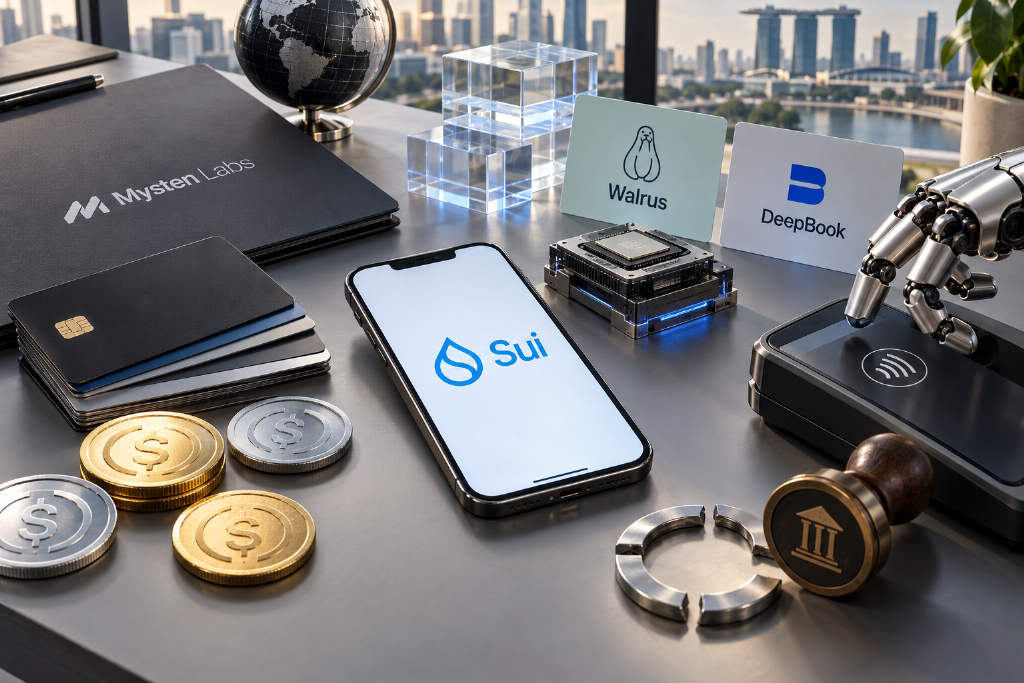
Mysten Labs co-founder and chief product officer Adeniyi Abiodun said Sui should no longer be framed simply as a high-performance Layer 1. In a WuBlockchain podcast interview, he described the network as infrastructure for global payments and, over time, a base layer for an agent-driven economy.
The discussion covered Sui’s growth logic, long-term value, stablecoin adoption, AI agent use cases, token economics, ecosystem support and governance limits. Abiodun’s central point was clear: stablecoin payments and automated agent-led transactions could become the strongest sources of on-chain demand.
Sui wants a different category than a standard Layer 1
Host Ehan noted that Sui has long been associated with Move, parallel execution, an object-centric architecture and high-performance infrastructure. He also pointed to the current market setup, where Solana still leads in user attention, liquidity and application activity, while Ethereum remains ahead in asset depth, security and institutional trust.
Abiodun said Sui is a high-performance blockchain built with the goal of letting money move as freely as messages. He said the team previously worked on highly distributed parallel systems at Facebook, where the vision was to build a global value flow layer, and argued that Sui is an attempt to realize that idea.
He said the difference is not only transaction processing. In his telling, Sui is designed for strong scalability and offers a full-stack set of capabilities for developers building real-world applications that need to scale.
Asked why an application that could launch on Ethereum Layer 2, Solana and Sui should choose Sui, Abiodun said Sui has the best chance to become infrastructure for global payments. He argued that the network’s scaling model allows it to maintain high performance and predictable fees as demand grows.
He also pointed to Walrus and DeepBook as parts of a broader effort to expand what Sui can do, saying the chain is not just a processing layer but a more complete ecosystem that continues to develop.
Abiodun said one of the biggest misunderstandings about Sui is that many people still see it as an ordinary Layer 1. He used a comparison to explain the distinction, saying most blockchains are more like Uber, while Sui is more like Google Search. Traditional blockchains see costs rise when the network gets congested because capacity is relatively fixed, he said. Sui, by contrast, uses a horizontally scalable architecture without a fixed ceiling on capacity, allowing processing power to grow with demand.
TVL fell, but the team says product building matters more
Ehan said Sui’s total value locked reached about $4 billion in late 2025 and later dropped to around $1 billion, then asked how the team interprets that shift.
Abiodun said this kind of decline is not unusual during a market slowdown and should be seen largely as a market-wide factor. From the team’s perspective, he said, the more important task is continuing to build highly scalable products.
He added that Sui’s stablecoin transaction volume has exceeded $1 trillion since August 2025. At the same time, he said the project has been working with multiple institutions and partners on implementation, and that DeepBook has been growing quickly as well. As markets mature, he said, Sui’s TVL could climb again.
Stablecoin payments are presented as crypto’s clearest use case
Abiodun said stablecoins are the most compelling application in crypto today because their role in global payments is direct and easy to understand. He said they can address several weaknesses in traditional payment systems by offering around-the-clock availability, instant settlement and lower-friction user experience.
As an example, he said RedotPay has integrated Sui and USDsui, which he described as Sui Dollar. According to him, that setup allows users to spend on-chain assets through traditional payment networks, including support for Apple Pay and Google Pay.
On that basis, he argued that stablecoins and related on-chain payment infrastructure have a real chance to become a better next-generation payment rail than legacy networks.
Sui is tying its next demand wave to the agent economy
When asked where the next major wave of crypto demand will come from, Abiodun’s answer was agents.
He said a large share of internet traffic is already automated, and he expects a large share of future on-chain transactions to be driven by automated flows, especially agent workflows. He added that the spread of stablecoins in payments will increasingly depend on this kind of activity because traditional payment systems are poorly suited to high-frequency, low-cost and micropayment-sized transactions.
In his view, agents will create demand from users and developers at the same time.
Ehan then asked whether crypto risks losing the fight for real users to AI. Abiodun said no. He argued instead that AI could become crypto’s biggest user. If a growing share of digital interaction requires fast, cheap settlement in micropayment form, he said, traditional payment rails are not the right fit, while Sui is being built for that type of economic activity.
He said Sui’s approach goes beyond high-throughput transaction processing. Through Walrus and Seal, he said, the network also offers decentralized data infrastructure and programmable access control, with the aim of helping AI systems handle large-scale data while preserving ownership and trust. He added that the team is working with Google on standards related to programmable agent payments to make Sui a better home for agent-driven on-chain interactions.
For AI, the blockchain case is framed around trusted data
Ehan asked why a blockchain like Sui is needed if AI agents can already call payment APIs or stablecoin APIs.
Abiodun’s answer focused on trust in the underlying data. As more money, decision-making and execution are handed to AI systems, he said, the data feeding those systems has to be trustworthy. He said Walrus is valuable because it can verify where data came from, prove that it has not been tampered with and guarantee data availability mathematically without sacrificing speed.
That, he said, means Sui should not be seen only as a transaction layer. It is also meant to provide trusted data infrastructure for high-throughput settings. If more work is delegated to agents over time, he said, that mix of security and verifiability becomes more important.
Asked which AI-native applications truly need blockchain support, Abiodun pointed to use cases with very high demands for data authenticity, integrity and traceability. He said blockchains are well suited to building a trusted path for data movement, where sources are clear, processes can be verified and outcomes are resistant to tampering.
He said conventional blockchains are usually not well suited for direct data storage because of cost, which is why the team built Walrus. It supports large-scale on-chain storage, he said, with costs close to cloud services but with stronger resilience, transparency and availability. Any AI application with strict requirements around data guarantees could become a strong blockchain use case, in his view.
AI is already part of Mysten Labs’ internal engineering flow
Abiodun said AI has already moved deeply into the company’s engineering process, including deployment, testing, performance benchmarking and data analysis. Work that once required a dedicated data scientist can now be handled through internal tools that let the team query an agent directly and get results in real time, he said.
He also said the company is building automated vulnerability detection tools for DeFi and smart contracts, an area where demand is now strong. Those tools are intended not only for internal use but also to help improve security across other ecosystems. Over time, he said, agent tools will become a bigger part of both security workflows and software development workflows.
Ehan then asked whether lower application development costs from AI could shift ecosystem competition away from branding and business development and toward tools, automation and developer efficiency. Abiodun said that change is already underway.
For Sui specifically, he said one important edge is that stablecoin transfers are free, making many agent workflows, especially payment-related ones, a better fit for Sui.
He described three main priorities in ecosystem development:
- back founders with strong ideas and help them refine projects and secure funding;
- support high-conviction, differentiated DeFi innovation;
- keep funding academic research in scalable systems and cryptography.
The SUI value case is tied to supply pressure and network returns
When the discussion turned to the token, Ehan asked where long-term value capture for SUI is expected to come from.
Abiodun said one piece is supply mechanics. He described Sui as having deflationary properties: as on-chain transfers and storage grow, and as the network carries more data, more tokens leave circulation, with part of that amount permanently burned. Total SUI supply is fixed at 10 billion tokens, he said, and the burn mechanism means final circulating supply could end up below that figure.
A second piece is the project’s aim to capture large-scale stablecoin flows. Because the cost of moving funds on Sui is very low, he said, larger stablecoin volumes could feed revenue back into the network and support token value through buybacks and staking rewards.
Asked how the market should tell real usage growth from short-term speculation as more SUI enters circulation, Abiodun said investors should look beyond price and TVL. He highlighted staking, gas, governance and storage as core network metrics that are more directly linked to actual use.
He also pointed to stablecoin adoption as a key metric and said Sui Dollar has grown to about $75 million. The stated goal is to push stablecoin liquidity on Sui into the multi-billion-dollar range. If stablecoin-related yield flows into the network, he said, it could provide more durable support for validators and the broader ecosystem.
Resource allocation is judged by on-chain results, not fundraising size
Ehan said strategic resource allocation is common across Layer 1 ecosystems, but markets often struggle to tell whether teams that receive support are actually creating value.
Abiodun said Sui looks first at what projects achieve on-chain rather than how much they have raised. Funding can be part of the conversation, he said, but the more important question is which key metrics the project actually improves.
From a longer-term perspective, he said Sui focuses on two types of teams: those building core infrastructure and those building important applications for the broader ecosystem. If a project lines up with Sui’s long-term goals and solves a real problem, he said, allocating resources to it makes sense.
He added that Sui’s scalability advantages could help it win a larger market share over time.
Governance limits after Cetus: Mysten Labs and the foundation cannot freeze addresses directly
The governance section of the interview centered on the Cetus incident, which Ehan described as a major stress test for Sui’s governance model. After the attack, validators froze part of the funds in attacker-linked addresses and helped support asset recovery. Some saw that as effective crisis coordination, while others saw it as evidence that validator power may be too broad and the intervention boundary too unclear.
Abiodun said governance on Sui is carried out by more than 100 independent validators distributed globally, and that no single entity or small group can control the network. In that structure, he said, any coordinated action requires broad consensus.
He said the fact that some funds were preserved showed validators responded quickly and were highly engaged in network security. In his description, this was not a decision made by a centralized actor, but the result of cooperation among independent validators and a demonstration of how the governance system works under pressure.
Ehan then asked under what conditions assets should be frozen and whether Sui has already established a clear emergency governance framework. Abiodun said validator power is fundamentally about collective judgment around what best serves the ecosystem, not something any single person or institution can define alone.
He also stressed that neither Mysten Labs nor the Sui Foundation can directly freeze addresses or intercept transactions, and neither directs validators on how to act. Coordination is carried out by validators themselves, he said, because they represent the interests of users, investors and institutions.
He framed that as a core part of proof-of-stake: token holders delegate stake to validators, and validators make decisions based on the broader interest of the network.
Global growth is being pursued where real demand appears
On regional growth, Abiodun said Sui is a global public chain and is continuing to expand across Asia, Africa and other major markets. Through Builder House and similar efforts, he said, the team stays in close contact with ecosystem builders and has already run events in Lagos, Seoul, Japan, Vietnam and Miami.
He also mentioned Paga as an example of a team building stablecoin-linked bank account services on Sui, which he said shows the ecosystem’s footprint spreading internationally.
Asked which regions matter most for Sui’s growth over the next year, Abiodun said it is too early to make a fixed call. The key question for the team is not geography by itself, he said, but where real demand exists.
From here, Sui will continue looking for growth in stablecoin payments, agent payments and broader real-world adoption. Abiodun said he will be watching several indicators in particular: the scale of stablecoin assets on Sui, how many agent payments the network actually processes, and how many institutions are integrating with Sui.
Those measures, he said, will say more than headline narratives about whether Sui has entered a new phase of development. He ended with the project’s most ambitious goal: replacing SWIFT, or more broadly, replacing traditional payment infrastructure. He said the team believes it has a chance to do that and is already seeing signals in that direction.
WuBlockchain noted in the original piece that the guest’s remarks do not represent WuBlockchain’s own views and do not constitute investment advice. The outlet also said the audio transcription and translation were completed by GPT and may contain errors.