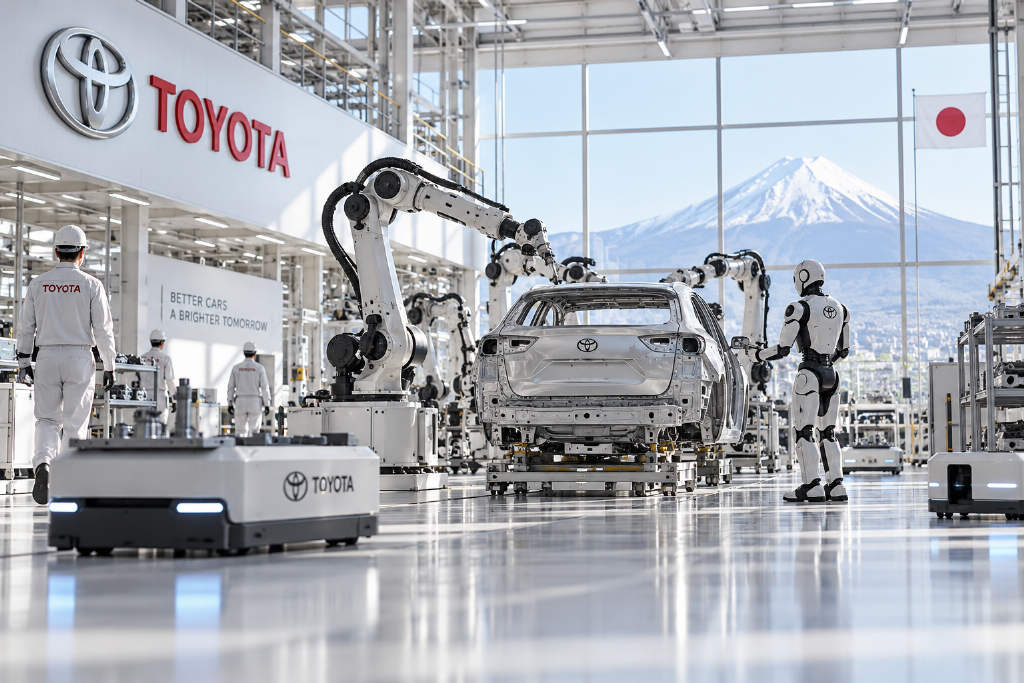
Toyota Motor said expanding automation across its factories, group companies and key suppliers could require about 400,000 robots by 2028, with annual spending of roughly 1 trillion yen, or about $6.4 billion. The company discussed the potential plan with investors in early September, though it has not confirmed whether it will commit the full amount or how many years that level of spending would continue. The estimate covers both replacement of existing equipment and new installations, including humanoid and non-humanoid systems. The potential scope spans industrial robots, automated logistics and human-robot collaboration on future factory floors. Toyota has already deployed and tested robotics in multiple manufacturing processes. The company uses the term "physical AI" for technology that lets robots sense their surroundings through sensors, learn from conditions or optimize movements, and operate autonomously. Its frontier research center is using robotics to address labor shortages and skills transfer, with the technology already applied in systems such as the KumiPro parts-picking robot, according to Reuters.
Toyota Motor estimates that expanding automation across its factories, group companies and major suppliers could require about 400,000 robots by 2028, with annual investment of roughly 1 trillion yen, or about $6.4 billion.
The potential investment plan was discussed with investors in early September. Toyota has not confirmed whether it will invest the full amount or how many years spending at that level would continue.
Estimate includes replacements and new installations
The 400,000-unit figure includes both replacement of existing equipment and new installations, covering humanoid and non-humanoid systems. The potential investment scope includes industrial robots, automated logistics and human-robot collaboration on future factory floors. Toyota has already used and tested robotics in several manufacturing processes.
Toyota describes the technology as physical AI
Toyota uses the term "physical AI" to describe technology that allows robots to sense their environment through sensors, learn from conditions or optimize their movements, and operate autonomously. Its frontier research center is using robotics to address labor shortages and the transfer of skills, and the technology has already been applied in systems including the KumiPro parts-picking robot.
The report was cited by Reuters.
This article was originally published by Bit.Fan. For more cryptocurrency news and market insights, visit www.bit.fan. Disclaimer:
The market information, project data, and third-party content displayed on this platform are for industry information sharing only and do not constitute any form of investment advice or return commitment.
Cryptocurrency trading carries high risks. Users should fully assess their risk tolerance and make independent decisions. All profits, losses, and legal responsibilities are borne by the users themselves.