
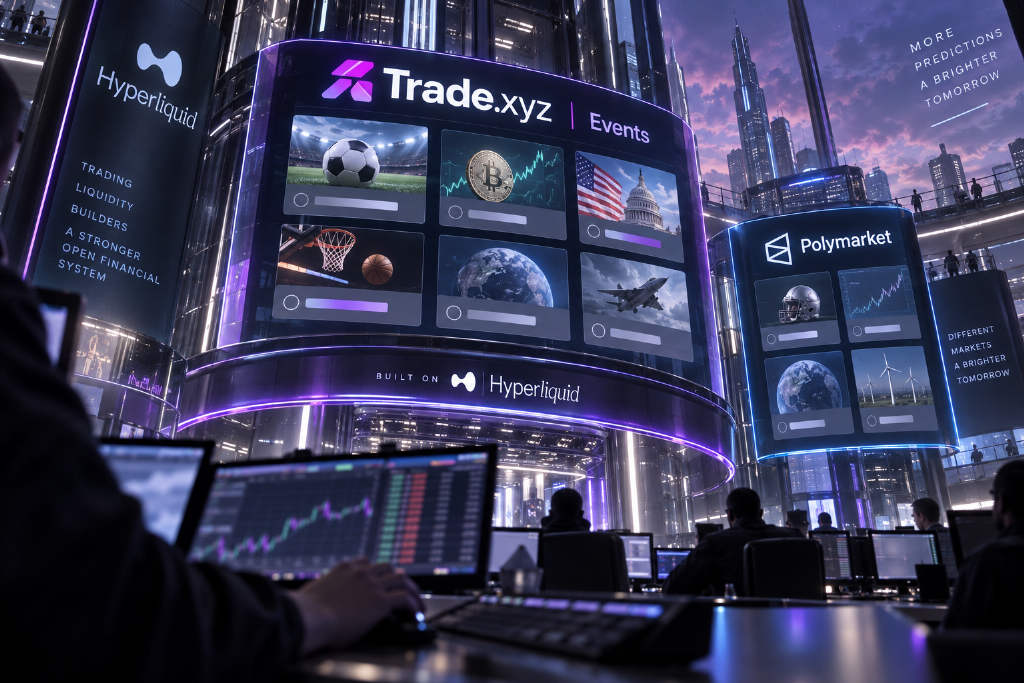
Trade.xyz has deployed its prediction market product on the Hyperliquid mainnet and is now the third HIP-4 prediction market project in the ecosystem, following Outcome.xyz and Skew Markets.
In its first few days live, Trade.xyz quietly listed 34 prediction events through the “Predict” section of its website, spanning finance, sports and other categories. Because the product had not been formally announced at the time, early activity remained limited. In its first week, it posted $180,000 in trading volume and 263 users.
Earlier today, the company began its first official push for the product and named it Events. According to the latest announcement, Events will cover sports, politics, economics and financial markets, with more categories and contract types planned later on.
Trade.xyz said the first batch of stock, commodities and Pre-IPO related events will draw on the depth and liquidity of Trade.xyz perpetual contracts on HIP-3. The aim is to make sure each contract is based on real prices from Trade.xyz’s own liquid markets rather than external oracles.
Through Events, the company says it wants to move Hyperliquid closer to a “universal exchange” model: a single, composable system for trading both financial assets and the outcomes of real-world events.
Trade.xyz and Polymarket use different fee models
Trade.xyz has added more design details for Events to its product documents, including a clearer fee schedule. That makes a direct comparison with Polymarket easier.
Events uses Hyperliquid’s Outcome Trading fee structure. At its current initial setting, there is no extra project-level fee, and users only pay the standard Hyperliquid spot trading fee.
The base rate is 0.07% for takers and 0.04% for makers. Those rates can fall based on a user’s weighted trading volume over the past 14 days, with the lowest tier reaching 0.025% for takers and 0 for makers. Staking HYPE can add fee discounts of as much as 40%.
One detail matters here: Events does not charge fees when a position is opened. Fees are taken when a position is closed or when the market settles, and makers do not receive any additional rebate.
Polymarket works differently. Maker orders pay no trading fee and receive rebates ranging from 15% to 25%. Taker fees are dynamic and depend on both the market category and the probability price at the time the order is matched.
At present, Polymarket lists a 0.07% fee parameter for Crypto markets; 0.05% for Sports, Economics, Culture, Weather and other categories; 0.04% for Finance, Politics, Mentions and Tech; and no trading fee at all for Geopolitics.
The fee is calculated as C × feeRate × p × (1-p). As a result, even markets with the same 0.04% parameter can produce very different actual fees depending on the price.
Trade.xyz is cheaper for taker activity around mid-probability markets
The article gives a simple example. If a user trades a $100 event as a taker at 50% probability, Trade.xyz would charge about $0.07 using its base 0.07% taker fee.
On Polymarket, a Finance or Politics market with a 0.04% fee parameter would cost about $1 under the C × feeRate × p × (1-p) formula. A Sports market with a 0.05% parameter would cost about $1.25, while a Crypto market would rise to about $1.75.
That means when an event is trading close to 50/50, where price discovery is usually most active, Polymarket’s actual fee can be 14 to 25 times higher than Trade.xyz’s.
The gap narrows quickly as the outcome becomes more one-sided. That is because Polymarket’s fee is tied to p × (1-p): the closer the probability is to 50%, the higher the fee; the closer it is to 0% or 100%, the lower the fee.
Using the same $100 Finance or Politics taker trade, if the event probability rises from 50% to 90%, the Polymarket fee drops from about $1 to about $0.36. At 95%, it falls to about $0.19. At 99%, it is only about $0.04.
So for events that are already nearing a highly certain outcome, Polymarket’s dynamic pricing can lower trading costs sharply and in some cases even undercut Trade.xyz’s base taker fee.
Polymarket has the edge for maker trading
The maker side tells a different story. Trade.xyz charges a base maker fee of 0.04%, while Polymarket charges makers nothing and also pays rebates.
For users who prefer to post limit orders and wait to be filled, that gives Polymarket a clearer cost advantage. For users who need immediate execution and cross the spread as takers, Trade.xyz still holds a visible fee advantage across much of the mid-probability range.
The category also matters. Geopolitics markets on Polymarket, for example, carry no trading fee at all. That makes blanket comparisons difficult. The effective cost depends on what kind of event is being traded and where the probability currently sits.
Scale still favors Polymarket, but Trade.xyz is trying a different route
Based on the current numbers, Trade.xyz is not yet in a position to compete head-on with Polymarket. Its first-week volume of $180,000 and 263 users remains several orders of magnitude below Polymarket’s existing liquidity, user base and market breadth.
At least for now, Trade.xyz looks more like a new challenger entering the field than a direct peer.
Still, the company is not entering empty-handed. Over the past year and more, Trade.xyz has already shown, through HIP-3 on Hyperliquid, that it can build markets, organize liquidity and support trading in long-tail assets. Events is an attempt to extend that experience into prediction markets.
In fees, liquidity design and the way it connects with Hyperliquid’s perpetual markets, the project is not simply copying Polymarket. It is trying to fold prediction markets into Hyperliquid’s broader trading system.
If Trade.xyz can move the trading capabilities it built on HIP-3 into Events and use Hyperliquid’s users and liquidity to get through the cold start phase, it could become a disruptive name in the prediction market sector.
For now, though, low fees are only one part of the equation. Liquidity, user scale, event coverage and market formation remain the factors that will decide how the sector develops. Whether Trade.xyz can reproduce its HIP-3 strengths in Events is still the key question to watch.