
Memory Sector Rout Deepens: MU Loses $1,000 Mark
BlockBeats – July 2, during U.S. afternoon trading, the NASDAQ turned negative by 0.3%, dragging the memory storage sector into a sharp correction. Micron Technology (MU) slipped 4.2%, falling below the psychologically important $1,000 level; SanDisk (SNDK) plummeted 10.1%, leading the decline; Seagate Technology (STX) and Western Digital (WDC) each dropped 6.2%; new memory ETF KMEM slumped 8.1%, while the Roundhill Memory ETF (DRAM) lost 6.45%. The sell-off was broad-based, reflecting extreme bearish sentiment across the storage semiconductor space.
Trump’s Vocal Support Falls on Deaf Ears
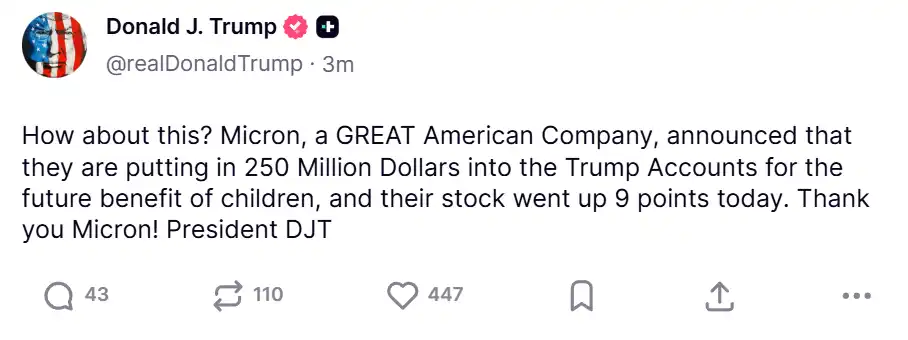
President Donald Trump made two separate public remarks on Tuesday praising Micron, in an apparent attempt to shore up investor confidence. In his midday statement, he said: “Micron, a truly great American company and one of the hottest in the world, announced a historic $250 million investment in President Trump’s account. This incredible move, driven by Micron’s outstanding CEO, will make many children extremely happy in the near future. It is the largest corporate investment of its kind, opening the starting point of the American Dream for these amazing children on the occasion of America’s 250th anniversary.” In his evening remarks, he reiterated: “Micron is a great American company, they announced a $250 million investment in President Trump’s account for the future of children. Today Micron’s stock was up $9. Thank you, Micron!”
Despite the president’s repeated praise, Micron shares actually fell 4.2% on the day, refuting his claim of a $9 gain. Market participants largely dismissed the so-called “$250 million investment in President Trump’s account” as politically motivated rhetoric lacking concrete details or feasibility. The primary drivers of the sector’s weakness remain sluggish memory demand, slow inventory digestion, and a tightening macroeconomic environment rather than any political endorsement.
Fundamentals Weigh Heavily on Memory Names
Tuesday’s storage collapse did not occur in isolation. Multiple research firms have recently revised down their memory chip shipment forecasts. While HBM (High Bandwidth Memory) maintains strong demand, conventional DRAM and NAND Flash pricing continues to soften. Micron’s last quarterly report exceeded expectations, but its forward guidance was cautious, leaving investors skeptical about an imminent memory recovery. Trump’s impromptu investment statement, lacking official backing from Micron management, was perceived by some as a “pump and dump” attempt, accelerating short-term profit-taking. SanDisk, Seagate, and other names had rallied substantially earlier this year, making them vulnerable to profit-taking when fundamentals weaken.
From a macro perspective, the NASDAQ’s late-day reversal highlights growing anxiety over technology valuations. Shifting Federal Reserve rate-cut expectations and capital rotation toward mega-cap tech platforms are creating headwinds for cyclical sectors like memory. In the near term, investors should focus on spot memory pricing trends and capital expenditure plans of major manufacturers; the marginal impact of Trump’s social-media-style endorsements is likely to be negligible.