
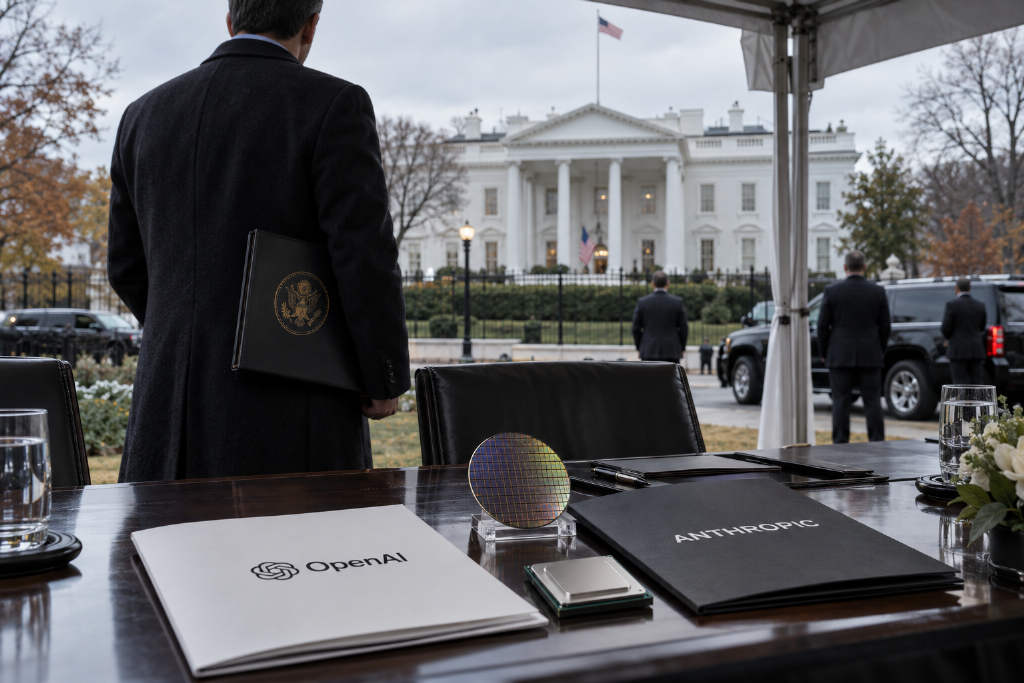
Donald Trump said in a Time interview that the U.S. government could "maybe" take stakes in OpenAI and Anthropic if it used the same approach he described in the Intel deal. The transcript of the interview was published on Oct. 1, one day after Anthropic CEO Dario Amodei had dinner with Trump at the White House for more than two hours.
Trump praised Amodei but rejected upfront regulation
The report says the Pentagon designated Anthropic as a supply-chain risk in March. On Sept. 25, a federal appeals court in Washington upheld that determination by a 2-1 vote. Two nights later, Amodei arrived at the White House for dinner with Trump.
In the Time interview published the next day, Trump said he liked Amodei and his wife. When asked why the government could not take stakes in OpenAI and Anthropic the way it did with Intel, he replied with a single line: "Maybe I could do that."
Trump’s comments on Amodei were notably positive. He said Amodei’s views were "very different from the way the media portrays him" and called him "very smart," adding that he may have been somewhat different from what Trump had originally thought. On regulation, though, Trump did not soften his position. "If you go for regulation, they can shut you down," he said, arguing that the U.S. is far ahead of the rest of the world and that he wants to keep winning.
Asked whether he would nationalize top AI labs, Trump answered plainly: "No, I wouldn’t." Pressed on why, he said the guardrails are the Department of Justice and the FBI, adding, "I’ve used them twice, and they were very effective." In that framing, enforcement comes after the fact rather than through rules imposed in advance.
Trump was equally blunt when discussing OpenAI CEO Sam Altman. "I like him. Do I trust him? Who can I trust?" he said.
White House voluntary AI pact and the contrast with Amodei’s earlier stance
The day after the Time interview, Amodei returned to the White House and signed a voluntary AI safety agreement alongside representatives from Google, Meta, OpenAI, Nvidia and xAI.
According to Time, officials described the understanding between the two sides as a pact to avoid surprising each other if something goes wrong. The report also notes that Amodei had argued in a September article for slowing frontier model development, yet the document he signed relied on self-regulation in place of government oversight.
The Intel formula was more complicated than "free" equity
Trump portrayed the Intel transaction in simple terms. He said the company had a problem he could solve, he offered the solution, and in exchange the U.S. would take 10% of the company. He also stressed that the stake was not purchased: "I got it for free."
The article says the actual structure was more complicated. In August 2025, the U.S. government subscribed to about 433 million newly issued Intel shares at $20.47 each, taking roughly 9.9% for a total of $8.9 billion. That money was not newly appropriated cash. Instead, it came from converting $5.7 billion in previously approved but undisbursed CHIPS Act subsidies and $3.2 billion from the Secure Enclave program into equity.
Trump said the deal made the U.S. "$60 billion or $70 billion." Using Intel’s Oct. 1 closing price of about $120 as a rough reference, the report estimates the 433 million shares would be worth about $52 billion. After subtracting the $8.9 billion cost, the paper gain would be about $43 billion.
Trump also said he had used the same approach elsewhere. He said Nvidia had a chip that was originally barred from sale, and if the company wanted to sell it, the U.S. government would take "a cut," though he did not specify the percentage. He also cited a land development project in Alaska where he demanded that the U.S. take 50%, and the other side agreed to a number. His conclusion was direct: "I’ve always done that, not for myself, for the country."
As laid out in the report, the formula is straightforward: the government controls an approval process, the company has a problem that needs to be solved, and the exchange is equity or a revenue cut.
If applied to Anthropic, the supply-chain ruling would be the obvious leverage point
If that Intel formula were copied directly onto Anthropic, the first question would be what problem Anthropic needs solved. The article’s answer is clear: the supply-chain risk designation.
The dispute began after Anthropic refused to allow Claude to be used for autonomous weapons and mass surveillance of Americans. The majority opinion at the appeals court came from Judge Gregory Katsas, while Karen LeCraft Henderson dissented. Anthropic said it was considering all options, including seeking further review.
That means the supply-chain risk finding could serve as ready-made leverage if the White House wanted to replicate the Intel model. Even so, the report says there is no sign that the two sides have discussed terms, and Trump’s actual wording went no further than "maybe."
Anthropic’s scale makes the comparison with Intel far less direct
The bigger difference is size. Citing Bloomberg, the article says Anthropic is seeking to begin its roadshow in mid-November and list before Thanksgiving, with a target valuation of about $2 trillion and fundraising of as much as $100 billion. It also says the company’s post-money valuation in its May financing round was $965 billion.
If the Intel benchmark of 10% were applied here, the stake would be worth around $200 billion, more than twenty times the size of the earlier $8.9 billion Intel transaction. The report argues that the bargaining positions are completely different: Intel, with a depressed share price at the time, needed approved subsidies to actually be disbursed, while Anthropic is described as pursuing an offering that investors are eager to buy.
Public opinion and regulatory boundaries remain unresolved
The article also highlights two polling figures raised by the Time reporter during the interview: 71% of Americans oppose building data centers, and 57% believe AI does more harm than good. Asked whether he worried that he might fail to persuade the public, Trump replied, "I probably can’t."
With only one month left before the Nov. 3 midterm election, the report says even polling by Trump’s own pollster, Tony Fabrizio, shows broad public anxiety.
That leaves the idea of a government stake as a double-edged proposition. For voters, the story that the government should share in AI-driven gains may be easy to tell, and both OpenAI and Anthropic have said in policy writings that the public should share in AI-led growth. For regulation, though, the line between referee and participant would blur once the government itself becomes a shareholder.