
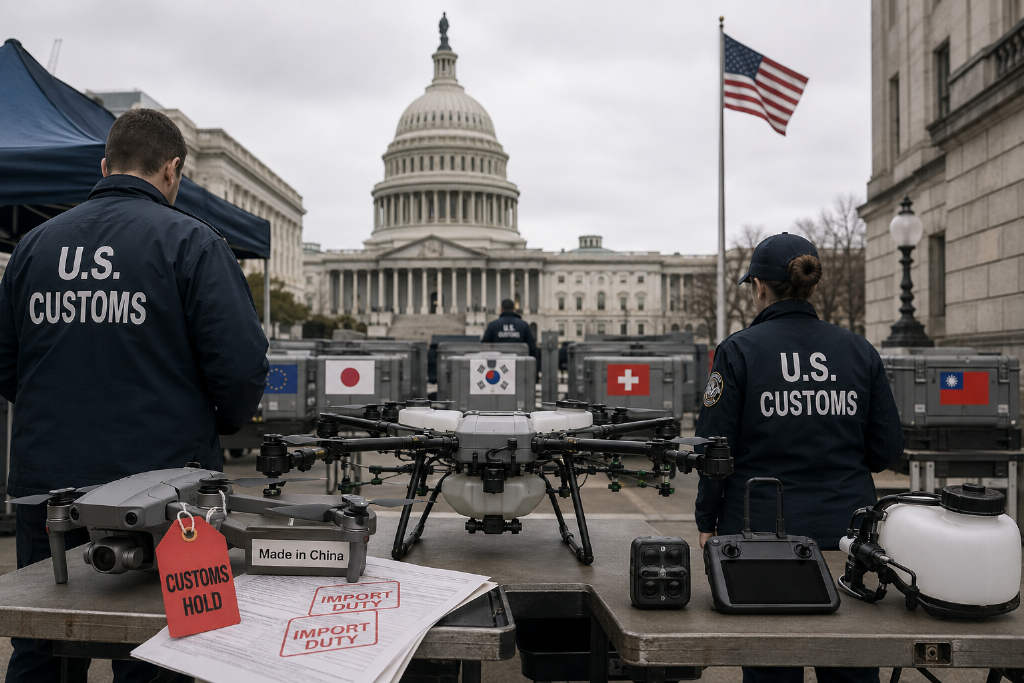
New U.S. tariffs on imported drones took effect on Sept. 3, with rates ranging from 15% to 100% depending on the model and its capabilities. China-made drones face the heaviest burden, with some products subject to duties as high as 100%. Drones made in the European Union, Japan, South Korea, Switzerland and Taiwan are assigned a 15% rate, but that treatment comes with conditions rather than a blanket exemption.
The legal basis comes from a Section 232 national security probe
The tariff round stems from an Aug. 13 proclamation signed by Donald Trump. Its legal foundation is a national security investigation under Section 232 of the Trade Expansion Act. The U.S. Commerce Department concluded that excessive dependence on foreign drones and drone components had become a national security threat.
Four tariff tiers, with China facing the top bracket
The new tariff structure is split into four levels.
- 100% applies to drones with a maximum takeoff weight above 25 kilograms, or to models equipped with thermal imaging cameras. It also covers key components listed in the proclamation annex, including docking stations.
- 25% applies to smaller drones that do not have those features.
- 15% applies to drones made in the European Union, Japan, South Korea, Switzerland and Taiwan, provided their hardware and technology originate in those places or in the U.S.
- 10% remains in place for the U.K.
Annex 3 of the proclamation also delays a 25% ad valorem tariff on a group of less sensitive components until Feb. 9, 2027. Products that go through the FCC Covered List exemption process before Sept. 2, 2026 can also receive a temporary reprieve.
DJI appears to be the main target
The report says the biggest target of the tariff package is Shenzhen-based DJI. The company accounts for more than two-thirds of the global drone market and more than 70% of the commercial segment. Under the current tariff schedule, many of DJI’s previously authorized models would fall into the 25% bracket, while drones equipped with thermal imaging cameras and docking-station accessories would be pushed into the 100% category.
FCC restrictions are tightening at the same time
Alongside the tariffs, the Federal Communications Commission is pressing ahead with tougher limits on foreign-made drones. According to the report, the FCC had already effectively barred the sale of new foreign-made drones without special waivers in December 2025. Models that had already been authorized could still fly and be imported, but the FCC has since proposed expanding the import ban to a range of older models and reclassifying drones that use common technologies such as thermal imaging and agricultural spraying as military-grade systems.
If that proposal passes, drones that are currently used legally by thousands of U.S. businesses, fire departments and law-enforcement agencies could retroactively become non-compliant. The proposal has received more than 3,000 public comments. Some industry participants have warned that it would block access in the U.S. to technologies that have already become standard equipment globally.
The 15% ally rate still requires supply-chain proof
The report argues that U.S. allies may not find it easy to build a non-China supply chain through this tariff round alone. Critics say the domestic U.S. drone industry is too small to fill the gap if Chinese products are pushed aside, and that a rushed policy shift could create more problems than it solves.
The condition attached to the 15% rate is central. Manufacturers in the European Union, Japan, South Korea and Taiwan must show that their hardware and technology come from local sources or from the U.S. In practice, that means proving their supply chains have been fully cut off from China, rather than simply presenting a certificate of origin.
At the same time, key upstream inputs such as magnets and batteries still depend heavily on Chinese production capacity in the near term. The tariffs may constrain exports of finished drones, but they do not remove reliance on upstream materials.
Trump family ties to the drone sector drew attention
The report also highlights links between the Trump family and the drone industry. Donald Trump Jr. joined the advisory board of U.S. drone maker Unusual Machines in November 2024 and received 200,000 shares. One month earlier, he had also bought 66,000 common shares and 66,000 warrants in a private placement.
On Aug. 14 this year, the day the tariff news became public, Unusual Machines rose about 22% to 24% in a single session, while Red Cat gained about 8.8% and Ondas added about 4%. A spokesperson for Donald Trump Jr. denied that he had lobbied the government on the company’s behalf.
Public agencies and small businesses may bear the cost first
The New York Times report cited in the source says foreign-made drones are widely used in the U.S. for wildfire tracking and missing-person search operations. That leaves public agencies and small businesses among the first groups to absorb the cost pressure created by the tariffs and possible FCC rule changes.
Next key date: Feb. 9, 2027
The next date to watch is Feb. 9, 2027, when the delayed second wave of component tariffs is set to take effect. That stage will test deeper layers of the supply chain.
If the FCC ultimately reclassifies drones with thermal imaging or agricultural spraying functions as military-grade, the impact would extend well beyond tariffs alone, because it would retroactively affect existing procurement and use across thousands of businesses and public bodies.
As for whether manufacturers in the European Union, Japan, South Korea, Switzerland and Taiwan can actually capture market share vacated by China under the 15% rate, the report says the answer will depend less on the headline tariff number and more on whether they can produce supply-chain documentation that stands up to scrutiny.