
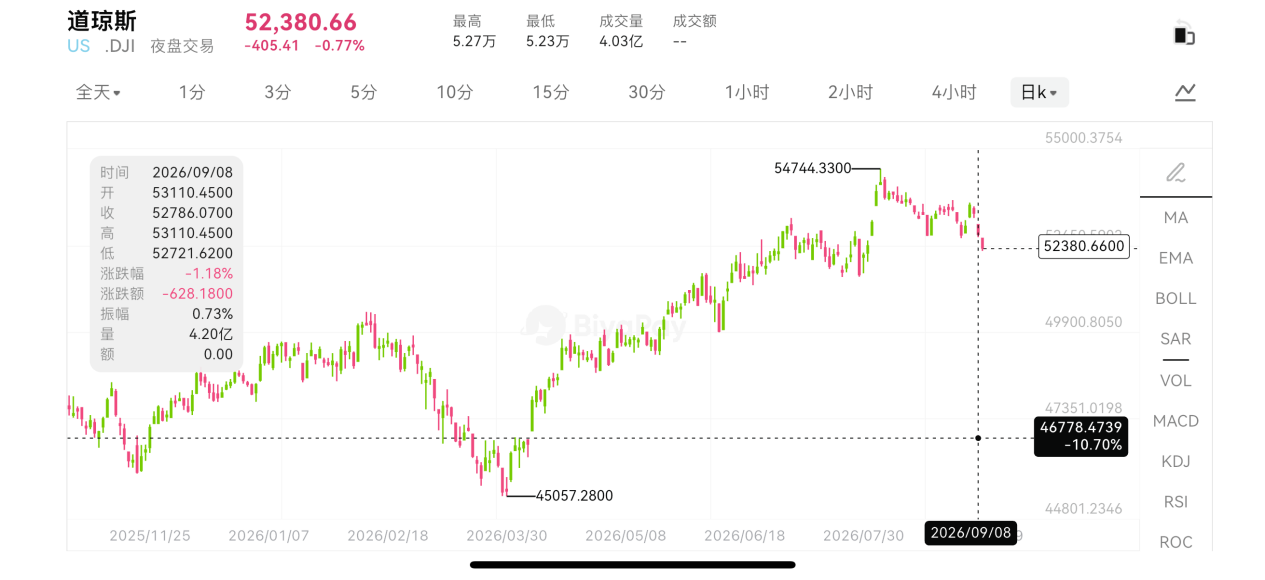
U.S. stocks reopened after the holiday without extending the previous risk-on tone. On Sept. 8, BiyaPay market data showed all three major indexes closing lower: the Dow Jones Industrial Average fell 1.2%, the S&P 500 dropped 0.6%, and the Nasdaq declined 0.3%.
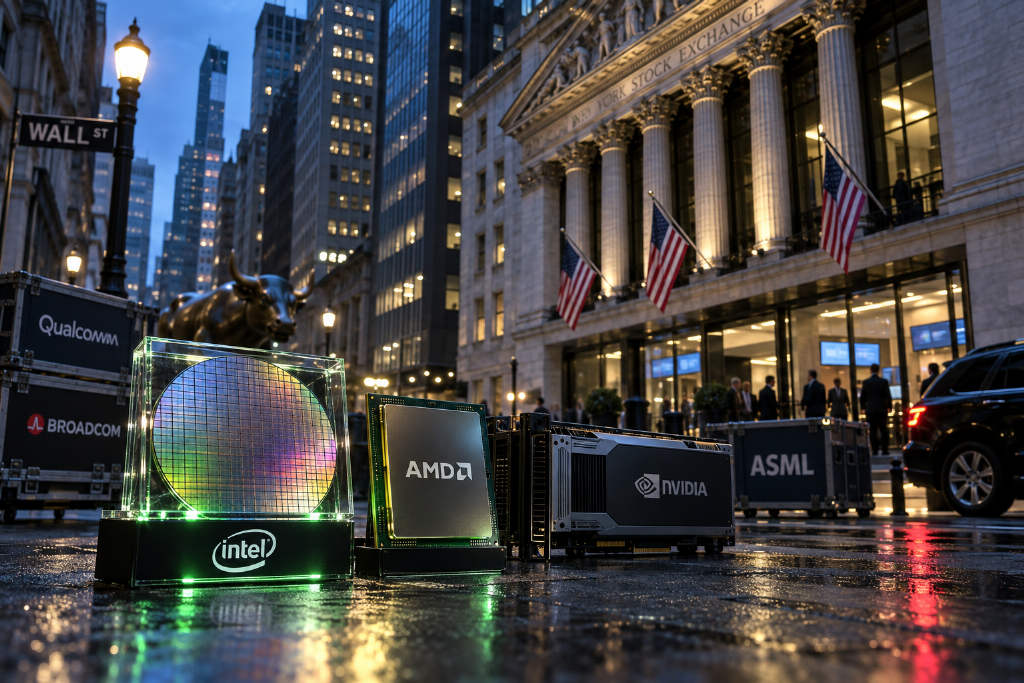
Under the surface, the semiconductor sector told a different story. Intel rose about 9%, AMD gained nearly 6%, and Qualcomm, Broadcom, and ASML also posted advances. Nvidia, by contrast, fell about 2%, while memory names including Micron and SanDisk were weaker.
That split is the main signal in the move. Looking only at the indexes suggests cooling sentiment in tech. Looking only at individual chip stocks suggests money never really left AI or semiconductors and instead rotated quickly between sub-sectors. The article says that with oil prices, Treasury yields, Federal Reserve expectations, and AI supply-chain developments all moving at once, watching a single market can miss the broader picture.
The report also notes that the BiyaPay app allows users to track U.S. stocks such as Intel, AMD, Qualcomm, and Nvidia alongside Hong Kong stocks, BTC, ETH, gold, and crude oil. It describes BiyaPay as a global one-stop asset allocation platform covering digital assets, U.S. stocks, Hong Kong stocks, and fiat exchange.
The broader point in the article is that capital is not simply exiting AI and chips. It is choosing new directions within the same trade.
Macro pressure is pushing a rotation inside tech
For some time, U.S. tech trading had been heavily concentrated in Nvidia, AI servers, memory chips, and AI-related capital spending. As oil prices moved higher again, Treasury yields rose, and the September Federal Reserve meeting approached, tolerance for richly valued assets weakened.
In that setup, the article says investors are gravitating toward two kinds of companies: those with clearer orders or customer validation, and those with a more visible earnings-repair story. Intel, Qualcomm, and AMD fit that screen in this latest session.
Oil and yields are putting pressure on valuations
The first source of pressure came from macro markets. Brent crude at one point approached and briefly moved above $100, while WTI climbed above $90. Higher oil prices can lift inflation expectations, and if inflation proves sticky, the Fed has less room to turn dovish quickly.
At the same time, the 10-year U.S. Treasury yield climbed to around 4.8%, while the 30-year yield also remained elevated. For equities, the combined pressure from oil, inflation, and rates usually hits valuation first.
By that logic, high-growth tech should be especially rate-sensitive because much of its valuation rests on future cash flows. Yet the Nasdaq fell less than the Dow, and semiconductor stocks still outperformed. The article reads that as a sign that the market is not selling technology across the board. It is rotating within it.
What investors are really pricing, it argues, is which companies can still present a credible growth story in a higher-rate environment, and which ones can turn pricing, orders, customers, and product roadmaps into profits.
Intel’s rally centered on pricing and earnings repair
Intel’s sharp gain was tied first to pricing and earnings expectations. DigiTimes reported that Intel may raise PC CPU prices again in October by about 10%. That report helped lift the stock and made Intel one of the stronger performers in the S&P 500 on the day.
The article also makes clear that Intel did not formally comment on the report, so it cannot yet be treated as confirmed company guidance. Even so, the market’s response suggests investors are paying close attention to whether Intel is regaining pricing power.
That matters because Intel’s problem over the past few years has not simply been revenue. Margins, manufacturing investment, and competitive pressure have all weighed on its valuation. If CPU prices rise, server demand improves, and cost pressure is passed through more effectively, investors may reassess the company’s earnings-repair potential. Layered on top of that is AI data-center demand for server CPUs, interconnect, and core infrastructure, which means Intel is no longer being viewed only as a traditional PC cycle stock. It is also being priced as part of the AI infrastructure chain.
The article stops short of calling this a full turnaround. It says the key question is not whether Intel can rise 9% in a day, but whether it can show over the next several quarters that higher prices will not materially damage demand, that data-center operations keep improving, and that concerns around advanced process technology and foundry operations begin to fade.
Qualcomm’s catalyst came from an AI data-center partnership
Qualcomm’s move was driven more by a new industry-growth angle. On Sept. 8, Qualcomm officially announced a multi-generation collaboration with Amazon on custom chips and optical interconnect solutions for large-scale AI data centers. The focus includes AI inference and optical connectivity of up to 1.6T.
The market is not only reacting to Amazon as a customer name. It is also looking at whether Qualcomm can open a second growth path outside smartphone chips. Qualcomm has long been associated with handsets, modems, and mobile computing. As AI moves deeper into inference, data centers need more than GPUs. They also need efficient inference chips, low-power computing, and high-speed interconnect, which gives Qualcomm a possible opening.
If the company can transfer the power-efficiency strengths it built in mobile into the data center, the article says, it may gain a way out of the traditional smartphone cycle.
Still, the report adds an important caveat. The so-called potential scale of up to $60 billion does not mean confirmed order revenue. Some reports linked that figure to Amazon warrants and future purchasing conditions. Whether that full amount can ever turn into Qualcomm revenue will depend on later product delivery, customer buying pace, and the competitive backdrop. In other words, the stock’s short-term rise reflects a repricing of Qualcomm’s AI data-center entry, not confirmation of a decade of revenue.
AMD rose with renewed interest in AI infrastructure names
AMD’s gain was described mainly as a sympathy move tied to AI chips and the server supply chain. The company occupies an in-between position. It is not the dominant AI leader in the way Nvidia is, but it is not absent from the space either.
The market’s focus on AMD comes down to two questions: whether its MI-series AI accelerators can keep winning orders from major customers, and whether its server CPU and data-center businesses can continue gaining share.
When Qualcomm gets fresh attention through Amazon and Intel starts being repriced for pricing power, AMD also gets pulled into the same comparison. Outside Nvidia, which companies can still capture a meaningful portion of AI infrastructure spending? That is where AMD’s upside sensitivity comes from, according to the article.
It also notes the risk in that setup. AMD is not being granted a certainty premium. It is getting more of a challenger premium. Challenger trades can move quickly, but they can also pull back on shifts in order timing, gross margin, supply chains, or software ecosystems. For that reason, the article says AMD’s move should be judged less by a single day’s gain than by whether AI revenue mix, customer expansion, and product execution continue to come through.
AI is not fading, but the market is getting more selective
The most important takeaway from the divergence in semiconductors is not simply which names rose and which fell. The article argues that AI trading is moving away from a single-leader narrative and toward more granular pricing across the supply chain.
Earlier in the cycle, investors preferred the companies with the strongest sense of certainty, which made Nvidia, TSMC, memory chips, and AI servers the main trade. As valuations climbed, the market began looking for new frameworks. Intel is being traded on pricing and margin repair. Qualcomm is being traded on AI inference and a new data-center entry point. AMD is being traded on optionality outside Nvidia. ASML and semiconductor equipment names are being traded on the expansion cycle in advanced manufacturing.
It is still the same AI theme. The position of each company within that theme is changing.
That also helps explain why semiconductors could rise while the broader market fell. The article’s view is that investors are not ignoring rates. They are looking for technology assets that can better prove their value in a higher-rate environment. As long as AI capital spending has not been disproven, chip stocks are unlikely to disappear as a theme. The rotation is more likely to move from one link in the chain to another.
What the market is watching next
In the near term, the semiconductor sector’s resilience sends a clear message: AI and chips remain a leading theme, but money is now searching for new support points outside the most crowded trades. Nvidia falling does not mean AI is over. Intel, Qualcomm, and AMD rising does not mean leadership has fully changed either. The article frames it as a redistribution of pricing power across the AI supply chain.
It highlights three variables to watch next.
- First, U.S. August CPI. The U.S. Bureau of Labor Statistics schedule shows the August CPI release is due on Sept. 11. With oil already moving higher, another strong inflation reading would add to the pressure around the Fed’s September meeting.
- Second, the FOMC meeting on Sept. 15-16. The article says the market is still assigning relatively high odds to a September rate hike, and the rate path will directly affect technology valuations.
- Third, follow-through in AI-related orders. Qualcomm’s Amazon partnership, Intel’s expected price increase, and AMD’s server demand all still need to be confirmed in future earnings and guidance.
The article’s conclusion is that this semiconductor rally looks more like a structural re-rating than a simple sentiment bounce. Oil prices and Treasury yields moving up would normally weigh on risk assets, yet chips still outperformed. That suggests investors are still willing to pay for AI infrastructure, but they are becoming more selective about where that money goes.
Broader U.S. equities remain under pressure, and AI chip trading has not gone quiet. The key question now is not whether chip stocks can still rise, but which companies can prove that AI spending will turn into cash flow.