
Robinhood Chain reports about $42.58 million in revenue over its first 70 days
Robinhood Chain generated roughly 17,171 ETH in cumulative revenue during its first 70 days online, equivalent to about $42.58 million in the figures cited in the report. That works out to an average of about $608,000 per day.
About 90% of that revenue, or around 15,454 ETH worth about $38.32 million, went to Robinhood Chain itself. The remaining roughly 10%, or about 1,716 ETH worth around $4.26 million, went to technology provider Arbitrum.
On Sept. 10, Robinhood Chain recorded $943,728 in gas revenue, down 82.6% from the Sept. 4 peak of $5.44 million. Trading activity onchain did not cool at the same pace. Its 24-hour DEX volume that day was about $1.8 billion and remained near historical highs. The divergence between revenue and trading volume points to a clear drop in average transaction fees.
Ink Foundation, GSR and others launch Charter Foundation
Charter Foundation was launched by Ink Foundation, the group behind Kraken-backed Ethereum Layer 2 network Ink, together with crypto market maker GSR and several law and audit firms. The stated goal is to provide a standardized legal framework for token issuance.
The organization said setting up a dedicated Cayman Islands company for each project could cut upfront issuance costs by more than half. Under the structure it described, projects often need a lab company, a Cayman Islands foundation, and a British Virgin Islands issuing subsidiary, with total setup costs potentially exceeding $100,000.
After a token launch is completed, the relevant Cayman entity would convert into an independent foundation and separate from Charter Foundation. Ink Foundation said Charter Foundation is not affiliated with Kraken.
Coinbase renames Base App back to Coinbase Wallet
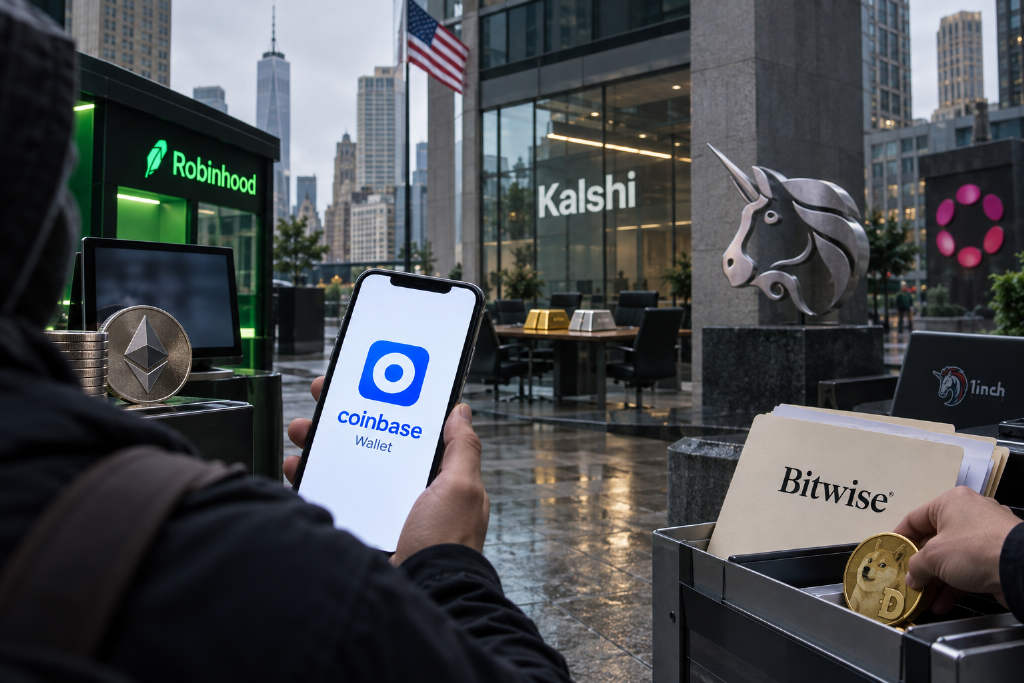
Coinbase has renamed Base App, which had been running for more than a year, back to Coinbase Wallet. The product focus is shifting toward multichain trading and access to onchain assets.
The self-custody wallet now supports more than 10 networks, including Robinhood Chain and Monad. It also offers access to Hyperliquid perpetuals, prediction markets, and tokenized stocks.
Bitwise to liquidate Dogecoin ETF BWOW
Bitwise said it will liquidate and close its Dogecoin ETF, BWOW, listed on the NYSE.
The fund will cease operations after the close of trading on Oct. 14, 2026, which will be its last trading day, and it will stop creating new shares. Remaining shareholders will receive a cash distribution on Oct. 22 based on the fund’s net asset value on Oct. 21. No further action is required from holders.
Bitwise said the liquidation is part of a broader adjustment to its product lineup.
Kalshi wins CFTC approval for gold and silver perpetuals
Kalshi received approval from the U.S. Commodity Futures Trading Commission, or CFTC, to launch gold and silver perpetual contracts on Sept. 10.
According to the report, these are the first non-crypto perpetual contracts approved by the CFTC. Kalshi first received approval in late May this year to launch crypto perpetual contracts, and the notional trading volume of those products has reached $44 billion.
Uniswap Labs launches StablePair Hook for stablecoin pairs
Uniswap Labs introduced StablePair Hook, a new Uniswap v4 hook designed for stablecoin trading pairs.
The tool is meant to replace fixed static fees with a dynamic fee mechanism so liquidity providers can retain more of the value generated by arbitrage and trading activity. Under the conventional model, when a peg deviates from 1:1, arbitrageurs and MEV bots often capture most of the profit created as the pair trades back toward parity.
StablePair Hook applies a Dutch auction mechanism to trades that help restore the price when it has moved materially away from its reference level. The fee then declines block by block until traders accept it, which is designed to keep as much of the arbitrage premium as possible inside the liquidity pool for market makers.
The first pools on Ethereum mainnet support USDC/USDG and USDC/USDT.
1inch co-founder says protocol is still not profitable after routing more than $814 billion
Sergej Kunz, co-founder of onchain DEX aggregator 1inch, said the protocol still has not reached profitability even though cumulative routed volume has surpassed $814 billion since launch in 2019.
Its 2025 transaction volume reached $214 billion, up 39% year over year. Kunz said the core issue is that the DeFi market remains too small to support durable and stable commercial net profit.
He added that the 1inch token is trading in the $0.07 to $0.09 range, down about 99% from its 2021 all-time high. The platform is looking for new growth through RWA tokenized trading in partnership with Ondo Finance and through Aqua, its shared-liquidity protocol.
Polkadot Community Foundation proposes native decentralized stablecoin dotUSD
Polkadot Community Foundation submitted a governance proposal to the Polkadot DAO to launch dotUSD, a protocol-native decentralized stablecoin intended to become Polkadot’s main stable-value asset.
The rollout would happen in phases. Phase one has already completed onchain development and would let users mint and redeem dotUSD with USDT at a 1:1 ratio. Phase two would add overcollateralized vaults using DOT as the main collateral, as well as oracles, a stability pool, and liquidation mechanics. The overall design draws on Liquity v2.
The proposal also calls for Polkadot Treasury to supply $2.5 million in USDT and $2.5 million worth of DOT as initial liquidity for the DOT/dotUSD pool. The measure is still in the voting stage.
trade[XYZ] launches Events contract market
trade[XYZ], a trading platform in the Hyperliquid ecosystem, launched an Events contract market spanning sports, politics, economics, and financial markets. The first listings cover Up/Down contracts tied to stocks, commodities, and pre-IPO assets.
The platform said users can operate from a unified account across spot assets, portfolio-margin borrowing, perpetuals, and event contracts. Its example described a user holding BTC, borrowing USDC, trading a SpaceX pre-IPO perpetual contract, and hedging SK Hynix earnings risk through the events market.
The initial Events contracts are built on trade[XYZ] perpetual markets under HIP-3 and use continuous price discovery from those markets for settlement instead of relying on external oracles.
FLOP Network releases first yellow paper draft
FLOP Network, tied to Arthur Hayes, released its v0.5.0 yellow paper draft. Flop Labs CEO Arthur Hayes said the project proposes an AI inference metering and settlement network built on Substrate/FRAME, using BABE block production and AlephBFT finality.
Its roadmap targets a testnet launch in the fourth quarter of 2026, with a token airdrop tied to participation in testing. Mainnet is targeted for the first quarter of 2027.
The yellow paper remains a draft, and multiple parameters and mechanisms have not been finalized.