

For a long period, prediction markets have occupied an awkward position in the crypto sector. They are popular inside specific vertical communities, but they have not fully become mainstream products. They can turn complex events into real-time prices, yet the same ability also places them near sensitive areas such as politics, sports and information asymmetry. Because those events can involve insider information or attempts to influence outcomes, prediction markets have remained close to regulatory gray zones.
The World Cup Turns Probability Trading Into a Familiar Conversation
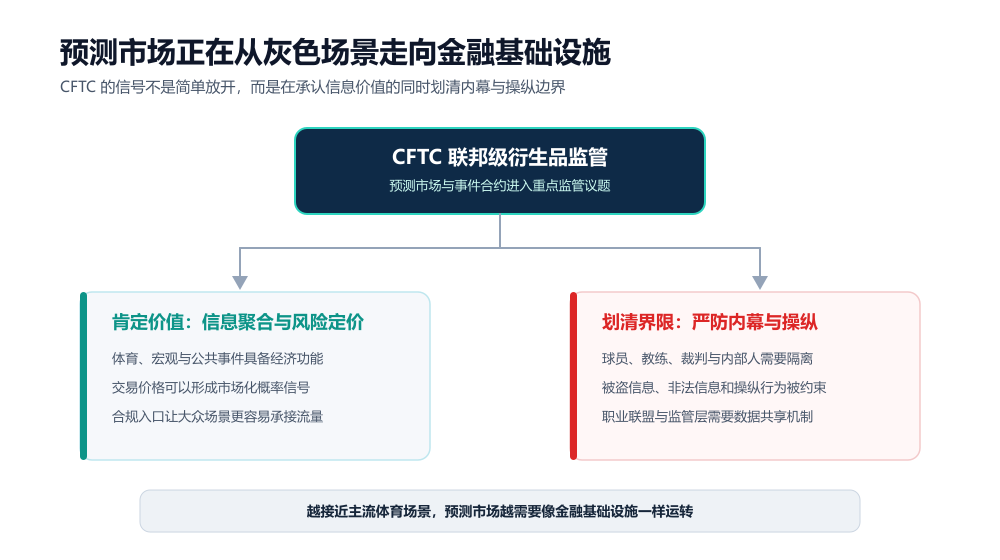
The 2026 World Cup changes the context because it is one of the most natural and largest prediction-market settings in the world. Questions such as which teams will qualify from the group stage, which side will win the title, whether a team can reach the quarter-finals, or whether the probability of a major match has already been priced by the market are already part of daily fan discussion. In the past, those conversations mainly happened on forums, in chat groups and across sports media. On platforms such as Polymarket, they become tradable probabilities and price curves that shift as matches progress.
This is why the integration of prediction markets by Web3 wallets such as imToken is important in this context. The product is no longer only a trading venue. It can also be positioned as an entry point through which ordinary users participate in real-world events with a wallet for the first time. From the front-end experience alone, prediction markets can look like a Web3 version of online guessing or sports betting. From the perspective of regulators, however, the product raises deeper questions about the legal definition of event contracts, the boundaries of trading activity and the integrity of markets linked to real-world outcomes.
CFTC Draws New Lines Around Sports-Linked Event Contracts
Prediction markets do not only trade the prices of BTC or ETH. They also cover the outcomes of real-world events, including economic data, elections, policy decisions and even more sensitive geopolitical events. That is why the regulatory debate around prediction markets has never been only a financial-market issue. If a market linked to an event becomes large enough, parties connected to the outcome, especially those with access to non-public information, can have incentives to affect the result itself or to trade before others by using informational advantages.
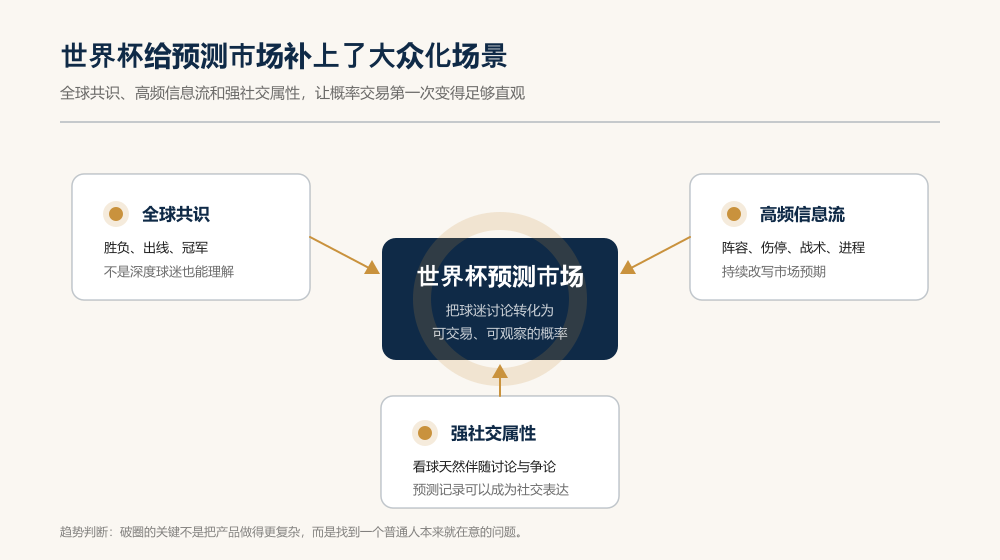
This is the background to the CFTC’s recent effort to redraw boundaries around prediction markets. Over the past two years, platforms including Polymarket have repeatedly moved beyond crypto-native circles through markets tied to the U.S. election, macroeconomic data and geopolitical events. As a result, the CFTC has been accelerating its focus on prediction markets and event contracts as a core regulatory topic. CFTC Chair Michael S. Selig recently said the agency is communicating with all major U.S. professional sports leagues in order to strengthen the regulatory framework for sports-related prediction markets and prevent insider trading and market manipulation risks.
That regulatory line is especially important for sports. Sporting events are naturally suited for prediction because their outcomes are clear, public and widely discussed. At the same time, they are also sensitive because athletes, coaches, referees and other insiders can be connected directly to the events being traded. Recent actions across the sector show a common direction: regulators and platforms acknowledge the information value of prediction markets, while moving faster to separate out the scenarios most likely to create integrity problems.
Kalshi has publicly said it will prohibit political candidates from trading in markets related to their own campaigns. It will also prevent athletes, coaches, referees and other relevant participants in professional and college sports from trading in markets related to their own events. Polymarket updated its market integrity rules in March, explicitly banning trading based on stolen information, illegally obtained information and other improper sources of information, while strengthening restrictions against market manipulation and information abuse. The information-sharing mechanism established by MLB and the CFTC also shows that sports leagues and regulators recognize the need to address game-integrity issues before prediction markets move further into mainstream sports settings.
Kalshi’s Growth Shows How Sports Contracts Are Reshaping Competition
For prediction markets to reach a broader audience, regulatory change alone is not enough. The sector also needs a public event large enough to lower the cognitive barrier. The World Cup fits that role. Many previous crypto breakout moments occurred when high-threshold technology was paired with low-threshold use cases. NFT adoption, at one stage, came from connecting on-chain assets with avatars, art and community identity. Meme assets spread quickly because they compressed complex financial behavior into simple emotion and cultural symbols.
For prediction markets, the most direct path to a wider user base is not necessarily macroeconomic data or complex political contracts. Sports, entertainment and events are more accessible because people are already willing to discuss them. The World Cup has three specific conditions. It has global consensus, meaning even people who are not deep football fans can understand who wins, who loses, who qualifies and who becomes champion. It has a high-frequency information flow, because lineups before a match, real-time form, injuries, tactical adjustments and match progress all change expectations. It also has a strong social layer, since watching matches is tied to group chats, reposts, discussions, arguments and shared emotion.
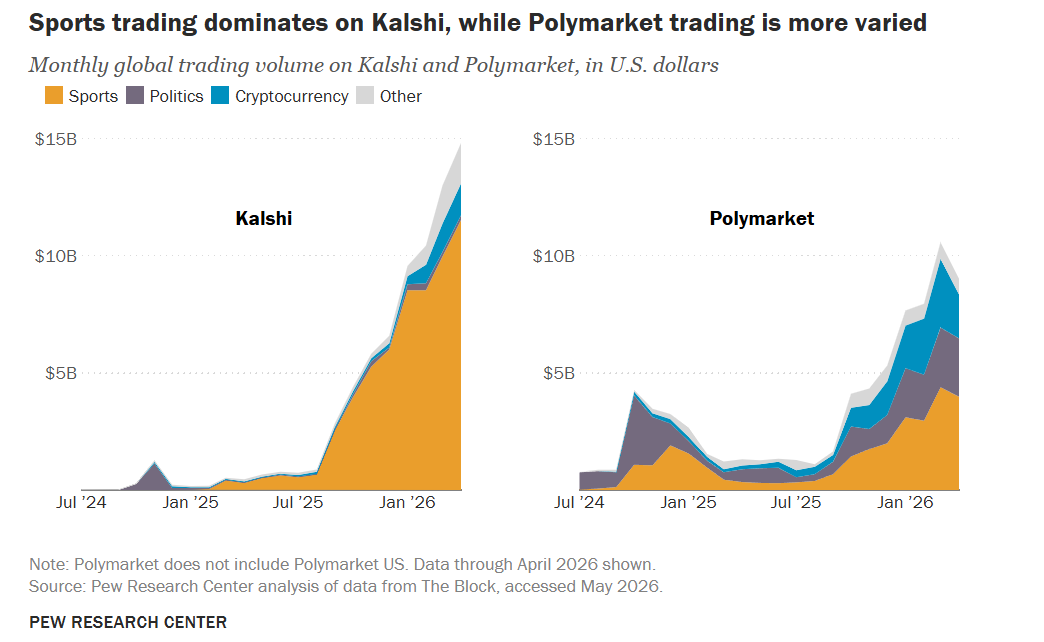
Recent disclosed data shows that overall prediction-market trading volume continued to rise in April 2026, reaching around $29.8 billion, up 12.4% month on month. Within that growing market, Polymarket’s total trading volume in April fell 8.9% compared with March. At the same time, Kalshi, which emphasizes a compliant path and is scaling through a federal regulatory framework and sports contracts, recorded a 13% increase in trading volume to about $14.8 billion. The figures point to a clear shift in the base of the prediction-market sector.
Previously, Polymarket attracted large amounts of crypto-native capital through global political competition, events inside the crypto sector and macro narratives. Now, Kalshi and similar platforms are using compliant user channels and sports contracts to expand quickly. The competition is therefore not only about a single World Cup campaign. It is also about which platforms can capture sports as a shared global event category and use it as the next stage of user growth.
Wallets Move From Asset Gateways to Event Participation Gateways
Prediction markets and traditional sports betting share some surface-level similarities, but they are not the same. Traditional odds are more often determined through bookmaker and handicap systems, with users seeing a quote processed by the platform. Prediction markets place more emphasis on user-to-user trading, market-based price formation and transparent settlement of results. In a crypto-native environment, fund flows, transaction records and settlement processes are easier to verify, giving prediction markets greater openness and observability.

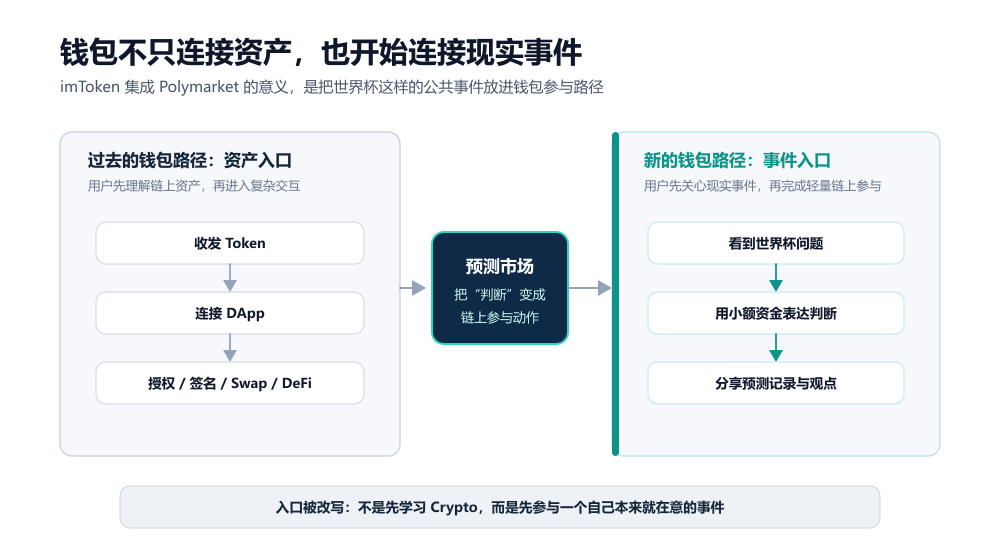
This does not mean prediction markets are inherently more advanced than traditional sports betting. Their essence remains risk trading. What they do provide is a different way to participate in events. When this is placed inside the wallet environment, the change points to an extension of the wallet’s role. In the past, the core functions of a wallet were asset custody and on-chain interaction. Users used wallets to send and receive tokens, connect to DApps, approve transactions, sign messages, swap assets and participate in DeFi or NFT trading. In other words, the wallet was an entry point to the crypto world, but that entry point was mostly organized around assets.
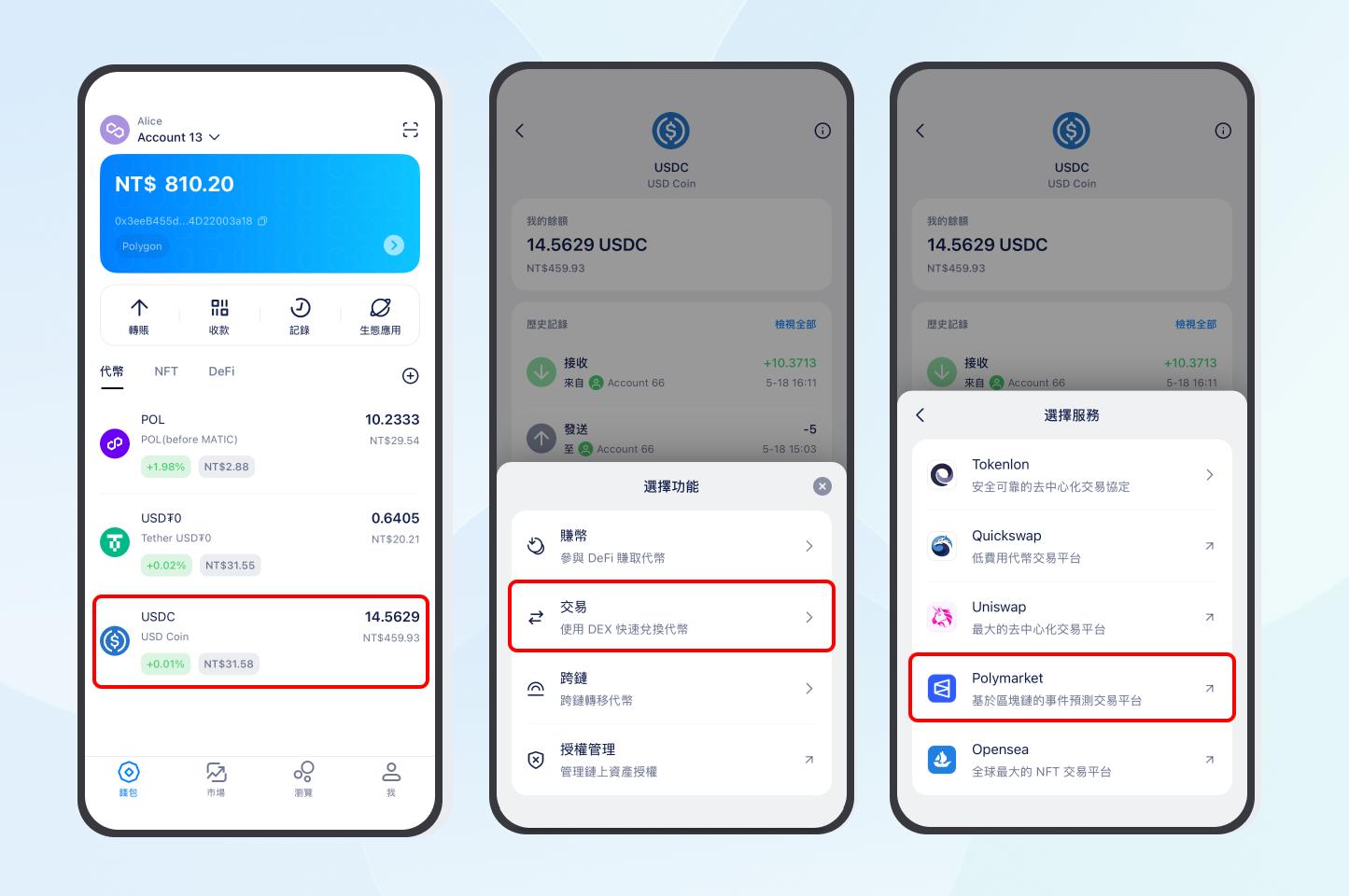
Prediction markets give wallets a chance to become event participation gateways. A user may care about the World Cup without first caring about crypto. A user may want to express a view on a match without first understanding on-chain trading. When the World Cup, Polymarket, USDC, wallet access and social sharing are combined, the user path changes. Instead of learning the wallet first and then entering a complicated on-chain environment, the user begins with a real-world event they already care about and completes a lightweight on-chain action around that event.

This matters for ordinary users because many crypto products have historically required them to understand public chains, gas, wallets, approvals, DEXs and cross-chain transfers before they can see why the product is useful. Prediction markets reverse that order. They begin with a clear question: do you think this outcome will happen, and are you willing to express that view with a small amount of capital? The importance of the World Cup for prediction markets is therefore not only about a wave of trading volume. It gives crypto a rare mass-market narrative built around a public event.
At the same time, prediction markets will not become fully mainstream immediately because of one CFTC proposal or one World Cup activity. The sector still faces issues including the formation of regulatory boundaries, governance of market manipulation and insider information, user privacy and on-chain security. Ordinary users also need to understand that prediction markets are not games that guarantee profit. The clearer direction is that the World Cup is pushing prediction markets from tools used by niche speculators toward broader public-event participation. As more users first participate in real-world events through wallets, the crypto entry point no longer has to be limited to price charts and assets. It can also be organized around public events as they happen.