

Beijing Zhongshu Ruizhi Technology has closed a strategic financing round worth several hundred million yuan, according to a report from Investment Community AI carried by MarsBit. Investors in the round include China Internet Investment Fund, Suchuangtou National Social Security Fund, Financial Street Capital, ICBC Capital, and Kunlun Capital. Existing shareholders also joined the round.
The financing came just three months after the company completed a B round worth more than 100 million yuan, putting Zhongshu Ruizhi back in the spotlight as a company some in the industry view as a China version of Palantir.
A Tsinghua-founded industrial AI company
Zhongshu Ruizhi was founded by a team from Tsinghua University and is led by chairwoman Han Han. The company is based in Zhongguancun in Beijing’s Haidian district.
The report said Han holds a PhD from Tsinghua University’s Department of Electronic Engineering and was a senior visiting scholar at Columbia University. During her time at Tsinghua, she worked deeply in data engineering and AI algorithms. After graduation, she joined the China Academy of Information and Communications Technology. The report added that Han was deeply involved in top-level national planning for big data and artificial intelligence, served as a core drafting member for multiple national policies, holds dozens of invention patents, and has long tracked global AI technology and industry trends.
In late 2019, as large model technology began to emerge globally, Han saw an opening and moved into industry. She formally founded Zhongshu Ruizhi in April 2020. The company set out with a mission to move AI from the digital world into the physical world, focusing on high-reliability, decision-intensive industrial AI and full-stack infrastructure for enterprise AI agents.
From the start, the company was trying to solve a difficult problem. China has one of the world’s largest and most complex energy and industrial systems, with vast amounts of accumulated data that are hard to use effectively. Existing data infrastructure was designed for human analysts, not for AI agents making complex decisions, and the report said there was no mature overseas model ready to copy.
That led Zhongshu Ruizhi to build a new intelligent operating system for key industries through in-house innovation.
Causal AI as the core technical approach
The company has assembled a team of master’s and doctoral talent focused on complex system modeling and industrial energy AI, according to the report. It says the team combines original work on foundational model technologies, frontier theoretical research, and hands-on experience in large industrial environments.
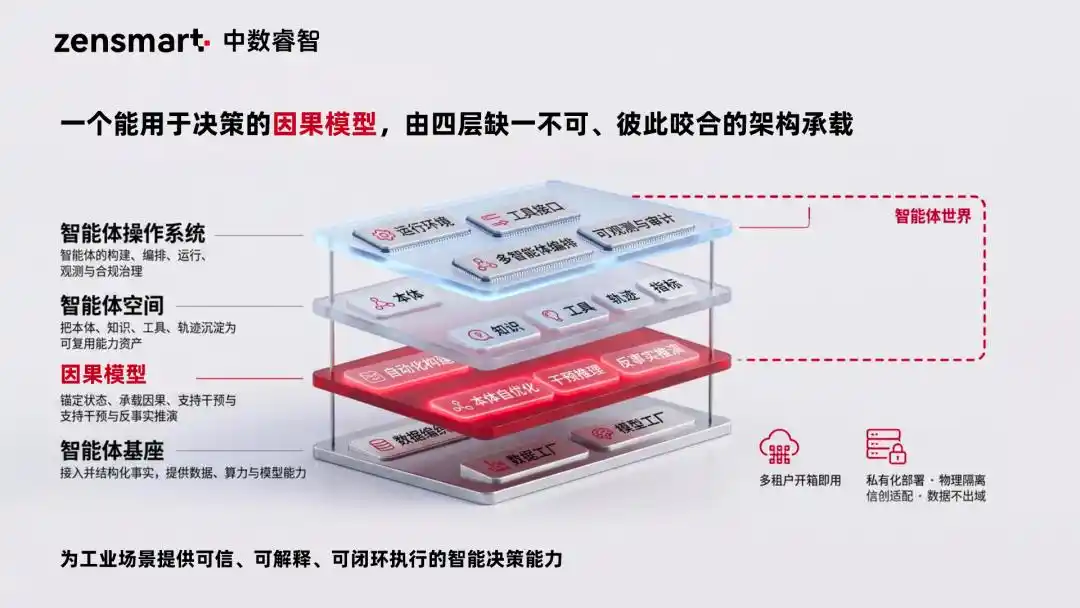
Zhongshu Ruizhi’s core technical pitch rests on three self-developed foundations: meta-causal cognitive theory, causal models, and a dynamic ontology engine. The report said these technologies are aimed at problems that generative large models have struggled with in industrial settings, including AI hallucinations, limited inference capability, weak temporal logic, unverifiable decisions, and conflicts across multiple rule systems.
The stated goal is to give industrial users intelligent decision-making tools that are trustworthy, explainable, and capable of closed-loop execution.
The report contrasted general-purpose large models with causal models in practical terms. General large models learn correlations from massive volumes of text, more like memorizing large numbers of on-site photos and inferring patterns from appearances. Causal models, by contrast, are meant to capture the relationships between equipment and industrial processes, more like having a blueprint of how a system works. In sectors such as energy dispatch, production safety, and advanced manufacturing, where tolerance for error is low, this approach is presented as a way to anticipate changes, reason through outcomes, and make AI decisions controllable and traceable.
Funding momentum has continued since 2025
Beyond its products, Zhongshu Ruizhi has also taken part in industry-level theoretical and standards work. The report said the company’s original meta-causal cognitive theory filled a domestic gap in foundational theory for trustworthy AI in complex industrial systems. It also said that at the 2026 WAIC World Artificial Intelligence Conference, Zhongshu Ruizhi released a Blue Book on the technical system for causal world models, with the aim of pushing forward a shared evaluation framework for trustworthy AI in industry.
Investors have been active around the company for some time. In 2025, Zhongshu Ruizhi completed a 200 million yuan A+ round led jointly by CDH VGC and the Beijing AI Fund, with Taiya Investment, Xiangcheng Financial Holding, and Sichuan Cultural Investment also participating. The report described that round as one of the largest financings at the time in China’s enterprise agent sector.
Less than a year later, the company completed its B round worth more than 100 million yuan, led jointly by Tsing Control Jinxin Capital, Oriza Chongyuan, and Shangxianhu Fund, with Guangdong Expressway also participating. Existing shareholder CDH VGC continued to invest.
With the latest strategic round, the report said support from a wider group of state-level shareholders is expected to strengthen the company’s loop from original foundational technology to production deployment and then global market expansion.
More than 50 clients and 800 production scenarios
Commercial execution was a major focus in the report. Zhongshu Ruizhi is described as one of the earlier enterprise AI agent operating system providers in China to achieve scaled commercial deployment.
As of now, the company has served more than 50 clients, including central state-owned enterprises, state-owned enterprises, and industrial groups in sectors such as electric power, petroleum, and aerospace. It has landed in more than 800 highly complex production scenarios, and the report said its cross-industry product capabilities have been tested in demanding real-world environments.
On operating performance, the report said the company has moved beyond a pattern seen at many AI startups that emphasize concept over deployment and rely on continuous financing for support. It described Zhongshu Ruizhi’s commercialization as having posted leapfrog growth, with revenue doubling in 2025 and a business profile built around high technical barriers, strong customer repurchase rates, and relatively clear earnings visibility.
The article also said the company already has strong self-sustaining cash-generation ability, something it described as uncommon among a new generation of AI companies.
From its technical framework and product architecture to its service model and target customer base, the report said Zhongshu Ruizhi is closely benchmarked against Palantir and has achieved technological outperformance. It also described the company as one of the few hard-tech firms in China able to deliver pure software AI projects priced in the tens of millions of yuan at scale.
How the company plans to use the new funding
Han said the proceeds from the latest round will go to three main areas.
- First, the company will continue work on frontier foundational theory, iterate on its causal models, improve original innovation at the base model layer, and build a fully domestic full-stack intelligent foundation.
- Second, it will replicate proven benchmark applications, widen its presence in core markets, expand the range of countries it serves overseas, and support steady revenue growth.
- Third, it will keep bringing in senior talent, lift organizational capability, and deliver higher-quality industrial AI capacity.
The report framed the broader AI market as entering an important turning point. Competition centered on the language abilities of general-purpose large models is giving way to industrial AI that can move into the real economy, support key decision-making, and create measurable industrial value.
China Internet Investment Fund, one of the investors in this round, said industrial-grade causal intelligence is an important part of building China’s digital foundation for modernization and cultivating new productive forces as AI shifts from a race in general large model capability to deep enablement of the real economy.
The investor said: 「China has the world’s most complex and demanding decision-making scenarios for critical infrastructure, creating the most urgent need for decision AI that is trustworthy, explainable, and capable of closed-loop execution. Zhongshu Ruizhi’s high-reliability decision AI products have already achieved scaled commercial deployment in core sectors including electric power, petroleum, and aerospace. China Internet Investment Fund will continue to support the company’s original innovation in foundational theory and ecosystem building, promote close cooperation between domestic enterprises and central state-owned enterprises as well as key industries such as energy and advanced manufacturing, define decision-making paradigms and trust standards for industrial intelligence from the ground up, and work together to help China gain a voice in rule-setting on the global physical AI track, using a self-controllable new-generation AI foundation to safeguard critical infrastructure security and support the building of a strong cyber nation.」
The original article was published by the WeChat account Investment Community AI and written by Yang Jiyun.