AAVE

Ethereum
2026-08-07 06:33:08

Ethereum’s priority fee market is splitting into distinct order-flow businesses, with MEV now leading spend

A new report from Greenfield Capital argues that Ethereum’s priority fee market should not be viewed as a single pool of demand. Instead, it is made up of separate order-flow segments with very different economic drivers, including MEV, Telegram trading bots, wallet trades, DEX frontends, smart-contract interactions, and solver-based systems. Based on onchain data, the study says the center of gravity has shifted sharply since 2024: retail-led Telegram bot activity no longer dominates priority fee spending, while MEV-related flow now accounts for roughly 66% to 80% of weekly spend. The report breaks MEV into three major categories — statistical arbitrage, sandwiching, and atomic arbitrage — and finds that each behaves differently in terms of concentration, opportunity frequency, and fee intensity. Statistical arbitrage remains the largest segment by DEX volume and fee outlay, sandwich activity has fallen from its earlier peak but recently picked up again, and atomic arbitrage has become more prominent and remains structurally fragmented. The study also highlights the rise of wallet-layer monetization and order flow auctions, arguing that priority fee rebates may distort how onchain data reflects users’ real willingness to pay. Among retail-facing products, MetaMask Swaps stands out for much higher average per-trade priority fees than in early 2024, while GMGN has emerged as a notable new spender after expanding to Ethereum mainnet. Greenfield says these trends matter because execution-layer rewards from builder auctions are one of the few validator revenue streams directly tied to demand for blockspace.

1070
Ethereum’s priority fee market is splitting into distinct order-flow businesses, with MEV now leading spend
Policy and Re
2026-08-07 02:20:00

Dow Protocol denies OKX Ventures backing as U.S. Senate delays Clarity Act vote to September

A busy news cycle from Aug. 6 to Aug. 7 brought a mix of crypto regulation, market structure, corporate disclosures, and AI-linked developments. Dow Protocol said claims that OKX Ventures had invested in the project were false and said a list of investors would be released this week without OKX Ventures on it. The U.S. Senate, meanwhile, decided to delay a vote on the Clarity Act until September, extending uncertainty around a major federal crypto bill. Outside Washington, Thailand confirmed a five-year capital gains tax exemption on crypto trades executed through Thai SEC-licensed venues from Jan. 1, 2025 through Dec. 31, 2029. MetaMask introduced a self-custodial AI wallet that lets agents execute on-chain transactions within user-defined limits, and Wintermute registered a broker-dealer subsidiary with the U.S. Securities and Exchange Commission and FINRA. The update set also included Binance Alpha’s AGT and AIA blind box airdrop, Cipher Digital’s sale of 1,619 BTC at a realized loss, a Chainalysis report on more than $30 million in violent robbery losses targeting crypto holders in the first half of 2026, Bernstein’s renewed $140 target on Circle, and several funding, hardware, and security stories tied to the broader AI sector.

1660
Dow Protocol denies OKX Ventures backing as U.S. Senate delays Clarity Act vote to September
Amber Group
2026-08-07 00:22:25

Address Linked to Amber Group Withdraws $9.97M in Tokens From Binance

On-chain analyst Yu Jin (Ember) reported that an address suspected to be linked to Amber Group, 0x2a79...51b, withdrew approximately $9.97 million worth of digital assets from Binance roughly five hours ago. That total was built from five separate token positions, according to the monitoring data referenced in the analyst's report. The largest single position was 38.89 million ENA tokens, carrying a value of about $3.58 million. AAVE made up the second-largest share, with 28,262 tokens valued at approximately $2.52 million. The same withdrawal also included 1,140 ETH, estimated at $2.18 million. Two more positions completed the transfer: 2,017 BNB worth around $1.2 million, and 59,202 LINK tokens valued at roughly $490,000. Adding those figures together produces the approximately $9.97 million total cited by the analyst. The monitoring update flagged the address because of its suspected connection to Amber Group, though no destination address was specified alongside the withdrawal details.

1130
Address Linked to Amber Group Withdraws $9.97M in Tokens From Binance
Grayscale
2026-08-06 04:40:41

Grayscale rebalances Q2 crypto funds, adds BNB to GSC and removes NEAR from AI Fund

Grayscale Investments has released the second-quarter 2026 rebalancing results for several of its multi-asset crypto funds, with changes made under the methodology of the indexes each product tracks. In the Grayscale Smart Contract Platform Fund, the firm sold part of its existing holdings and used the proceeds to buy BNB, making it the fund’s largest position as of Aug. 3. In the Grayscale Decentralized AI Fund, NEAR Protocol was sold and the capital was redistributed across the fund’s remaining components. Grayscale also adjusted its DeFi Fund by selling Uniswap and reallocating the proceeds based on the existing weight of current holdings. The updated portfolio breakdowns disclosed by the firm show how those moves reshaped exposure across BNB, ETH, SOL, TAO, RENDER and other tokens.

1150
Grayscale rebalances Q2 crypto funds, adds BNB to GSC and removes NEAR from AI Fund
Grayscale
2026-08-06 04:36:03

Grayscale completes Q2 2026 rebalancing across DeFi, smart contract and decentralized AI funds

Grayscale has completed the scheduled rebalancing of its multi-asset digital asset funds for the second quarter of 2026, according to Globenewswire. The changes covered the Grayscale DeFi Fund, the smart contract fund and the decentralized AI fund. In the DeFi portfolio, the firm sold Uniswap (UNI) and redistributed the proceeds based on existing component weights. As of Aug. 3, UNI still accounted for 34.16% of the fund, followed by ONDO at 25.44%, AAVE at 19.97%, ENA at 12.19%, CRV at 4.42% and LDO at 3.82%. In the smart contract fund, Grayscale sold part of its existing holdings under index rules and used the proceeds to buy BNB, which became the fund’s largest position at 30.6%. The decentralized AI fund sold NEAR and reallocated the proceeds across current holdings, with NEAR, TAO, RENDER and FIL listed as of Aug. 3.

1170
Grayscale completes Q2 2026 rebalancing across DeFi, smart contract and decentralized AI funds
Ethereum
2026-08-05 19:54:41

Aave and ether.fi founders push back on Ethereum staking reward burn proposal

A proposal to burn a growing share of Ethereum validator rewards has triggered a sharp backlash from some of the ecosystem's best-known DeFi and staking founders, including Aave founder Stani Kulechov and ether.fi CEO Mike Silagadze. The draft, first posted on Aug. 4 ahead of the Hegotá proposal deadline, would remove the incentive to stake beyond half of all ETH by scaling up reward burns as the staking ratio rises, with the burn reaching 100% at a saturation balance of 60.25 million ETH. At current staking levels, the authors say the measure would lower net consensus yield from roughly 2.6% to 1.2%, though they propose phasing it in over 18 months. Critics argue the mechanism would hurt solo stakers, create tax complications in jurisdictions that tax rewards on receipt, and pressure liquid staking and DeFi protocols tied to staking income. Kulechov said the design could cut validator income by 48% under one scenario, while Silagadze called the process and timing "disappointing on every level." Supporters of the proposal counter that Ethereum should not keep subsidizing unlimited growth in staked ETH and say the loudest critics are those with revenue most exposed to the change. The proposal, initially referred to as EIP-8361 and later corrected to EIP-8363, is expected to come up on Thursday's All Core Devs consensus call.

1000
Aave and ether.fi founders push back on Ethereum staking reward burn proposal
Castle Labs
2026-07-30 03:33:26

Why token prices still lag even as top crypto protocols post strong revenue

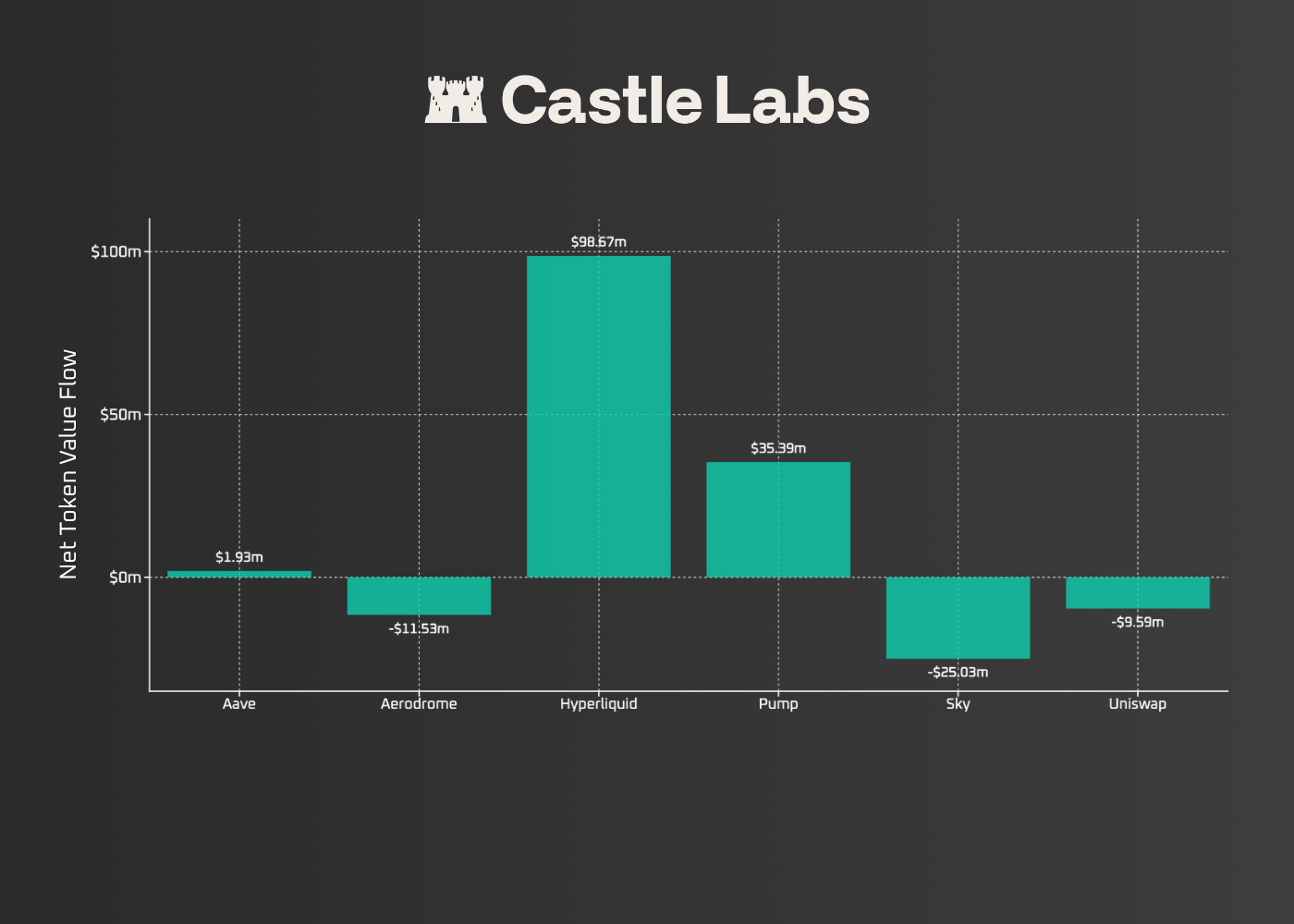
A new analysis from Castle Labs argues that strong protocol revenue alone has not been enough to lift many crypto tokens, because the real driver for holders is the link — or lack of link — between revenue, distribution and token supply expansion. The report reviews six major protocols, Aave, Aerodrome, Hyperliquid, Pump, Sky and Uniswap, which together generated $726 million in revenue in the first half of 2026. Even so, many of their tokens failed to match the strength of the underlying businesses. Castle Labs says investors are now asking harder questions than they did in earlier market cycles: How durable is a protocol’s revenue? How much of that revenue reaches token holders? How much value is offset by inflation, unlocks and incentives? And do equity holders capture economics that token holders do not? The report points to examples across buybacks, burns, fee-sharing and ve-token models, while also showing how fast unlock schedules, treasury discretion and weak value capture can overwhelm otherwise healthy revenue. Its core conclusion is plain: a good protocol does not automatically make a good token.

1100
Why token prices still lag even as top crypto protocols post strong revenue
Artemis Analy
2026-07-27 07:48:09

S&P Pantera index debuts as Robinhood Chain climbs into the top four by DEX volume

Artemis Analytics’ weekly data review pointed to two developments that stood out across crypto markets. On July 20, S&P Dow Jones Indices and Pantera Capital launched the S&P Pantera Digital Asset Index, an 18-token benchmark that screens constituents for protocol revenue before applying capped market-cap weighting. Artemis supplies the revenue classification, circulating supply and total supply data, while Lukka provides pricing. ETH, BNB, SOL, TRX and HYPE are the five largest components by weight, and both BTC and XRP were excluded under the revenue screen. The report also drilled into Robinhood Chain, an Arbitrum Orbit L2 that went live on July 1. For the week of July 18-25, the chain posted $4.7 billion in DEX volume, ranking fourth behind BSC, Ethereum and Base, and ahead of Solana. Even so, Artemis said the economics on the chain are concentrated elsewhere: as of July 25, 70% of TVL came from Morpho and Ethena, Robinhood stock tokens accounted for just 4.2% of TVL, Uniswap handled 98% of DEX flow that day, and memecoin pairs made up 74.7% of trading volume. In Artemis’ framing, Robinhood built distribution, while third-party applications and protocols captured most of the value.

2250
S&P Pantera index debuts as Robinhood Chain climbs into the top four by DEX volume