Brent crude2026-09-11 09:21:58Wall Street Raises Brent Oil Outlook as Gulf Shipping Disruptions PersistWall Street banks are raising their forecasts for Brent crude as shipping disruptions in the Middle East continue and add to pressure on global oil supplies. According to the market update cited by BlockBeats on Sept. 11, HSBC now expects Brent crude to average $90 in 2026. Goldman Sachs said prices could move above $120 if severe production disruptions in the Gulf persist. Bank of America outlined a more extreme scenario, saying Brent could reach $150 if major damage hits energy infrastructure. The revised outlook reflects growing concern that prolonged transport disruptions in the Gulf could tighten supply conditions further.810
US August CPI2026-09-11 05:58:13U.S. August CPI due tonight as traders put September Fed hike odds near 70%The U.S. Labor Department is set to release August CPI data at 20:30 Beijing time on Sept. 11, a report markets see as a key input for the Federal Reserve’s policy decision next week. Consensus expectations cited in the source put headline CPI at 0.4% month over month and 3.4% year over year, while core CPI is seen rising 0.2% on the month and 2.4% on the year. The data arrives as investors debate whether the Fed will deliver its first rate increase in more than three years. The report comes after U.S. August PPI rose 5.4% year over year, above July’s 4.8%. The source also said oil prices in the U.S. climbed above $100 a barrel as the Iran war pushed up energy costs, adding to transportation, supply-chain and tariff-related expenses. According to the report, the Fed will be watching whether higher energy prices pass through into core goods and services. Market attention is centered on the monthly core CPI reading: 0.2% could leave room for rates to stay unchanged, while 0.4% could push policy toward another hike. CME FedWatch data currently shows about a 70% chance of a 25-basis-point increase in September, though Bank of America and Nomura offered different views on the likely outcome.800
Polymarket2026-09-09 04:47:23Polymarket odds for foldable iPhone debut above $2,100 in the U.S. rise to 70%PPP, a prediction-market tracking tool, said odds on Polymarket for a foldable iPhone launching in the U.S. at more than $2,100 have climbed to 70%, up 20% over the past week. In the same market, the probability of a launch price above $2,200 fell to 30%, down 29% on the week. Settlement will be based on Apple’s first announced pre-tax starting price for the lowest-spec foldable iPhone in the U.S. market. If Apple unveils more than one foldable iPhone, the market will use the lowest starting price among them. If no price is announced by 11:59 p.m. Eastern Time on Sept. 30, the market resolves to “No.” Apple has already said its fall 2026 product launch event will take place at 1:00 a.m. Beijing time on Sept. 10. Pricing for Apple’s first foldable iPhone has become a key focus ahead of that event. Earlier, Bank of America cited media reports saying the device could start at about $2,099, while tech reporter Mark Gurman recently said the first foldable iPhone is expected to be priced at around $2,000.800
Federal Reser2026-09-07 07:14:19BofA says split Fed signals from Warsh and Waller are reshaping September hike betsBank of America said in its latest global economics weekly that Federal Reserve messaging has become difficult for markets to read, with Chair Warsh striking a hawkish tone at Jackson Hole while Governor Christopher Waller offered a markedly different, more conditional signal in the same week. BofA framed the contrast as a communication paradox: Warsh, in its view, has been pushed to give more explicit forward guidance after damage to the Fed’s credibility from the July press conference, while Waller has had more room to describe a state-dependent policy approach without carrying the same burden. The bank argued that the real warning sign for long-end Treasury yields is not the U.S. debt stock crossing $40 trillion, but federal interest costs rising to 3.5% of GDP. The report also set out BofA’s expectations for a 25-basis-point September rate hike from the European Central Bank, a hold from the Bank of England in 2026 before a cut in November 2027, and widening fiscal strain in the Philippines alongside growing divergence across Central and Eastern Europe.1030
Federal Reser2026-09-07 05:33:10BofA says Warsh’s hawkish tone points markets toward a more aggressive Fed pathBank of America said in a Sept. 4 global economics weekly that Federal Reserve Chair Warsh’s hawkish Jackson Hole remarks effectively told markets the default policy path has shifted toward a later but more forceful tightening track, which the report framed as the "Kohn" path rather than the slower, preemptive "Bernanke" approach. The note contrasted Warsh’s messaging with Governor Waller’s more dovish comments the same week, arguing that the gap reflects a communication paradox inside the Fed: Warsh, after damage to credibility from the July press conference, had to offer more directional guidance, while Waller could stick more closely to a state-dependent rule without signaling a firm rate path. The report also covered several macro themes beyond the Fed. BofA argued that the U.S. crossing $40 trillion in federal debt is mainly a symbolic milestone and not the near-term driver of higher long-end yields, which it linked instead to deficit expectations and debt issuance. In Europe, the bank expects the European Central Bank to raise rates by 25 basis points in September to 2.50%, likely the final move of the cycle, while warning that energy prices remain the main upside risk. It also revised its UK growth and inflation outlook, and flagged wider fiscal deficits in the Philippines alongside uneven gas-price transmission risks across Central and Eastern Europe.880
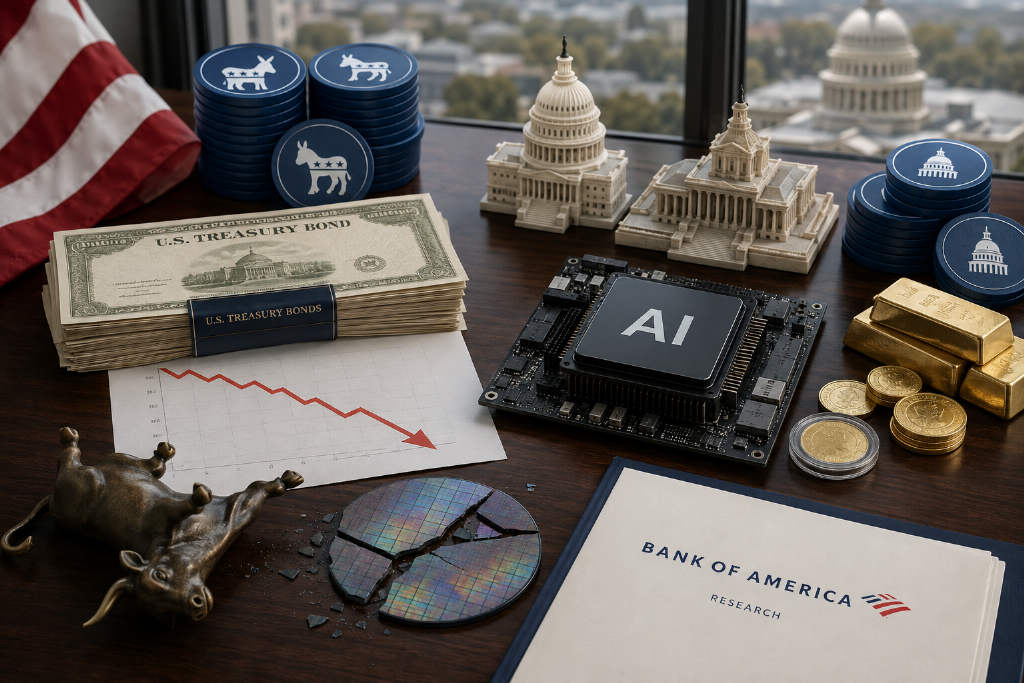
Bank of Ameri2026-09-07 03:05:23BofA’s Hartnett warns Democratic sweep could knock U.S. stocks down more than 10% and puncture the AI tradeBank of America chief investment strategist Michael Hartnett said surging global bond yields have become the biggest threat to the AI capital spending boom, and he argued that the coming U.S. midterm election may be the catalyst markets are overlooking. In the latest edition of his "Flow Show" note, Hartnett said a Democratic sweep of both chambers of Congress could send U.S. equities down by more than 10%, weaken the dollar, push bond yields lower and raise the risk of an AI bubble bursting. He pointed to rising odds on Polymarket, where a Democratic sweep was priced at 50%, versus 10% for a Republican sweep. Hartnett also highlighted weak political standing for President Donald Trump, whose approval rating was described at 35% to 40%, below the historical 53% average seen two months before past midterm elections. Hartnett’s broader framework centers on bonds. He said long-dated yields, not equity narratives, are the real anchor for AI trades. He kept his longer-term preference for commodities and gold, while warning that crowded AI infrastructure positions look vulnerable. He also laid out different asset implications for a Democratic sweep, a Republican hold and a split-government outcome, with the last one described as a more benign "Goldilocks" setup.1210
Bank of Ameri2026-09-07 03:14:08BofA's Michael Hartnett warns Democratic sweep could knock U.S. stocks down more than 10% and puncture the AI tradeBank of America Securities chief investment strategist Michael Hartnett said surging global bond yields have become the biggest threat to the AI capital spending boom, and he argued that the coming U.S. midterm election could act as the market trigger. In the latest edition of his Flow Show note, Hartnett said a Democratic sweep of both chambers would likely send U.S. equities down more than 10%, weaken the dollar, push bond yields lower and raise the risk of an AI bubble break. He described that outcome as one of the market's biggest tail risks and said investors have barely priced it in. Hartnett pointed to signs already flashing in fixed income markets, with the U.S. 10-year Treasury yield at 4.81%, the 30-year at 5.31%, Japan's 10-year yield above 3.0%, and Germany's 10-year yield at 3.38%. He argued that long-end yields, not equity narratives, are the true anchor for the AI trade. He also kept his broader allocation stance intact, favoring commodities and gold as hedges against inflation and geopolitical risk while warning against crowded AI infrastructure positions.1980
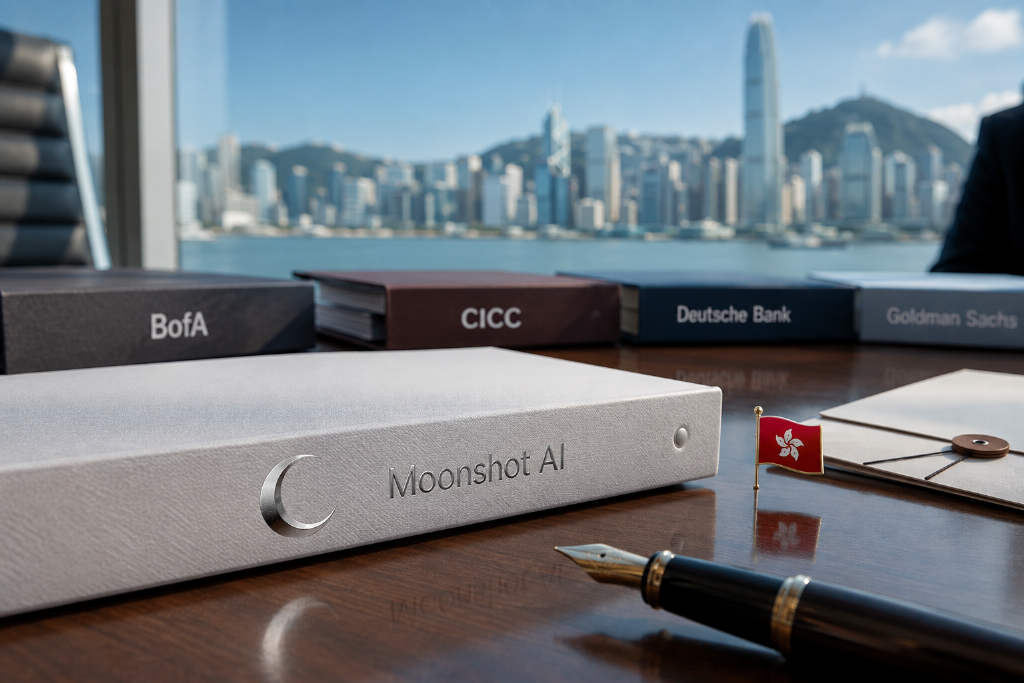
Yue Zhi An Mi2026-09-04 11:20:32Yue Zhi An Mian Plans Hong Kong IPO, Could Raise Up to $5 BillionYue Zhi An Mian, a company aiming to go public in Hong Kong as early as this year, plans to raise up to $5 billion through an IPO, according to people familiar with the matter. The company has appointed Bank of America as global coordinator, with CICC, Deutsche Bank, and Goldman Sachs as joint sponsors. A confidential IPO filing has been submitted, and the offering could raise between $3 billion and $5 billion. The plans are still under consideration and details may change.870